Table of Contents
Toggle🚆 The Route: Trading Gaudí for Paella
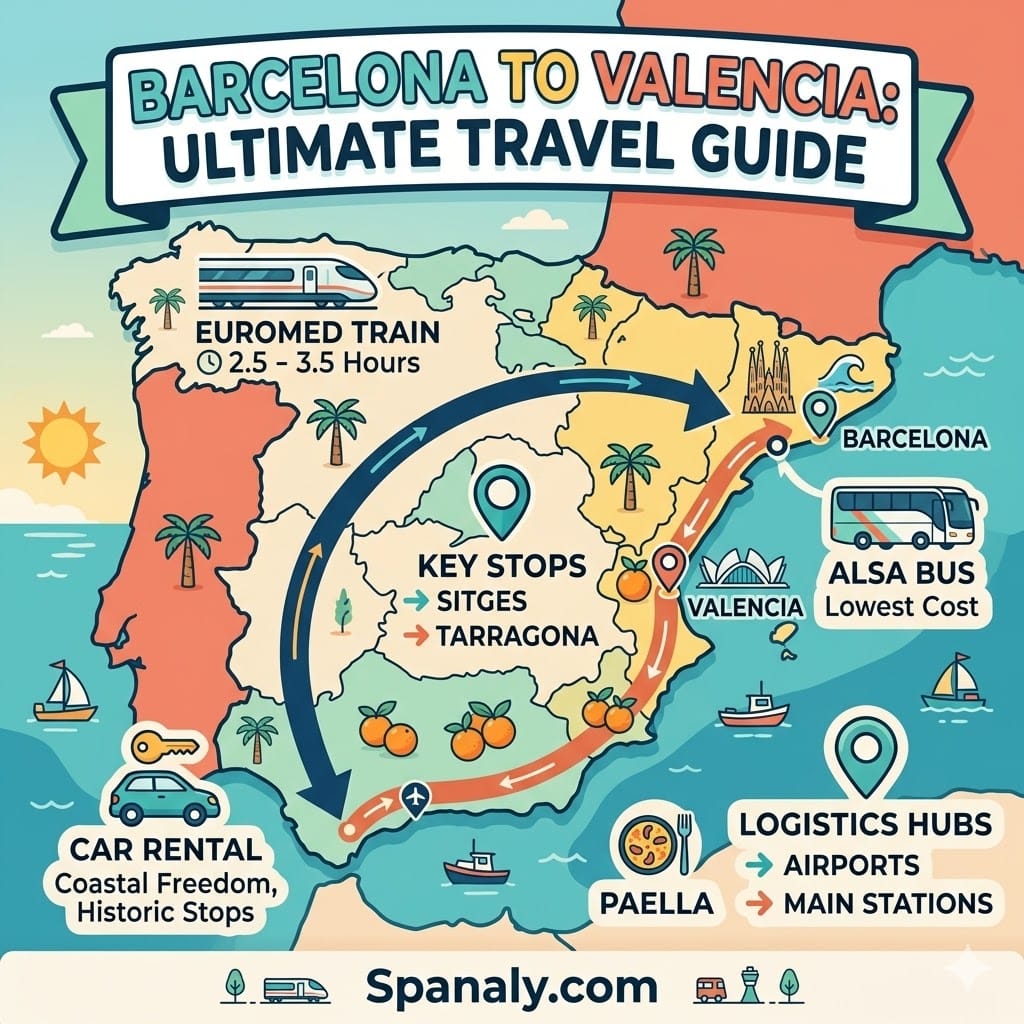
Undeniably, the journey from Barcelona to Valencia is one of the most popular coastal routes in Spain. Actually, it connects the cosmopolitan energy of Catalonia with the sun-drenched, orange-scented capital of the Valencian Community.
📍 The Connection: Traveling south along the beautiful Mediterranean coast (Costa Azahar).
🛣️ Distance: Approximately 350km separating two of Spain’s most iconic cities.
⚡ Top Speed: Reach your destination in as little as 3 hours via high-speed rail.
🌊 The Vibe: From historic Gothic quarters to futuristic City of Arts and Sciences.
As a result, this route is a favorite for those wanting to experience the diverse flavors of eastern Spain.
Before you leave the Catalan capital, make sure you’ve explored our Barcelona Travel Guide. If you are planning a grand tour of the north later, don’t miss our Bilbao & San Sebastian 3-Day Itinerary for more coastal inspiration.
Spanaly Insight: 💡 To enjoy the best views, try to book a seat on the left side of the train when heading south. Consequently, you’ll have a front-row seat to the stunning Mediterranean blue for most of the trip! 🌊💺
🌊 Barcelona → Valencia Route Snapshot
📋 Quick Overview: Barcelona to Valencia at a Glance
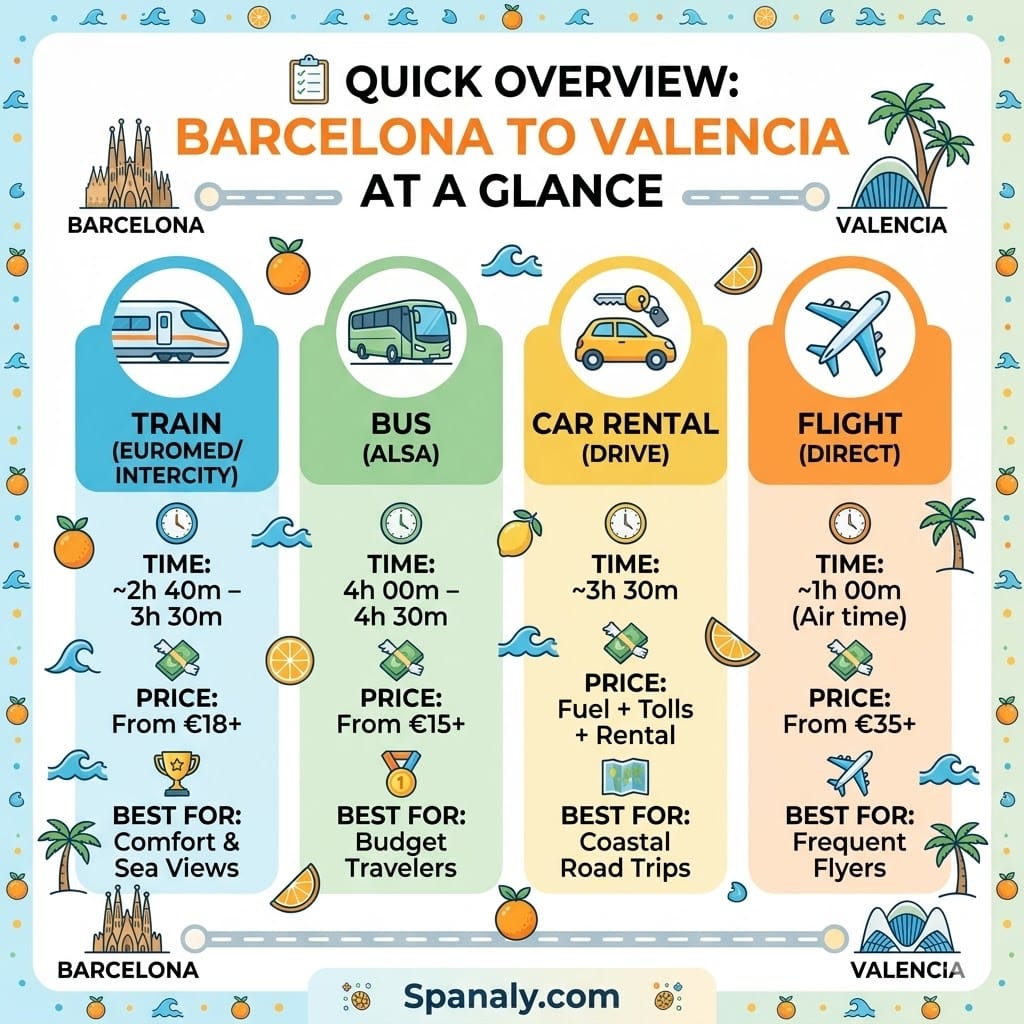
Unquestionably, having a bird’s-eye view of your travel options is the best way to start your planning. Actually, the route along the Mediterranean coast is one of the most efficient in Spain, offering a perfect mix of sea views, competitive pricing, and high-frequency connections.
| Feature | Train (Euromed/Intercity) | Bus (ALSA) | Flight (Direct) | Car Rental (Drive) |
| Travel Time | ~2h 40m – 3h 30m | 4h 00m – 4h 30m | 1h 00m (Air time) | ~3h 30m |
| Starting Fare | From €18+ | From €15+ | From €35+ | Fuel + Tolls + Rental |
| Best For | Comfort & Sea Views | Budget Travelers | Frequent Flyers | Coastal Road Trips |
Consequently, whether you want to be enjoying a paella by the beach by lunch or you prefer a slow-paced drive through the charming towns of Sitges and Tarragona, there is a perfect mode of transport for you.
Spanaly Insight: 💡 To secure the ultimate “at a glance” deal, remember that the high-speed Euromed train is nearly as fast as flying when you include airport security and transfers. Consequently, unless you find a mega-sale on a flight, the train remains the undisputed king of this route! 🚆🏆
📍 Barcelona to Valencia: Interactive Coastal Route - Spanaly.com
Live MapSource: Spanaly.com
⚖️ Transport Comparison: Finding Your Perfect Balance
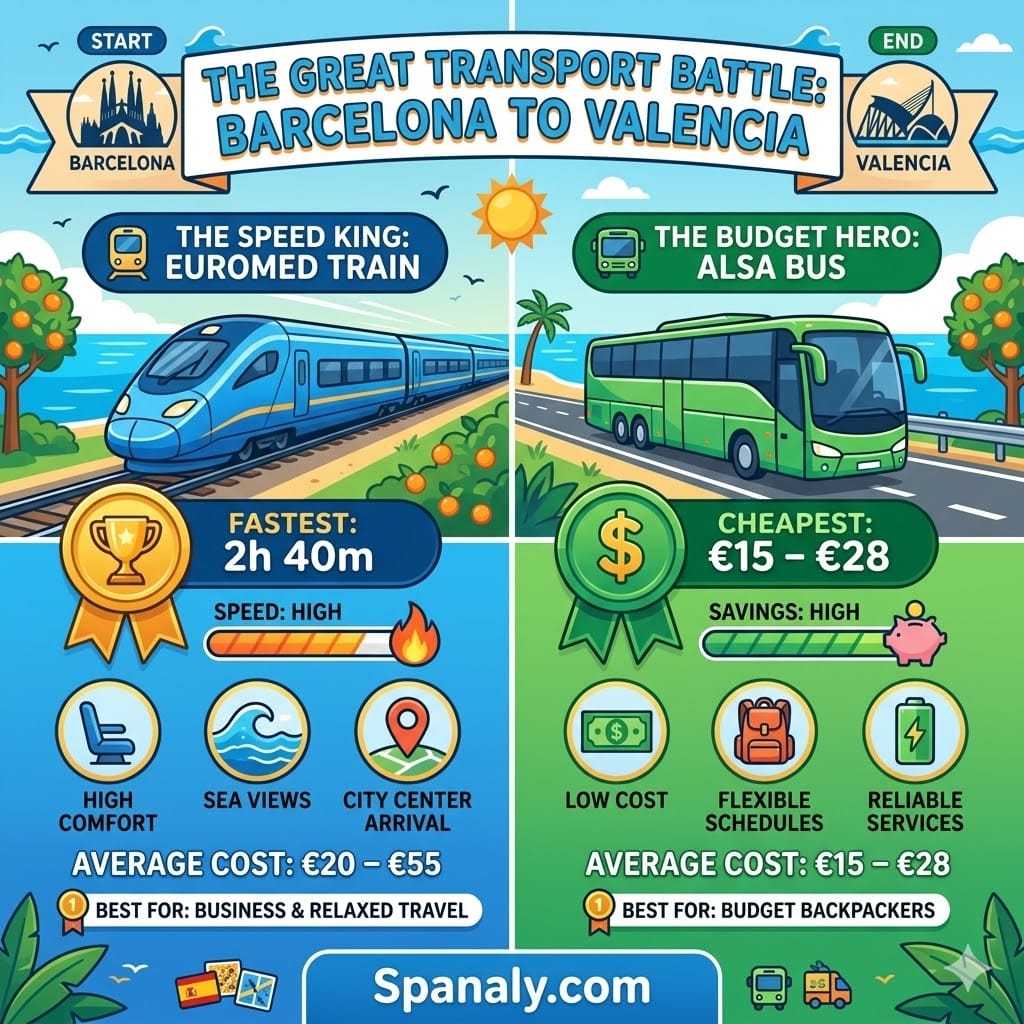
Ultimately, deciding between the train, bus, or car is a trade-off between speed and savings. Actually, for the Barcelona to Valencia route, the competition is fierce, making it a win-win for travelers who plan ahead.
| Category | 🚆 Train (Euromed) | 🚌 Bus (ALSA) | 🚗 Car (Self-Drive) |
| Travel Time | 2h 40m – 3h | 4h 15m – 4h 45m | ~3h 30m |
| Average Cost | €20 – €55 | €15 – €28 | Fuel + Tolls + Rental |
| Comfort Level | ⭐⭐⭐⭐⭐ (High) | ⭐⭐⭐ (Standard) | ⭐⭐⭐⭐ (Flexible) |
| Best For | Business & Relaxed Travel | Budget Backpackers | Families & Road Trippers |
As a result, if you value your time and comfort, the train is the undisputed champion. However, if you are traveling on a “shoestring” budget, the bus offers unbeatable value for a slightly longer journey.
Spanaly Insight: 💡 To save the most money, always compare “Intercity” train prices with “Euromed.” Consequently, you might find that an Intercity train takes only 30 minutes longer but costs half the price of the faster Euromed! 💰🚆
🚆 Train: The High-Speed Coastal Experience
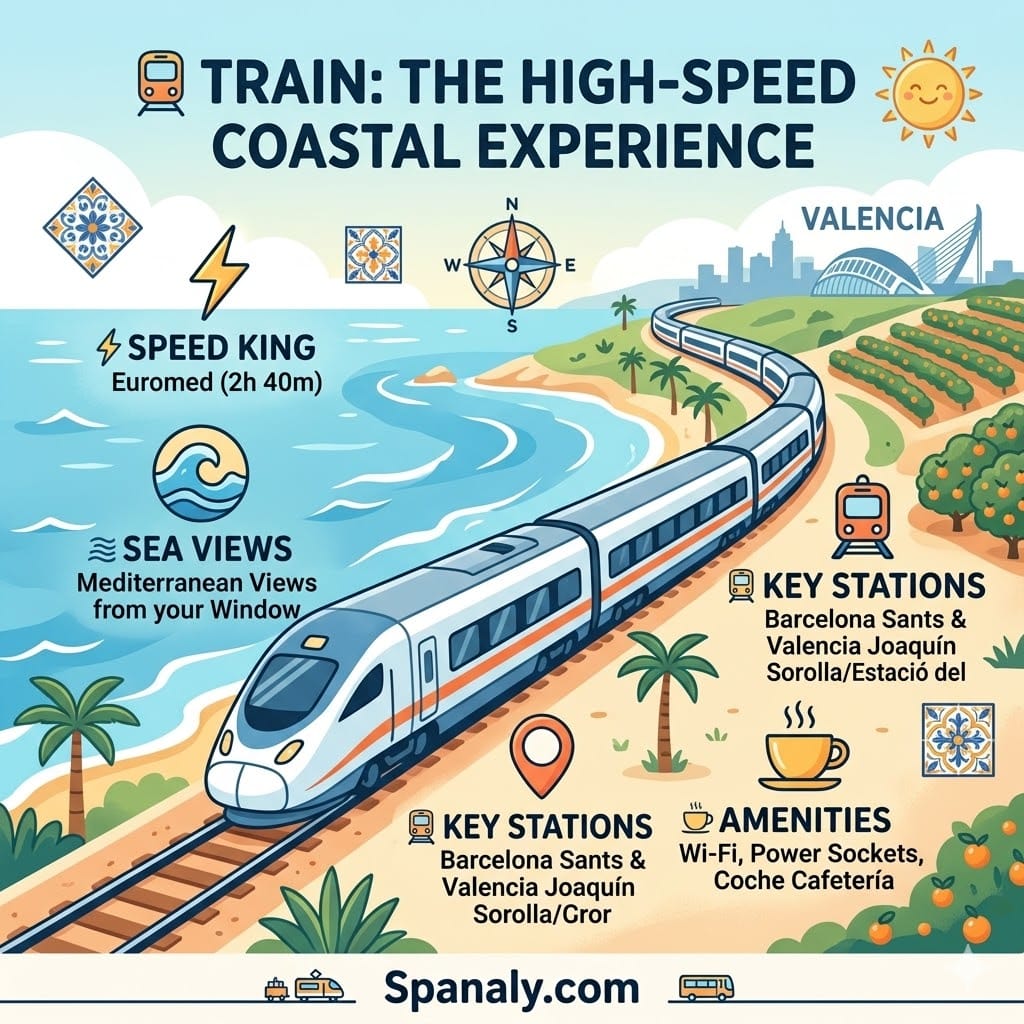
Without a doubt, taking the train is the gold standard for this route. In fact, the rail connection between the Catalan capital and the Turia city is seamless, offering some of the best Mediterranean views right from your window.
⚡ The Euromed (Speed King): This is the flagship service operated by Renfe. It’s fast, modern, and completes the journey in approximately 2h 40m.
🚆 Regional & Intercity: These are slightly slower alternatives (3h to 4h) but often significantly cheaper. They are perfect if you want a more relaxed pace after exploring the top attractions in Barcelona.
🚉 Key Stations: You’ll depart from Barcelona Sants (easily reached via Barcelona public transport) and arrive at Valencia Joaquín Sorolla (high-speed) or the historic Estació del Nord, located right next to La Lonja de la Seda.
☕ Amenities: Most long-distance trains offer free Wi-Fi, power sockets, and a “Coche Cafetería” (buffet car) for snacks.
As a result, you get to enjoy the “sweet spot” of travel: reaching your destination faster than a car without the stress of airport security.
Spanaly Insight: 💡 To ensure you hit the ground running, we recommend syncing your arrival with our 3-day Valencia itinerary. Consequently, you can go from the train station to enjoying an authentic Paella Valenciana by the beach in less than an hour! 🥘🌊
✈️ Flight: The Quick Sky Link
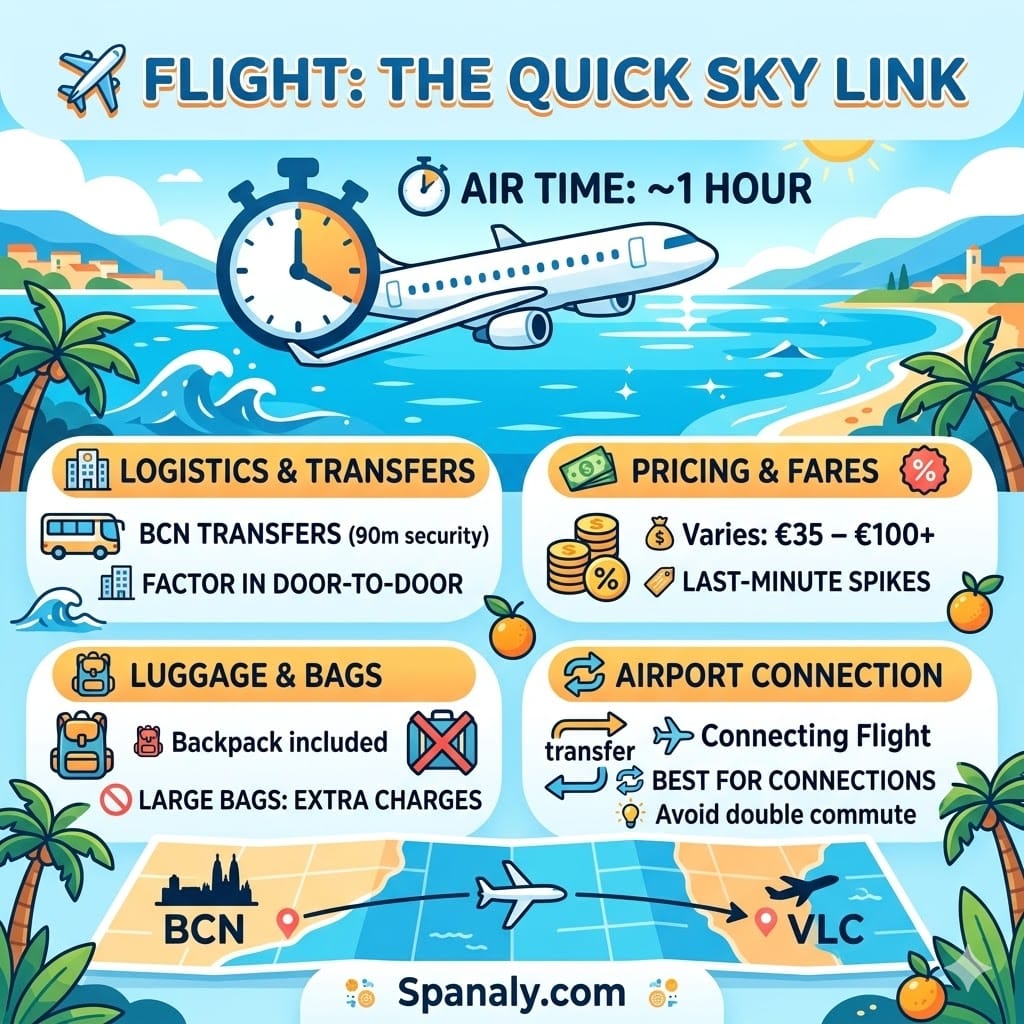
Undeniably, flying is the fastest way to bridge the distance if you only look at the time spent in the air. In reality, several daily flights connect Barcelona-El Prat (BCN) to Valencia Airport (VLC), primarily operated by regional carriers like Air Nostrum (Iberia).
⏱️ Air Time: The flight itself takes only about 1 hour.
🏢 Logistics: Remember to factor in the Barcelona airport transfers and arriving 90 minutes early for security.
💸 Pricing: Fares vary wildly; you might find a deal for €35, or pay over €100 for a last-minute seat.
🎒 Luggage: Unlike the train, budget airlines will charge extra for anything larger than a small backpack.
As a result, while the flight is “fast,” the total door-to-door time often equals the train once you include airport commutes and waiting at the gate.
Spanaly Insight: 💡 To make flying worth your while, only choose this option if you are already at the airport for a connecting flight. Consequently, you’ll avoid the double commute and save yourself a trip to the city center! ✈️🔄
🚌 Bus: The Budget-Friendly Mediterranean Ride
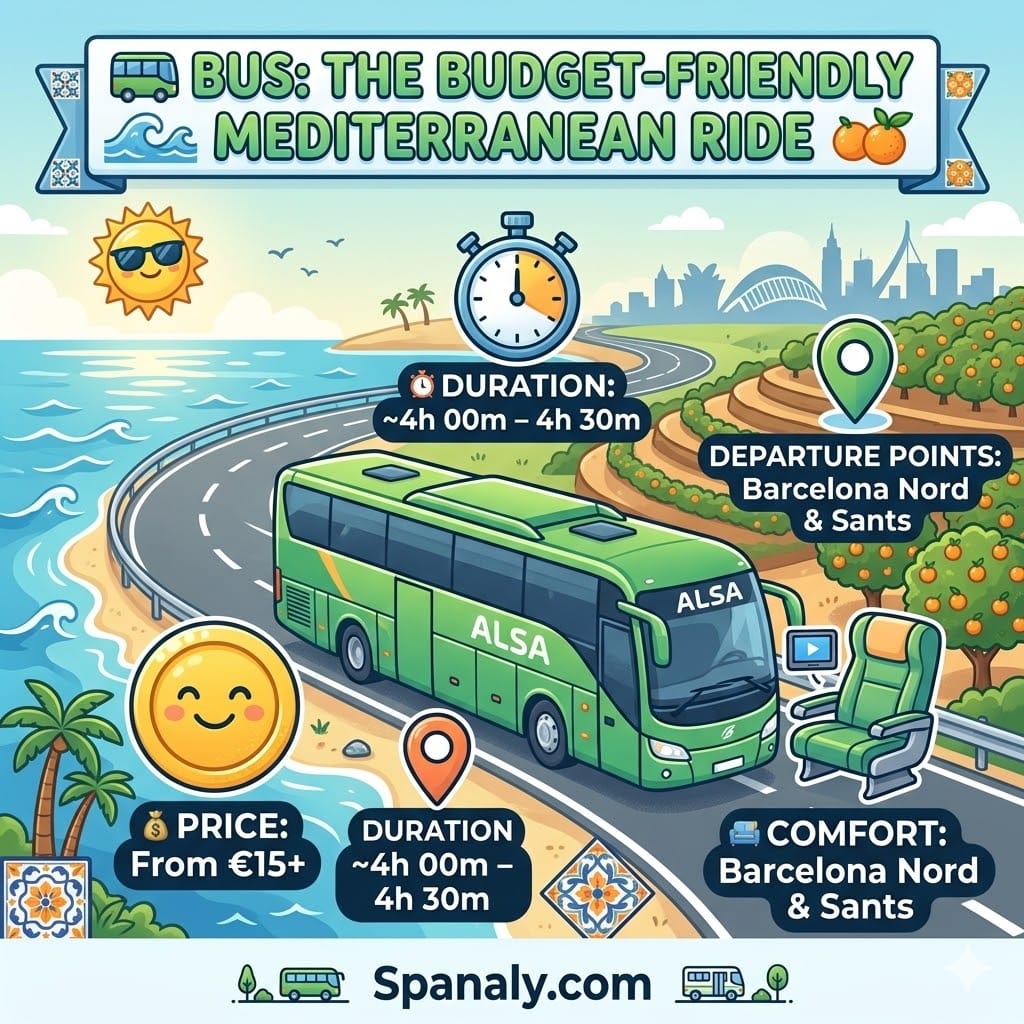
Plainly, the bus is the ultimate lifesaver for budget-conscious travelers. In practice, the service between Barcelona and Valencia is high-frequency and very reliable, primarily managed by ALSA, Spain’s leading bus company.
⏱️ Duration: The journey typically takes between 4h 00m and 4h 30m, depending on the number of stops.
💸 Price: This is where the bus shines. Tickets can be found for as low as €15, and unlike trains, prices don’t skyrocket as drastically at the last minute.
📍 Departure Points: Most buses leave from Barcelona Nord station (near Arc de Triomf) or Barcelona Sants.
🛋️ Comfort: Modern ALSA buses (especially the Supra class) offer comfortable seating, Wi-Fi, and individual entertainment screens.
As a result, if you are looking to save money while traveling in Spain, the bus is your most consistent and affordable ally.
Spanaly Insight: 💡 To get the absolute best seat, try to book the “Supra” service if available. Consequently, you’ll enjoy extra legroom and a single-seat row option, making that 4-hour trip feel like a premium experience for just a few extra Euros! 🚌luxury
🚗 Car: The Ultimate Freedom Road Trip
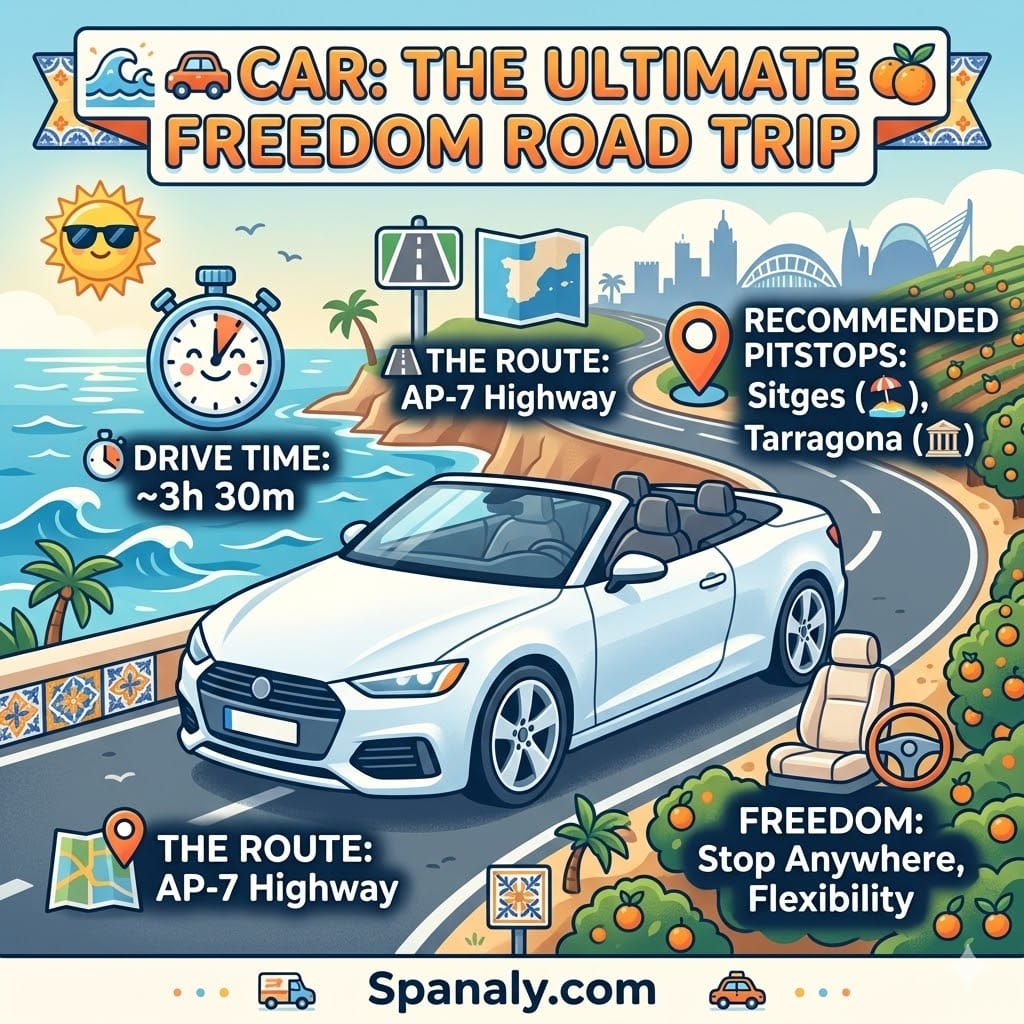
As it turns out, driving is the best way to turn a simple transfer into a memorable Mediterranean adventure. To be fair, the route from Barcelona to Valencia allows you to hug the coastline, offering the flexibility to stop whenever you see a hidden cove or a charming village.
⏱️ Drive Time: Approximately 3h 30m via the AP-7 highway.
🛣️ The Route: Most travelers take the AP-7 (Autopista del Mediterráneo). It is efficient, well-maintained, and offers stunning blue horizons.
📍 Recommended Pitstops: Don’t miss the chance to stop in the Roman city of Tarragona or have a seaside lunch in Sitges.
🅿️ Valencia Parking: If you are staying near La Lonja de la Seda, remember that the historic center has many pedestrian zones; booking a hotel with parking is essential.
As a result, if you are traveling with family or carrying lots of gear, driving in Spain provides a level of comfort and spontaneity that public transport simply cannot match.
Spanaly Insight: 💡 To avoid unexpected costs, remember that while many Spanish highways are now toll-free, some stretches might still have charges. Consequently, always keep some change or a card handy, and use an app like Waze to stay updated on the best coastal detours! 🚗🌊
🎒 Logistics: Arrival & Departure Points
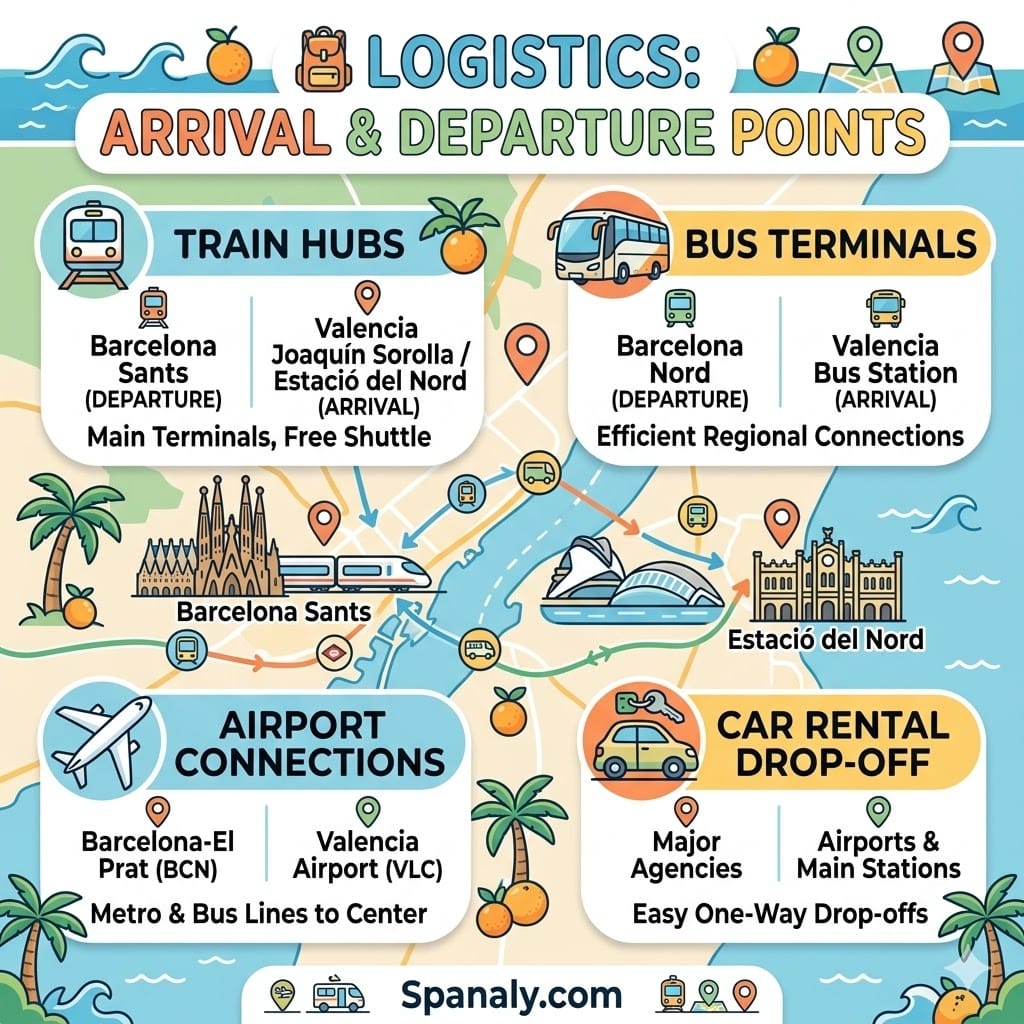
Clearly, knowing exactly where your journey begins and ends is crucial for a stress-free trip. In fact, both Barcelona and Valencia are exceptionally well-organized, but each transport mode uses different hubs that you need to be aware of.
🚉 Train Hubs: Most travelers depart from Barcelona Sants, the city’s main terminal. In Valencia, high-speed trains (Euromed) arrive at Valencia Joaquín Sorolla, while regional trains often pull into the stunning, historic Estació del Nord.
🚌 Bus Terminals: Your primary departure point will be Barcelona Nord (near the Arc de Triomf), though some ALSA services also stop at Barcelona Sants. You will arrive at the Valencia Bus Station (Estació d’Autobusos), located just north of the city center.
✈️ Airport Connections: Flights operate between Barcelona-El Prat (BCN) and Valencia Airport (VLC). Both are connected to their respective city centers by efficient metro and bus lines.
🚗 Car Rental Drop-off: If you are driving in Spain, most major rental agencies have offices at both the airports and the main train stations for easy one-way drop-offs.
As a result, whether you are landing at the airport or stepping off a train, you are never more than a short metro ride away from the heart of the action.
Spanaly Insight: 💡 To avoid getting lost in Valencia, remember that Joaquín Sorolla and Estació del Nord are separate stations but connected by a free shuttle bus for ticket holders. Consequently, always check your ticket carefully to see which station your train uses! 🚉🔄
🏆 The Winner: Which Travel Mode Should You Choose?
Ultimately, the “best” way to travel from Barcelona to Valencia depends entirely on your travel DNA. Actually, there is no one-size-fits-all answer, but we can crown a winner based on three distinct categories:
🥇 The Overall Champion: The Euromed Train. If you want speed, comfort, and city-center-to-city-center convenience, the train wins. Consequently, you’ll save time and start your 3-day Valencia itinerary feeling refreshed.
🥇 The Budget Hero: The ALSA Bus. If you are looking to save money while traveling in Spain, the bus is the undisputed winner. It’s reliable and often costs less than a single meal at a fancy restaurant.
🥇 The Adventure King: Car Rental. If your goal is to explore hidden gems like the Roman ruins in Tarragona or the beaches of Sitges, driving in Spain is the only way to go.
As a result, most travelers will find that the Euromed train offers the perfect Mediterranean balance. However, no matter which mode you choose, the stunning views of the coast will make the journey as enjoyable as the destination.
💡 Insider Tips for a Flawless Journey

Admittedly, it’s the little details that make a trip truly smooth. The truth is, traveling from the Catalan capital to the land of oranges is simple, but these expert tips will help you navigate the route like a local.
🎫 Book “Mesa” Seats on Trains: If you are traveling as a group of four, look for the “Mesa” (Table) fare on Renfe. Consequently, you can get up to a 60% discount by booking the entire table together.
📱 Use the Right Apps: Download Renfe, ALSA, and Cabify (the Spanish equivalent of Uber) before you leave. To ensure you stay connected for maps and bookings, check our guide on internet and SIM cards in Spain.
🌞 The “Sun Side” Hack: When booking your train or bus seat from Barcelona to Valencia, try to sit on the left side of the aisle. As a result, you’ll have an unobstructed, front-row seat to the Mediterranean Sea for most of the journey.
🥘 Time Your Arrival: Spain follows a unique daily rhythm. If you arrive in Valencia between 2:00 PM and 4:00 PM, most shops will be closed for the siesta. Consequently, this is the perfect time to head straight for a late lunch! Read more about the Spain daily rhythm and siesta.
🛡️ Secure Your Belongings: While both cities are generally safe, transport hubs are prime spots for pickpockets. Always keep your bags in sight and review our travel safety in Spain guide for extra peace of mind.
As a result, by following these small “hacks,” you transform a standard transfer into a stress-free part of your vacation.
🛡️ Essential Visitor FAQs – Barcelona to Valencia Travel
🚆 Can I use my Barcelona "T-Usual" card for the train to Valencia?
No, the T-Usual and other Barcelona local metro cards are only valid for the city's metropolitan zones. For a long-distance journey to Valencia, you must purchase a specific ticket (Euromed or Regional) through Renfe or other high-speed operators. These tickets are typically digital and specific to your chosen departure time.
🧴 What are the "Low Emission Zones" (ZBE) for cars in Valencia?
Valencia, like many major Spanish cities, enforces ZBE (Zonas de Bajas Emisiones) to reduce pollution. If you are driving a rental car, it must display the correct environmental sticker (Etiqueta Ambiental). Always check with your rental agency to ensure the vehicle is authorized to enter the historic city center to avoid automated fines.
🧳 Are there luggage lockers at the main train stations?
While main terminals like Barcelona Sants may have lockers, smaller or high-speed stations like Joaquín Sorolla often rely on third-party luggage storage services. You can easily find certified storage points near the station exits, which are often more flexible and affordable than traditional lockers.
🐾 Is it possible to travel with a pet on this route?
Yes, pets are generally welcome. Renfe trains allow small pets (up to 10kg) in carriers, and some newer high-speed lines offer spots for larger dogs. ALSA buses also have dedicated, ventilated compartments for pets. Always check the specific carrier's current pet policy before booking as fees and weight limits may apply.
🚲 Can I bring my bicycle on the train or bus?
Bicycles are permitted but usually require prior booking. On trains, bikes should be folded or disassembled in a bag. On buses, a small extra fee is often required to secure a spot in the hold. Since Valencia is one of Spain’s most bike-friendly cities, taking yours along is a fantastic way to explore the Turia Gardens.
Curated Expert Guide by Spanaly.com
In short, the trip from Barcelona to Valencia is more than just a transfer; it’s a front-row seat to the Mediterranean’s soul. Whether you choose the speed of the rails or the freedom of the road, an unforgettable experience awaits.
🚆 Speed Lover? Stick with the Euromed train.
💸 Budget Traveler? The ALSA bus is your best friend.
📸 Explorer at Heart? Rent a car and hug the coastline.
Spanaly Insight: 💡 Don’t stop at Valencia! Spain’s north is just as captivating. If you’re planning to cross the country, check out our expert guide on traveling from Madrid to Bilbao to discover the lush Basque Country. 🟢🌊
Safe travels, and enjoy every sunset! 🌅🇪🇸