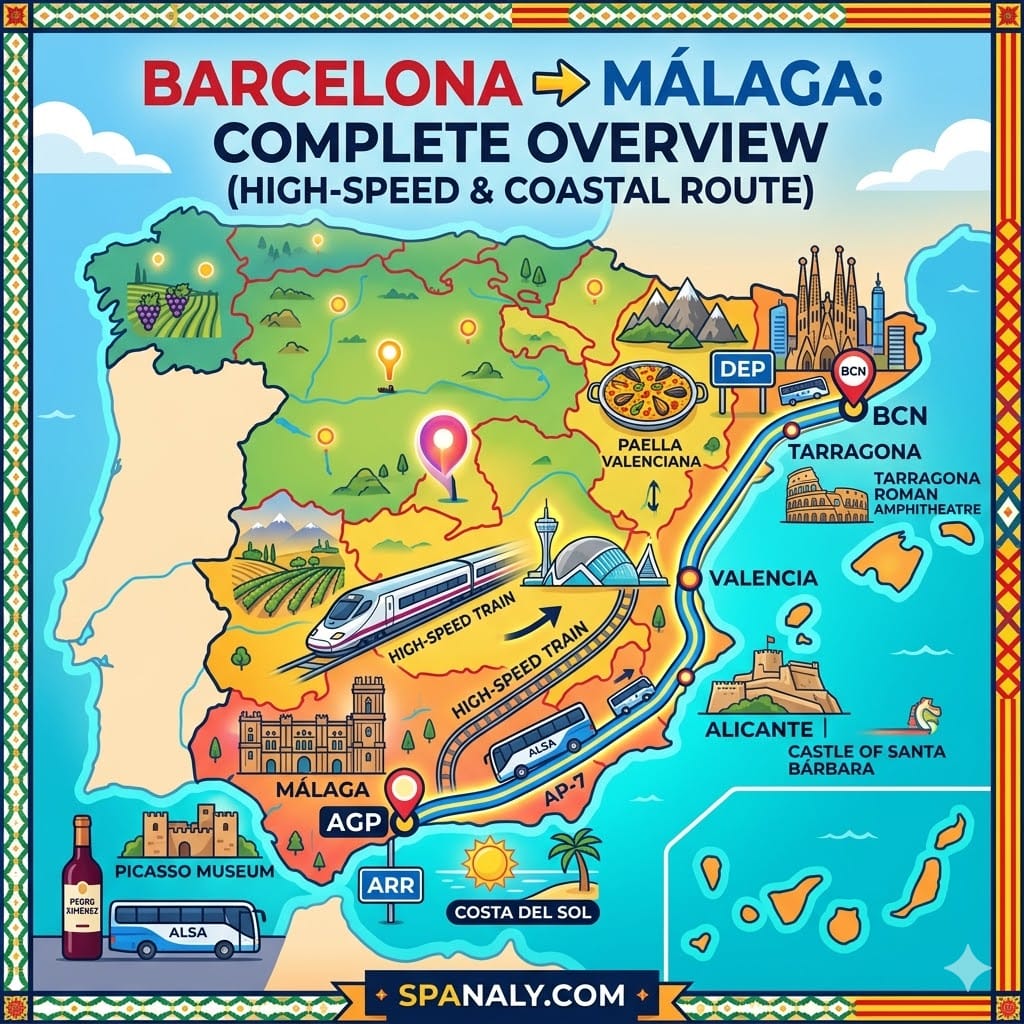
🚄 Barcelona to Málaga
The fastest way to travel from Barcelona to Málaga is by a direct flight (1h 40m), while the most scenic and comfortable choice is the high-speed AVE train (approx. 5h 30m). For budget travelers, booking flights in advance can often be cheaper than the train, with prices starting as low as €30.
Crossing Spain from Gaudi’s architectural masterpieces to the sun-drenched Costa del Sol is a journey of nearly 1,000 km. Whether you are chasing the Mediterranean sun or heading south for a coastal escape, picking the right transport is the secret to a flawless trip.
Once you arrive in the birthplace of Picasso, you’ll want to hit the ground running. Make sure to check our Málaga 3-Day Itinerary to discover the best local tapas spots and hidden gems to maximize your stay.
Table of Contents
Toggle🔍 Quick Trip Facts: Barcelona ➡️ Málaga
✈️ The Speed Winner: A direct flight takes less than 2 hours (excluding airport transfers).
🚄 The Premium Choice: High-speed AVE or Avlo trains offer a direct city-center to city-center connection.
🛣️ The Road Trip: A massive 1,000 km drive via the AP-7, perfect for exploring the Spanish coast.
💰 Budget Win: Low-cost carriers often offer unbeatable deals for early birds.
📍 Route Snapshot: Barcelona to Málaga
Barcelona to Málaga: Interactive Route Guide
📍 How to Travel from Barcelona to Málaga
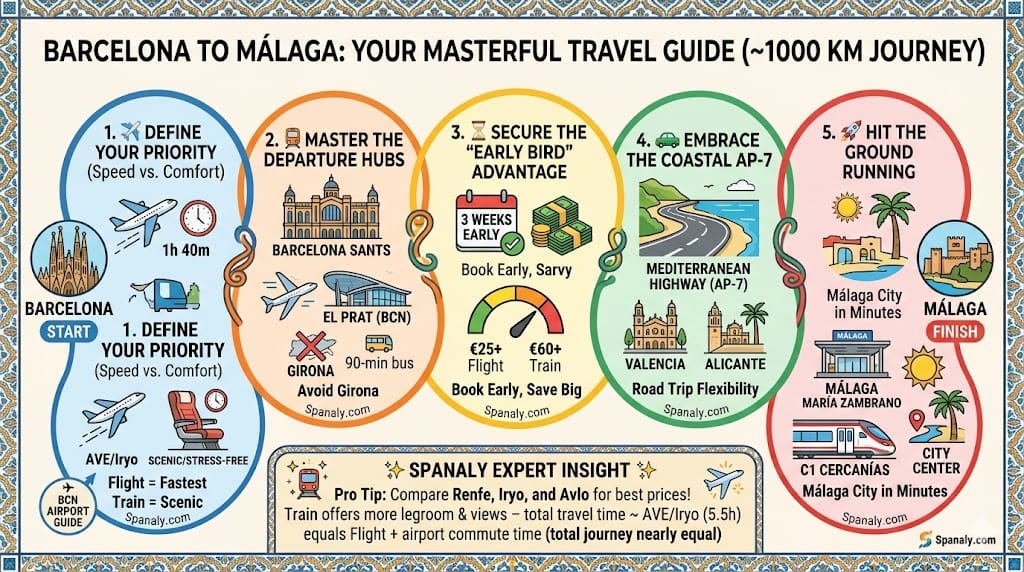
Mastering the 1,000 km journey from Gaudi’s Mediterranean capital to the sunny Costa del Sol requires strategic planning. To ensure a seamless transition between these two Spanish giants, follow these essential steps:
✈️ Define Your Priority (Speed vs. Comfort): A direct flight is the fastest way (1h 40m), while the high-speed train offers a scenic, stress-free experience. If flying, make sure to consult our Barcelona El Prat Airport Guide for a smooth departure from the city center.
🚉 Master the Departure Hubs: For the rail, head to the majestic Barcelona Sants Station for direct AVE or Iryo trains. For air travel, stick to El Prat (BCN); avoid distant airports like Girona to save yourself a 90-minute unnecessary bus ride.
⏳ Secure the “Early Bird” Advantage: On this long-haul route, prices fluctuate wildly. Booking at least 3 weeks in advance can secure low-cost flight deals from €25 or high-speed train seats from €60.
🚗 Embrace the Coastal AP-7: If you choose to drive, you will traverse the Mediterranean highway. This epic road trip allows you the flexibility to stop in Valencia or Alicante before reaching the Andalusian south.
🚀 Hit the Ground Running: Once you arrive at Málaga María Zambrano or the airport, take the C1 Cercanías train to reach the city center in minutes. You are now perfectly positioned to start your coastal escape.
✨ Spanaly Expert Insight
Pro Tip: When booking the train, look for newer operators like Iryo or Avlo alongside Renfe. They often provide high-speed service at a fraction of the cost. If flying, remember that while the airtime is short, adding security and commute time makes the total journey nearly equal to the 5.5-hour train—choose the train for more “legroom” and better views!
📊 Transport Comparison: Time, Cost & Comfort
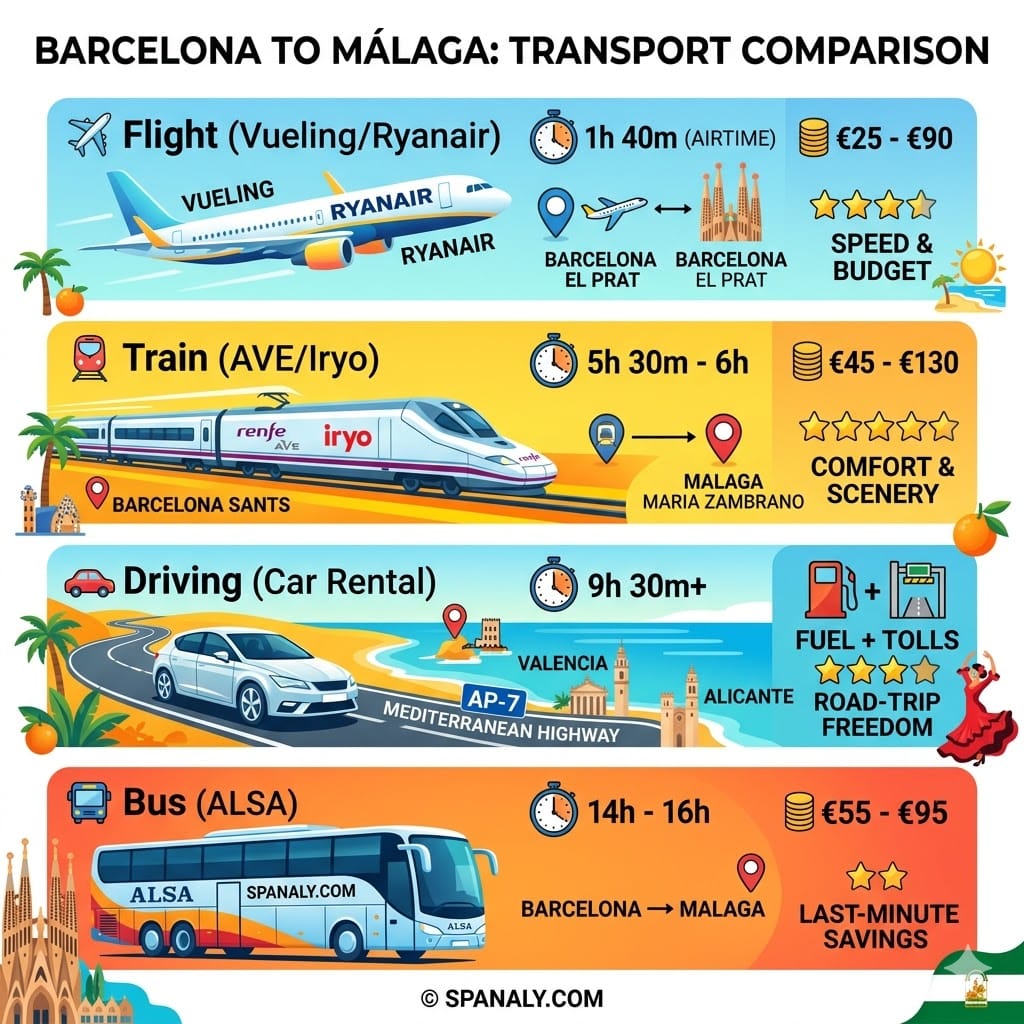
Choosing how to travel from Gaudi’s Mediterranean capital to the sunny Costa del Sol depends entirely on your budget and how much you value city-center convenience. Since the distance is significant (nearly 1,000 km), here is how the top options stack up:
| Transport Mode | Travel Time | Typical Cost | Comfort Level | Best For… |
| ✈️ Flight | 1h 40m (Airtime) | €25 – €90 | ⭐⭐⭐ | Speed & Budget |
| 🚄 Train (AVE/Iryo) | 5h 30m – 6h | €45 – €130 | ⭐⭐⭐⭐⭐ | Comfort & Scenery |
| 🚗 Driving | 9h 30m+ | Fuel + Tolls | ⭐⭐⭐⭐ | Road-trip Freedom |
| 🚌 Bus (ALSA) | 14h – 16h | €55 – €95 | ⭐⭐ | Last-Minute Savings |
🤔 Which one should you choose?
Choose the Flight if: You want the absolute fastest connection. Low-cost carriers like Vueling and Ryanair make this route incredibly affordable if booked in advance. To ensure a smooth departure, don’t forget to check our Barcelona El Prat Airport Guide.
Choose the Train if: You prefer a premium experience without the hassle of airport security. High-speed trains (AVE) take you directly from Barcelona Sants to Málaga María Zambrano. For the best rates and a modern experience, we recommend checking both the official Renfe website and the new competitor Iryo.
Choose Driving if: You are planning an epic Spanish road trip along the Mediterranean coast (AP-7). This route allows you to stop in Valencia or Alicante. If you are starting your journey from the capital first, you might find our guide on Madrid to Barcelona useful for planning your grand tour.
🚄 Traveling by Train: High-Speed Efficiency (AVE & Iryo)
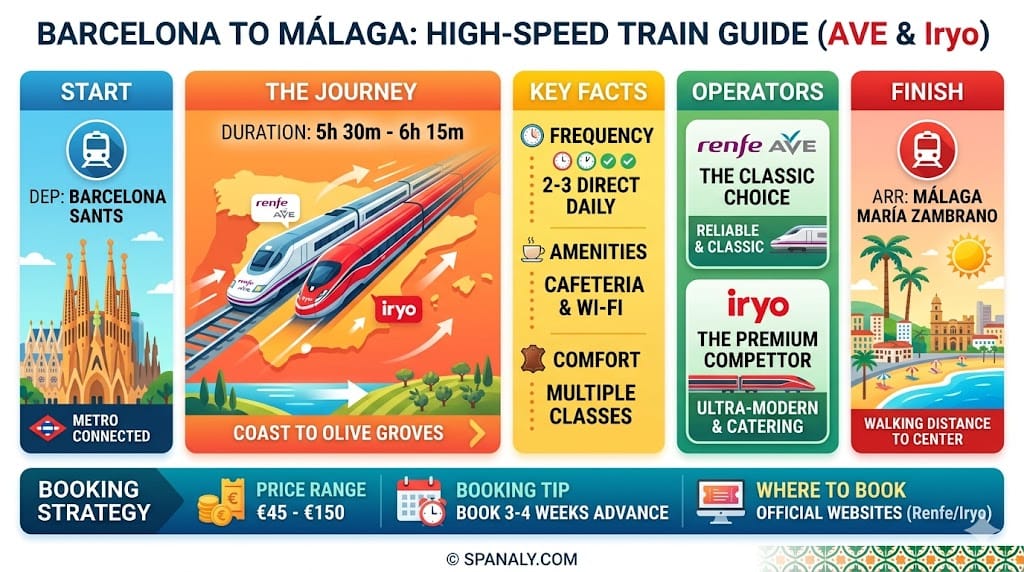
Traveling from Barcelona Sants to Málaga María Zambrano by train is one of the most rewarding ways to see the Spanish heartland. In just over 5 hours, you transition from the Catalan coast through the plains of Castilla and into the rolling olive groves of Andalusia.
Key Train Facts:
Duration: Direct high-speed trains (AVE) typically take between 5h 30m and 6h 15m.
Frequency: Usually 2 to 3 direct daily connections, with more options available if you don’t mind a quick transfer at Madrid Atocha.
Stations: Departure is from Barcelona Sants (perfectly connected via the Barcelona Metro) and arrival is at Málaga María Zambrano, which is walking distance from the city center.
Top Operators in 2026:
Renfe (AVE): The classic Spanish high-speed service. Reliable, with multiple classes and a cafeteria onboard.
Iryo: The new premium competitor. Known for ultra-modern red trains, superior seat comfort, and excellent Italian-inspired catering.
Avlo: Renfe’s low-cost version. Perfect if you want speed but are traveling on a budget (just be mindful of luggage restrictions).
Booking & Pricing Strategy:
💰 The Price Range: Tickets can fluctuate from €45 (if booked weeks in advance) to over €150 for last-minute business class seats.
🎟️ Where to Book: Use the official Renfe or Iryo websites to avoid extra commission fees from third-party apps.
⏳ Pro Tip: Set an alert for “Early Bird” tickets. Since this is a popular route for both tourists and locals, seats on direct morning trains often sell out first during the Spanish Festivals season.
Spanaly Expert Insight: If you have some extra time, consider a “stopover” in the capital! You can easily combine this trip by following our Madrid to Barcelona guide and then heading south, effectively seeing the three biggest icons of Spain in one journey.
✈️ Flying from Barcelona to Málaga: The Shortcut to the Sun
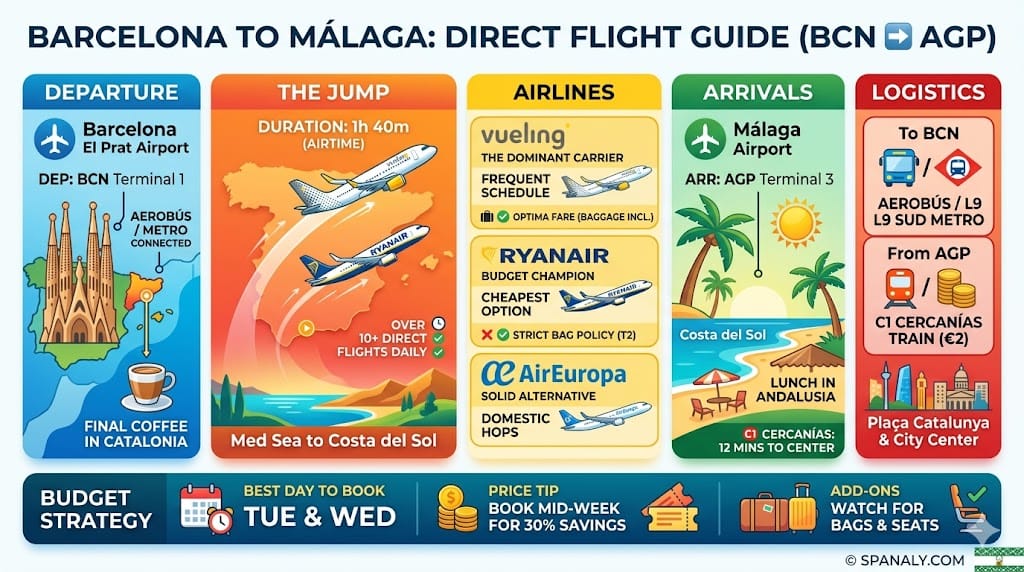
If you want to maximize your time on the beaches of the Costa del Sol, flying is your best bet. With a flight time of just 1 hour and 40 minutes, you can have breakfast in a Catalan café and lunch at a Málaga chiringuito.
Key Flight Facts:
Airtime: Approximately 1h 40m.
Frequency: High (over 10+ direct flights daily).
Airports: Departure from Barcelona El Prat (BCN) and arrival at Málaga Airport (AGP).
Top Airlines on this Route:
Vueling: The dominant carrier for this route. It offers the most frequent schedule and competitive “Optima” fares that include luggage.
Ryanair: Often the cheapest option, but be wary of strict cabin bag policies and further gates at BCN Terminal 2.
Air Europa: A solid alternative, often used for connecting passengers but also offering direct domestic hops.
Logistics & Transfers:
To Barcelona Airport: Use the Aerobús from Plaça de Catalunya or the L9 Sud Metro line. For a detailed breakdown, check our Barcelona El Prat Airport Guide.
From Málaga Airport: The C1 Cercanías train is the “local secret”—it takes only 12 minutes to reach the city center for less than €2. For more details on navigating the terminal, see our Málaga Airport (AGP) Guide.
💰 The “Budget Traveler” Strategy:
Book Mid-Week: Tuesday and Wednesday flights are consistently 30% cheaper than weekend departures.
Watch the Add-ons: Low-cost carriers charge for everything from seat selection to overhead bin space. Always factor these into your total “Comparison” price.
Spanaly Expert Insight: While the flight is only 100 minutes, remember to add 3 hours for airport transit, security, and boarding. If the total time exceeds 5 hours, the AVE Train becomes a much more relaxing “door-to-door” alternative with no liquid restrictions!
🚌 Taking the Bus: The Budget Long-Haul Option
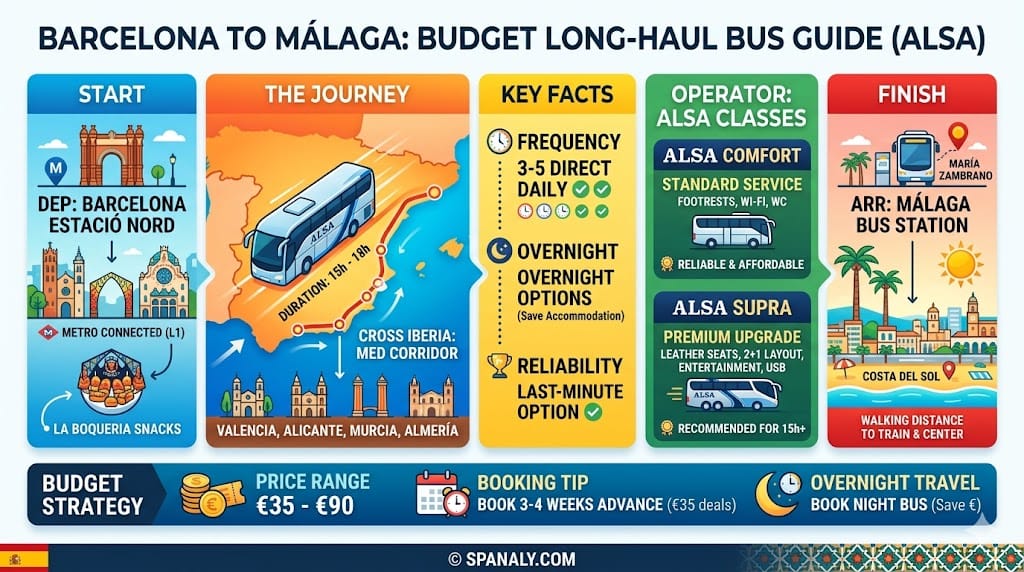
Traveling from Barcelona to Málaga by bus is a true journey across the Iberian Peninsula. While it is the longest option, it is often the most reliable way to find a seat when trains and flights are fully booked or overpriced.
Key Bus Facts:
Duration: The journey typically takes between 15 and 18 hours, depending on the number of stops.
Frequency: Around 3 to 5 direct daily departures, with several overnight options that allow you to save on a night’s accommodation.
Stations: Buses depart from Barcelona Estació Nord (near Arc de Triomf) and arrive at the Málaga Bus Station, which is conveniently located right next to the María Zambrano train station.
Top Operator: ALSA
The primary operator for this route is ALSA. They offer two main classes for this long journey:
ALSA Comfort: The standard service with Wi-Fi, footrests, and onboard restrooms.
ALSA Supra: If you are going to be on a bus for 15 hours, this is well worth the extra few euros. It features spacious leather seats in a 2+1 configuration, individual entertainment screens, and USB chargers.
Route & Scenic Stops:
The bus typically follows the Mediterranean corridor, passing through major hubs like Valencia, Alicante, Murcia, and Almería. If you have time to spare, you might consider breaking the journey in one of these cities. Check our Valencia to Málaga guide if you decide to turn your trip into a multi-city adventure.
💰 Booking Strategy:
Advance Tickets: Prices can drop as low as €35 if booked weeks ahead, but usually hover around €60–€90.
Overnight Travel: The “Night Bus” is a favorite for backpackers. It departs late in the evening and arrives in Málaga the next morning, giving you a full day of sightseeing immediately.
Spanaly Expert Insight: For a 15-hour trip, the ALSA Supra service is a game-changer. The extra legroom and individual seats make a massive difference in your energy levels upon arrival. Also, always pack a neck pillow and some local snacks from La Boqueria before you leave Barcelona!
🚗 Driving from Barcelona to Málaga: The Epic Mediterranean Road Trip
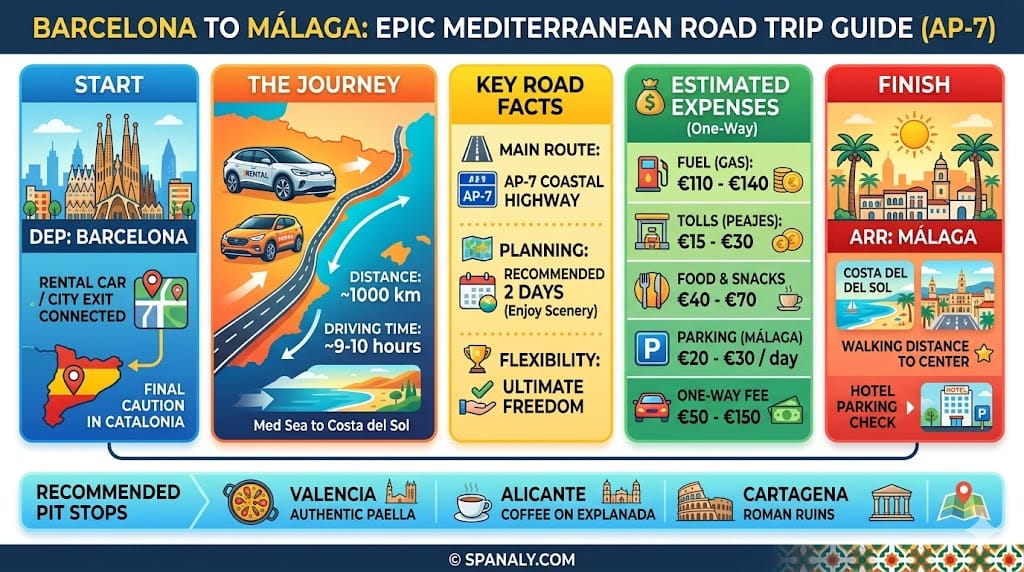
Driving from Catalonia to Andalusia via the AP-7 (Autopista del Mediterráneo) is one of Europe’s most iconic coastal routes. It offers the ultimate flexibility to trade the highway for hidden coves and white-washed villages.
Key Driving Facts:
Distance: Approximately 970 km to 1,000 km.
Driving Time: Around 9 to 10 hours of pure driving. However, we recommend breaking this into 2 days to enjoy the scenery.
The Route: The most direct path is the AP-7, which hugs the coast, or a mix of the A-7 and A-4 via Madrid if you prefer the inland plains.
💰 Estimated Trip Expenses (One-Way)
To help you budget for this 1,000 km journey, here is a breakdown of the typical costs for a standard rental car:
| Expense Category | Estimated Cost | Notes |
| ⛽ Fuel (Gasoline) | €110 – €140 | Based on average consumption & 2026 prices. |
| 🛣️ Tolls (Peajes) | €15 – €30 | Many sections of the AP-7 are now toll-free, but some private links remain. |
| 🍽️ Food & Snacks | €40 – €70 | Stop at “Áreas de Servicio” or local ventos. |
| 🅿️ Parking (Málaga) | €20 – €30 | Per day in the city center; hotels may charge more. |
| 🚗 One-Way Rental Fee | €50 – €150 | Extra fee for dropping the car in a different city. |
🛣️ Recommended Pit Stops:
Don’t just drive—explore! Here are three perfect halfway points:
Valencia: Stop for an authentic Paella Valenciana by the beach.
Alicante: Walk the famous Explanada de España for a quick coffee break.
Cartagena: Explore the Roman ruins if you have an extra hour to spare.
Spanaly Expert Insight: If you are planning to rent a car, always check if your hotel in Málaga offers parking. The city center is heavily pedestrianized and narrow. A great trick is to use our Driving in Spain Guide to understand the “Blue Zones” (Zona Azul) for cheaper street parking!
📍 Logistics: Where to Start and End Your Journey
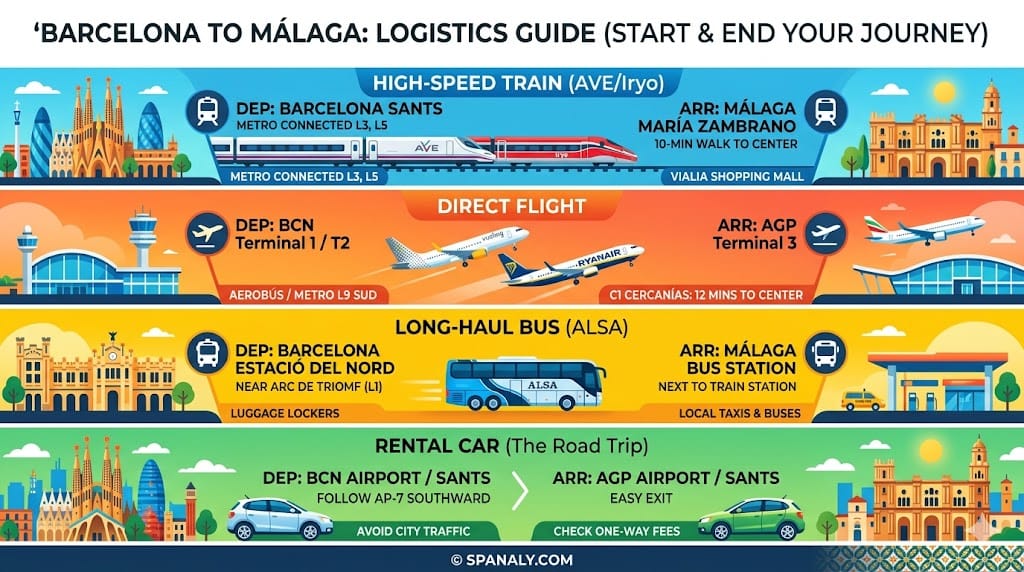
Navigating the 1,000 km between Catalonia and Andalusia is straightforward once you know your primary hubs. Here is your logistical blueprint for a seamless transition from Barcelona to Málaga:
🚉 By High-Speed Train (AVE/Iryo)
Departure: Your journey begins at Barcelona Sants Station, the city’s primary rail hub. It is perfectly connected via the Blue (L5) and Green (L3) Metro lines.
Arrival: You will arrive at Málaga María Zambrano Station. Located just a 10-minute walk from the historic center, it also houses the “Vialia” shopping mall for any immediate needs.
✈️ By Direct Flight
Departure: Head to Barcelona El Prat Airport (BCN). Most domestic flights depart from Terminal 1 (T1), while some budget carriers use Terminal 2 (T2). Use the Aerobús or Metro L9 Sud for the fastest transfers.
Arrival: You will land at Málaga Airport (AGP), specifically Terminal 3. For the quickest city link, follow signs for the C1 Cercanías train, which reaches the center in just 12 minutes.
🚌 By Long-Haul Bus (ALSA)
Departure: Most intercity buses depart from Barcelona Estació del Nord, located near the iconic Arc de Triomf (Metro L1).
Arrival: The bus terminates at the Málaga Bus Station, conveniently situated right next to the main train station, offering immediate access to local taxis and city buses.
🚗 By Rental Car (The Road Trip)
The Start: Pick up your vehicle at Barcelona Airport to bypass city traffic, or at Sants Station offices. Follow signs for the AP-7 (Autopista del Mediterráneo) southward.
The Finish: Drop off your car at Málaga Airport for a quick exit, or at the María Zambrano rail station offices. Always verify “One-Way” drop-off fees during your booking.
Spanaly Expert Insight: If you arrive early at Barcelona Sants, there are plenty of luggage lockers available. Conversely, if you have a late departure from Málaga, the María Zambrano Station is the best place to kill time—it’s effectively a high-end shopping center with a cinema and great dining options!
🏆 Final Recommendation: Which Choice is Best for You?
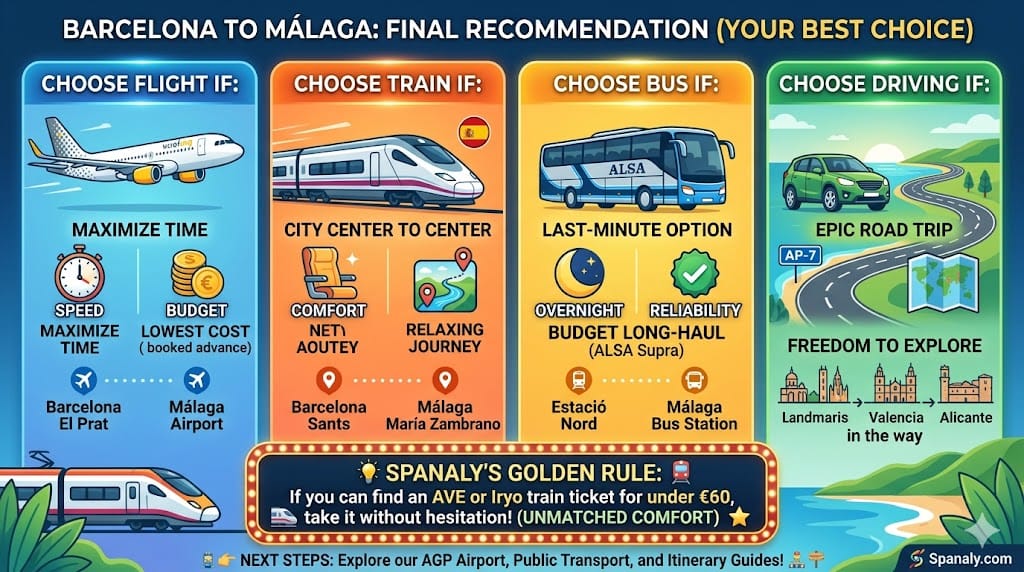
Bridging the gap between Barcelona and Málaga is about balancing time, budget, and comfort. To make your decision easier, here is our final expert breakdown based on your travel style:
Choose the Flight if: You are on a tight schedule or a strict budget. With dozens of daily connections, it is the most efficient way to skip the 1,000 km distance. Just remember to factor in airport transit times.
Choose the High-Speed Train if: You value comfort and convenience. Arriving directly in the city center of Málaga from Barcelona Sants without security queues is a luxury. It’s the most “Spanish” way to travel—scenic and stress-free.
Choose the Bus if: You are booking at the very last minute during peak season and everything else is overpriced. It’s a long haul, but the ALSA Supra service makes it surprisingly bearable.
Choose Driving if: The journey is as important as the destination. If you have 2–3 days to spare, the Mediterranean road trip is an experience you will never forget.
💡 Spanaly’s Golden Rule: If you can find an AVE or Iryo train ticket for under €60, take it without hesitation. The comfort of the Spanish rail system is world-class and far superior to the cramped seats of a budget airline. However, if speed is your only metric, Vueling remains the undefeated champion of this route.
☀️ Best Time to Visit: Weather & Logistics
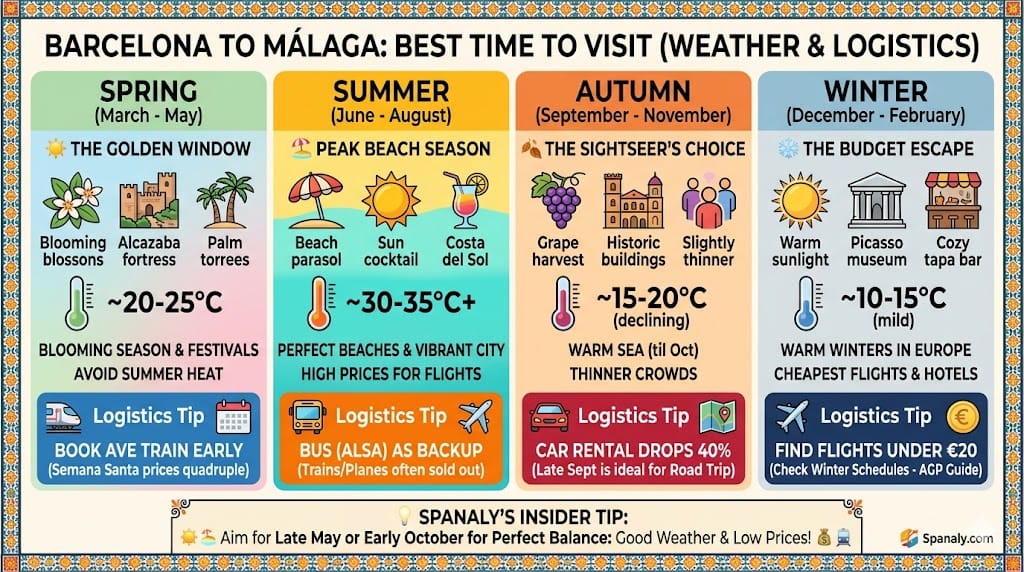
Timing your journey from Catalonia to the Costa del Sol can make or break your budget. While Málaga is a year-round paradise, the logistics of your trip often shift with the seasons. To see how this route fits into the bigger picture of your trip, check out our master guide on the Best Time to Visit Spain.
Here is a seasonal breakdown to help you sync your Barcelona-to-Málaga travel with the Andalusian climate:
🌸 Spring (March to May) – The Golden Window
Why: This is arguably the best time to visit. With temperatures in the mid-20s and the scent of orange blossoms in the air, you’ll avoid the sweltering heat of July.
Logistics Tip: This is peak festival season. If you are traveling during Spanish Festivals like Semana Santa, book your AVE train at least 4 weeks in advance, as prices can quadruple at the last minute.
🏖️ Summer (June to August) – Peak Beach Season
Why: The ultimate time for Mediterranean sun seekers. The city is electric, and the chiringuitos (beach bars) are at their best.
Logistics Tip: Expect premium prices for flights. If trains and planes are sold out or overpriced, the ALSA Bus becomes your most reliable “Plan B” during these busy months.
🍂 Autumn (September to November) – The Sightseer’s Choice
Why: The seawater stays warm enough for swimming until late October, but the summer crowds disappear, leaving the historic sites peaceful.
Logistics Tip: Car rental rates often plummet by up to 40% in late September, making it the perfect window for a coastal road trip along the AP-7.
❄️ Winter (December to February) – The Budget Escape
Why: Málaga boasts one of the warmest winters in Europe. It’s the perfect time to explore the Alcazaba and Picasso Museum without the summer sweat.
Logistics Tip: This is the season for “travel hacking.” You can often find domestic flights from BCN to AGP for under €20. Check our Málaga Airport (AGP) Guide for updated winter schedules.
💡 Spanaly’s Insider Tip: For the perfect “sweet spot” of low prices and glorious weather, aim for late May or early October. You’ll enjoy the full summer vibe without the peak-season “price tag” on your transport and hotels!
💡 Pro Tips for a Stress-Free Journey from Barcelona to Málaga
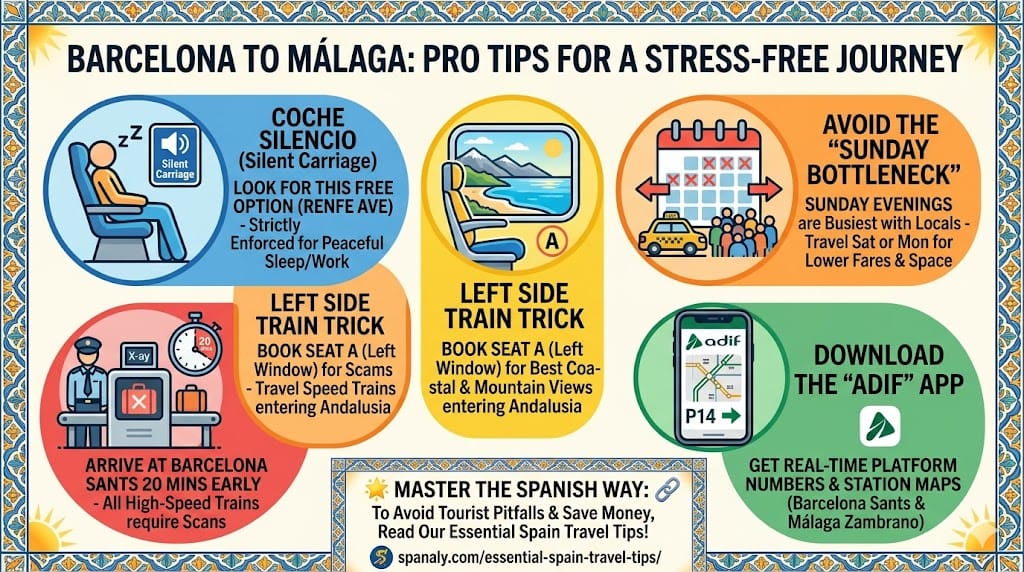
To ensure your transition from the Catalan capital to the Andalusian coast is as smooth as a glass of Tinto de Verano, keep these expert insider tips in mind:
The “Silent Carriage” (Coche Silencio): When booking your Renfe AVE train, look for the “Silent Carriage” option. It’s free and strictly enforced—perfect for catching up on sleep or work during the 5-hour journey without the noise of phone calls or loud groups.
The “Left Side” Train Trick: If you are traveling south from Barcelona to Málaga by train, try to book a window seat on the left side (Seat A). This side offers the best views of the Mediterranean coastline and the rugged Sierra Nevada mountains as you enter Andalusia.
Avoid the “Sunday Bottleneck”: Sunday evenings are the busiest for domestic travel in Spain. Trains and flights are often packed with locals returning home. If possible, travel on Saturday or Monday morning to enjoy more space and significantly lower fares.
Luggage Scans are Mandatory: Unlike many other European rail systems, Spain has security luggage scans for all high-speed trains. Don’t arrive at the platform 2 minutes before departure—give yourself at least 20 minutes to pass through the scan at Barcelona Sants.
Download the “Adif” App: This is the official app for Spanish train stations. It provides real-time platform numbers (which often change at the last minute) and station maps for both Barcelona Sants and Málaga María Zambrano.
🌟 Master the Spanish Way: Traveling 1,000 km across Spain requires a bit of local know-how beyond just booking a ticket. To avoid common tourist pitfalls and save money on everything from tipping to dining hours, make sure to read our comprehensive guide on Essential Spain Travel Tips before you pack your bags.
🛡️ Barcelona to Málaga – Travel Safety & Essential Logistics
🛡️ Is it safe to use overnight buses between Barcelona and Málaga?
Yes, overnight buses operated by ALSA are very safe. Drivers are strictly regulated regarding rest periods, and vehicles are equipped with modern GPS tracking. For solo travelers, we recommend booking a seat in the Supra class for extra space and peace of mind, and always keep your valuables in a small carry-on bag by your feet.
🎫 Do I need to print my train or bus tickets?
No, Spain is highly digitized. You can simply show the QR code on your smartphone for Renfe (AVE), Iryo, and ALSA tickets. However, ensure your phone is fully charged before arriving at Barcelona Sants, as you will need to scan your code twice—once for the security luggage check and once at the boarding gate.
☕ Are there food services on the high-speed trains?
Absolutely. Most AVE and Iryo trains feature a Cafetería carriage where you can buy sandwiches, coffee, and snacks. If you book a "Preferente" or "Infinita" class ticket, a hot meal may be served directly at your seat. For budget travelers, we recommend grabbing a bocadillo at Barcelona Sants before boarding to save money.
📶 Is there reliable Wi-Fi during the 1,000 km journey?
High-speed trains provide free Wi-Fi (via the PlayRenfe or Iryo portal), though it can be spotty when passing through tunnels in the mountains. Bus Wi-Fi is generally slower. For a guaranteed connection, we recommend a local Spanish SIM card, as 4G/5G coverage is excellent along the entire Mediterranean coastal route.
🚉 Can I store my luggage at the stations in Málaga?
Yes, Málaga María Zambrano Station has a secure luggage locker area (Consigna). This is perfect if you arrive early and want to explore the city center or visit the nearby beaches without dragging your suitcases. Prices vary based on locker size, and they generally accept both cash and card.
Last updated by Spanaly.com – Expert Spain Travel Guides.
Your journey from Barcelona to Málaga is more than just a trip across Spain—it’s a transition from the avant-garde streets of Gaudi to the sun-soaked spirit of Andalusia. 🇪🇸
⚡ Fast Track: Grab a flight if every hour counts.
🛋️ Comfort First: Choose the AVE or Iryo train for the ultimate relaxing ride.
🛣️ Slow Travel: Take the wheel on the AP-7 for a coastal adventure.
💰 Budget Savvy: The ALSA bus is your loyal companion for last-minute savings.
📍 Planning to explore more of the South? Málaga is the perfect gateway to the rest of Andalusia. If you’re thinking of heading further east to see the Alhambra, don’t miss our guide on traveling from Granada to Málaga to complete your itinerary!
Safe travels, and enjoy every kilometer of the Spanish landscape! 🥂✨