💶 Spain Money Basics
Stepping into Spain without a clear money strategy can be a costly mistake. While the Euro (€) remains king, the way you spend it has completely transformed. Whether you are tapping your phone in Madrid or counting coins in a rural village, knowing the local “rules of payment” is the first step to a stress-free trip.
⚡ The Quick Reality Check
Digital First: Over 90% of businesses in major cities now prioritize contactless payments.
The Cash Gap: Smaller towns and traditional markets still rely heavily on physical Euro notes.
Hidden Fees: Using the wrong ATM or card can eat up to 10% of your travel funds in bank charges.
Smart Planning: Before you dive into the details, checking our Spain travel budget guide will help you estimate your daily costs accurately.
💰 Why Your Payment Strategy Matters
Spain is a country of contrasts. You can pay for a €1.50 coffee with an Apple Watch in a city center, yet find a “Cash Only” sign at a legendary tapas bar in Andalusia. Navigating this balance requires more than just carrying a wallet; it requires knowing where the hidden fees hide and which cards the locals trust.
Spanaly Insight: Don’t exchange large amounts of currency at your home bank. You’ll almost always get a better rate by withdrawing Euros directly from a “fee-free” Spanish ATM upon arrival!
📊 The 2026 Spain Money Snapshot: Essential Facts
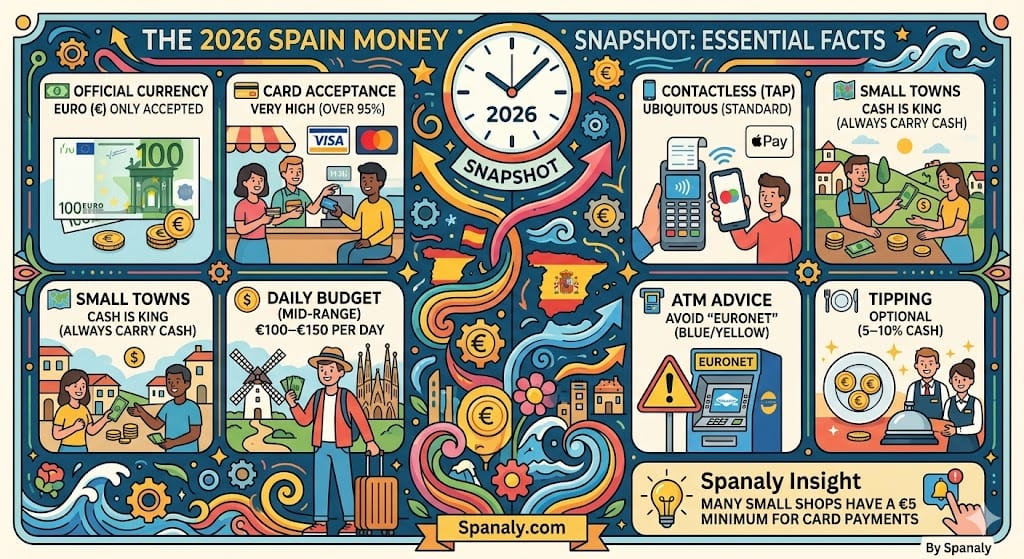
Before we dive into the details, here is the high-level reality of handling your finances while traveling through the Iberian Peninsula.
Official Currency: The Euro (€) is the only currency accepted.
Card Acceptance: High. Over 95% of businesses in cities take Visa and Mastercard.
Contactless (Tap): Ubiquitous. Apple Pay, Google Wallet, and tap-to-pay cards are the standard.
Small Towns: Cash is King. Always carry at least €40–€50 in small bills for rural areas.
Daily Budget: A mid-range traveler spends around €100–€150 per day.
ATM Advice: Avoid “Euronet” (blue/yellow) machines; they charge the highest fees in Spain.
Tipping: Optional. Usually 5–10% for exceptional service in restaurants, mostly in cash.
Spanaly Insight: Many small shops (Tabacos or bakeries) still have a €5 minimum for card payments. Always keep a few €1 and €2 coins in your pocket for that morning espresso or a quick bottle of water!
💳 Cash vs. Digital: When to Tap and When to Pay Cash
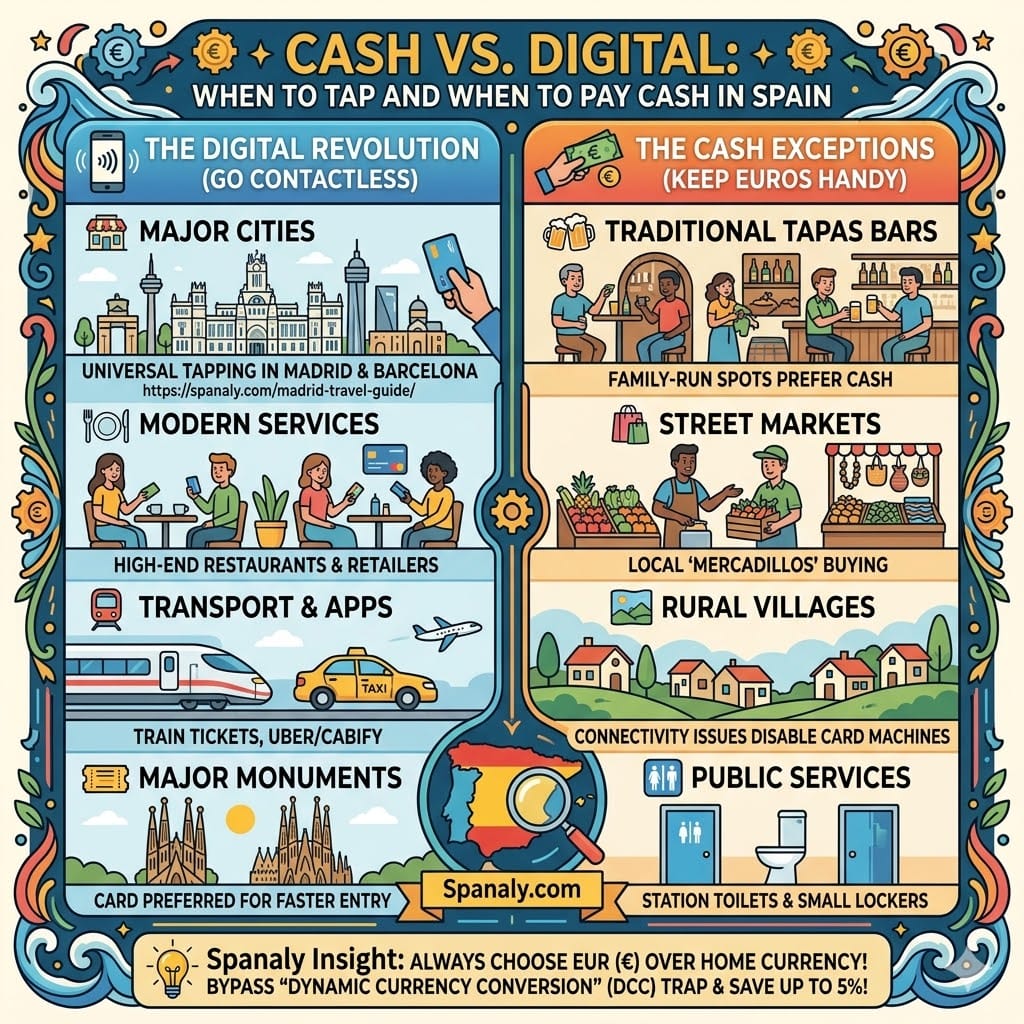
In 2026, Spain leads the way in contactless payments. However, a deep-rooted “Cash Culture” still thrives in specific local scenarios. Knowing when to use your digital wallet and when to keep Euros handy ensures a smooth experience across the country.
📱 The Digital Revolution (Go Contactless)
For most of your journey, your smartphone or card will be your best friend. Digital payments are now the standard for:
Major Cities: Tapping is universal in the Ultimate Madrid Travel Guide and Barcelona hubs.
Modern Services: High-end restaurants, trendy cafés, and international retailers.
Transport & Apps: Booking high-speed trains or using most city taxis.
Major Monuments: Ticketing counters strictly prefer cards for faster entry.
💶 The Cash Exceptions (Keep Euros Handy)
Despite the digital push, you will still encounter “Efectivo Solamente” (Cash Only) signs. We recommend checking our Spain trip checklist to ensure you carry enough small denominations for:
Traditional Tapas Bars: Older family-run spots in Andalusia often prefer cash for small orders.
Street Markets: Buying fresh fruit or artisan crafts at local “Mercadillos.”
Rural Villages: Connectivity issues in mountain areas can sometimes disable card machines.
Public Services: Some station toilets or small lockers still require €0.50 or €1 coins.
Spanaly Insight: If a merchant asks whether you want to pay in Euros or Your Home Currency, always choose Euros. This simple choice bypasses the “Dynamic Currency Conversion” (DCC) trap, saving you up to 5% in hidden bank markups.
🏧 Using ATMs in Spain: Fees & Best Practices
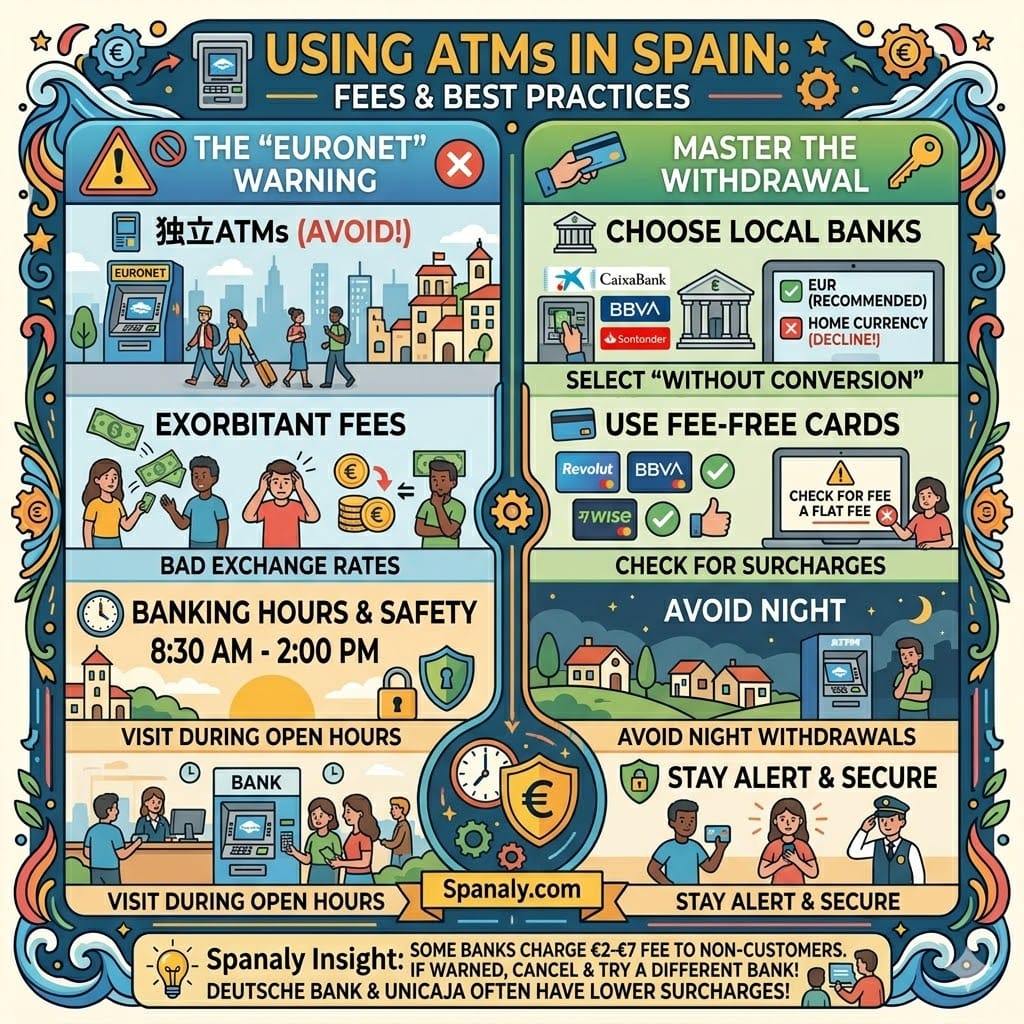
Withdrawing cash in a foreign country can be a minefield of hidden charges. In Spain, not all ATMs are created equal. Knowing which machine to trust and which buttons to press can save you from paying an extra 10% in unnecessary bank fees.
🚫 The “Euronet” Warning
The most important rule for any traveler is to avoid independent ATMs, especially the blue and yellow Euronet machines. These are strategically placed in high-traffic tourist areas and charge exorbitant flat fees and terrible exchange rates. Instead, always look for official bank branches like CaixaBank, BBVA, or Santander.
🔑 Master the Withdrawal Process
To get the most out of your Spain travel budget, follow these high-speed rail-fast steps at the ATM:
Choose Local Banks: Stick to “Cajeros” located inside or attached to a physical bank branch for better security and lower fees.
Select “Without Conversion”: If the machine offers to charge you in your home currency (USD, GBP, etc.), always decline. Choosing Euros (EUR) lets your home bank handle the conversion, which is significantly cheaper.
Check for Fee-Free Cards: Using Neobanks like Revolut or Wise is a top essential Spain travel tip to avoid international transaction fees altogether.
🕒 Banking Hours & Safety
Most Spanish banks are only open to the public from 8:30 AM to 2:00 PM. If you have an issue with an ATM, try to use it during these hours so staff can assist you immediately. For safety, avoid withdrawing large sums at night in isolated areas, even in safe cities.
Spanaly Insight: Some Spanish banks now charge a “Surcharge Fee” (usually €2–€7) to non-customers. If the screen warns you about a fee, cancel the transaction and try a different bank. Deutsche Bank and Unicaja often have lower surcharges for international visitors!
🍽️ Spending Locally: Restaurants, Taxis & Shopping Tips
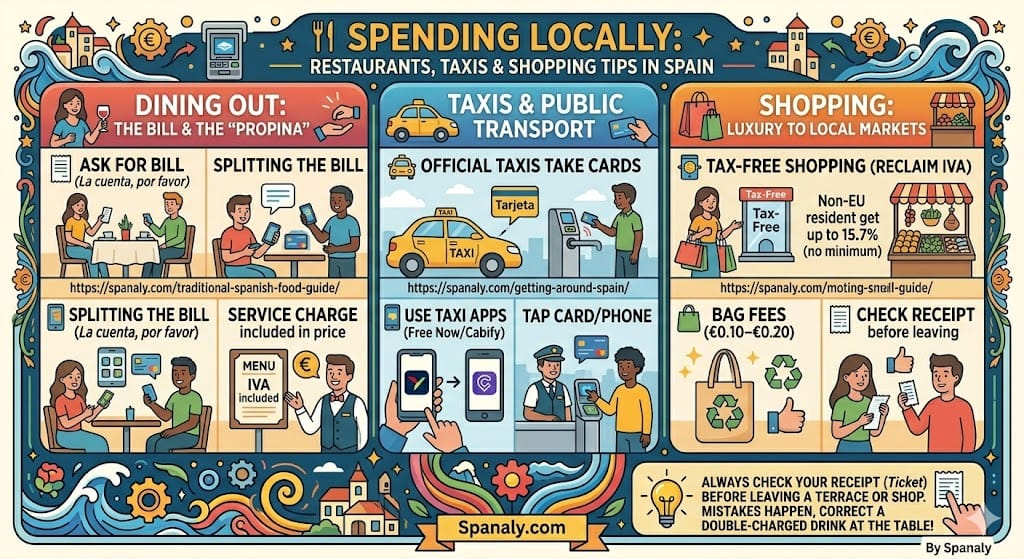
Navigating daily expenses in Spain is generally straightforward, but a few local customs can catch you off guard. From the “Service Charge” myth to tapping your way through the city, here is how to handle your Euros while enjoying the best of Spanish life.
🍷 Dining Out: The Bill & The “Propina”
In 2026, most restaurants in major hubs like Madrid and Barcelona are fully digital. However, the dining culture has its own rhythm:
The Bill (La Cuenta): It is rarely brought to your table automatically. You must ask for it (“La cuenta, por favor”).
Splitting the Bill: While common among friends, some traditional spots prefer a single payment. Check our Spanish Cuisine guide for more on dining etiquette.
Service Charges: By law, the menu price must include all taxes (IVA). There is no mandatory “Service Charge” added at the end.
🚕 Taxis & Public Transport Payments
Getting around is easier than ever with integrated payment systems:
City Taxis: All official taxis in Spain are required to take cards. However, apps like Free Now or Cabify are safer for tracking expenses.
Buses & Metro: In most cities, you can now tap your physical card or phone directly at the turnstile. For a deeper look at transport costs, see our Getting Around Spain guide.
🛍️ Shopping: From Luxury to Local Markets
Tax-Free Shopping: If you are a non-EU resident, look for the “Tax-Free” sign in windows. You can reclaim up to 15.7% IVA on purchases over a certain amount (usually no minimum in 2026).
Bag Fees: Expect to pay €0.10 to €0.20 for a shopping bag. It’s a national sustainability effort, so carrying a reusable tote is a smart “Money-Saving” hack.
Spanaly Insight: Always check your receipt (Ticket) before leaving a terrace or shop. Mistakes happen, and it’s much easier to correct a “double-charged” drink while you are still at the table!
💰 The Tipping Etiquette in Spain: Cash or Card?
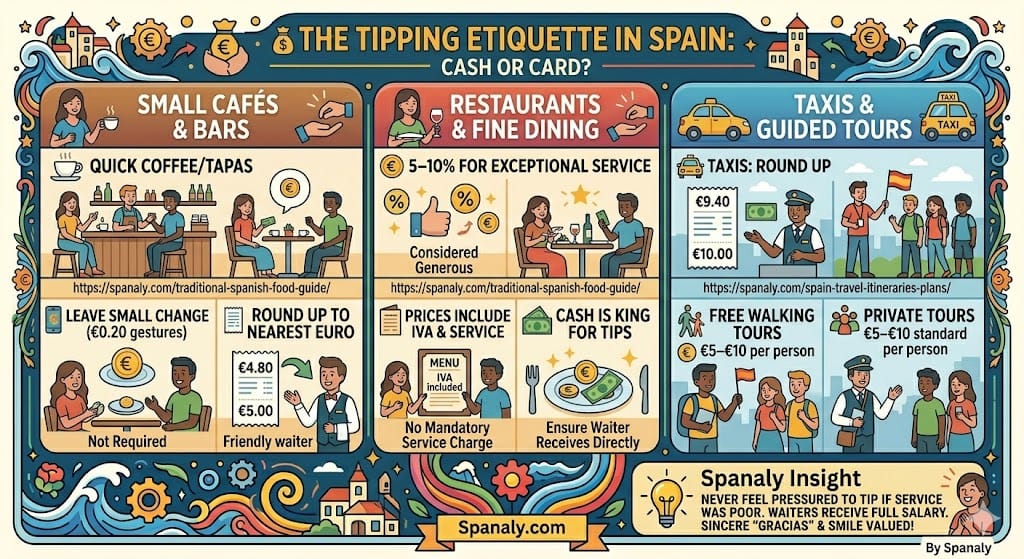
Tipping in Spain (known as La Propina) is not mandatory, and the rules are very different from the US or UK. In 2026, while digital payments are the norm, the way you show appreciation for good service remains a relaxed, local affair.
☕ Small Cafés & Bars
For a quick coffee or a couple of tapas, tipping is rarely expected. If your bill is €4.80, leaving the €0.20 change is a nice gesture but not required. Most locals simply “round up” to the nearest Euro if they feel the service was friendly.
🍽️ Restaurants & Fine Dining
In sit-down restaurants, a tip of 5% to 10% is considered generous for exceptional service.
The “Service Charge” Myth: Remember, by law, all prices in our Spanish Cuisine guide already include taxes and service.
Cash is King for Tips: Even if you pay the main bill by card, it is always better to leave the tip in cash (coins or small bills). This ensures the waiter receives it directly.
Adding to the Card: While some modern POS terminals now ask for a percentage tip, it is still less common in traditional spots.
🚕 Taxis & Guided Tours
Taxis: Rounding up to the nearest Euro is sufficient. If the fare is €9.40, giving €10 is perfectly fine.
Tours: For free walking tours or private guides mentioned in our Spain travel itineraries, a tip of €5–€10 per person is standard if you enjoyed the experience.
Spanaly Insight: Never feel pressured to tip if the service was poor. In Spain, waiters receive a full salary and don’t rely solely on tips to survive. A sincere “Gracias” and a smile are often valued as much as a few coins!
💳 Smart Banking: Best Travel Cards to Use in Spain
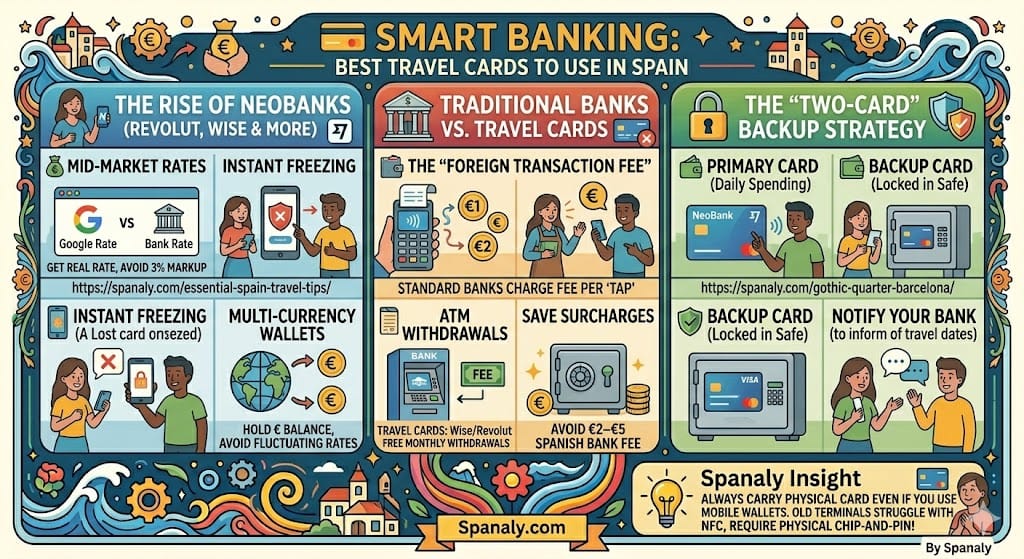
In 2026, carrying the right plastic in your wallet is just as important as having a valid passport. Standard bank cards often hide foreign transaction fees and poor exchange rates that can quietly drain your funds. Switching to a travel-optimized card is one of our top essential Spain travel tips for savvy explorers.
🚀 The Rise of Neobanks (Revolut, Wise & More)
Digital-first banks have revolutionized how tourists spend in Spain. Unlike traditional banks, these platforms offer:
Mid-Market Rates: Get the real exchange rate you see on Google, without the 3% markup banks usually add.
Instant Freezing: If you lose your card in a crowded spot like the Gothic Quarter in Barcelona, you can freeze it instantly via your app.
Multi-Currency Wallets: Hold your balance in Euros (EUR) to avoid fluctuating rates during your trip.
🏦 Traditional Banks vs. Travel Cards
The “Foreign Transaction Fee”: Most high-street banks charge a fee for every single “Tap” you make abroad. These small €1 or €2 charges add up fast.
ATM Withdrawals: Travel cards like Wise or Revolut often allow a certain amount of free international ATM withdrawals each month, saving you the standard €2–€5 Spanish bank surcharge.
🛡️ The “Two-Card” Backup Strategy
Never rely on a single card. Technology can fail, and cards can be swallowed by machines.
Primary Card: Use a Neobank card for daily spending and taps.
Backup Card: Keep a traditional Credit Card (Visa or Mastercard) locked in your hotel safe for emergencies.
Notify Your Bank: If using a traditional bank, inform them of your travel dates to Spain so they don’t block your card for “suspicious activity.”
Spanaly Insight: Always carry a physical card even if you use Apple Pay or Google Wallet. Some older card terminals in smaller Spanish shops still struggle with mobile “NFC” payments and require a physical chip-and-pin transaction!
🗺️ Big Cities vs. Rural Spain: The Payment Gap
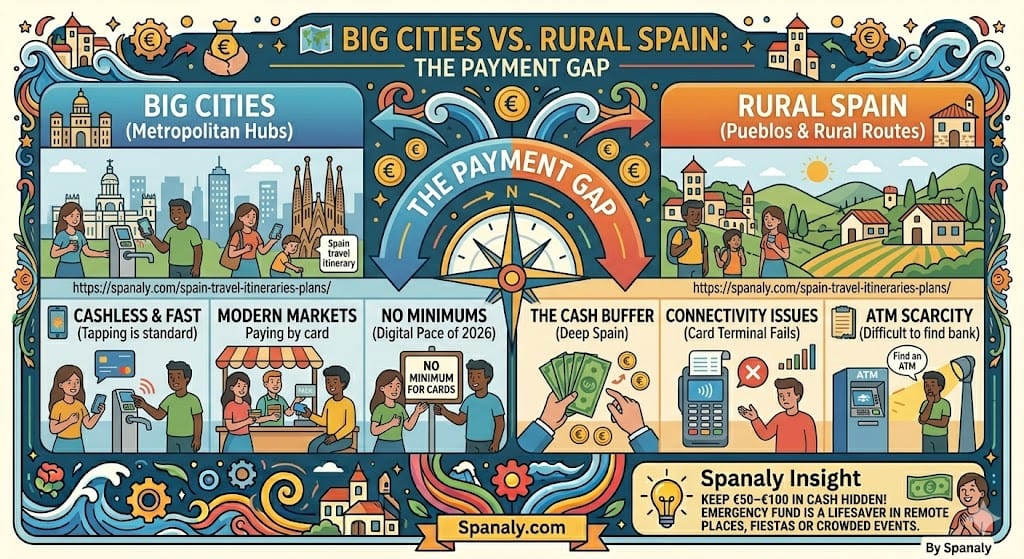
Spain is a country of two financial speeds. While metropolitan hubs are racing toward a cashless future, the charming “Pueblos” (villages) and rural routes still march to the beat of physical Euro notes. Understanding this gap is essential for anyone planning a diverse Spain travel itinerary.
🏙️ The Urban Experience (Cashless & Fast)
In cities like Madrid, Barcelona, and Valencia, you can practically leave your physical wallet in the hotel safe.
Tapping Everywhere: From high-end boutiques to the smallest kiosks, contactless is the default.
Modern Markets: Even many stalls in famous spots like Mercado de Triana in Seville now accept card payments for even a single piece of fruit.
No Minimums: Most urban businesses have abolished the “€5 minimum” for cards to keep up with the digital pace of 2026.
🌲 Rural & Small Town Reality (The Cash Buffer)
Once you head into the “España Profunda” (Deep Spain) or hike the Camino de Santiago, the rules change:
Connectivity Issues: In mountain villages, weak internet signals often cause card terminals to fail.
The “Solo Efectivo” Rule: Traditional bakeries, local pharmacies, and small family-run guesthouses often only accept cash.
ATM Scarcity: Finding a bank machine in a village of 200 people can be impossible. Always withdraw your “Rural Fund” before leaving the big city.
🎭 Festivals & Seasonal Events
During major local celebrations, systems often get overwhelmed. Whether you are attending a small town “Fiesta” or a crowded event, having coins and small bills will save you from long queues at the only working ATM in town.
Spanaly Insight: If you are planning a road trip through rural Spain, keep at least €50–€100 in cash hidden in your car or luggage. This “emergency fund” is a lifesaver if you hit a remote gas station with a broken card reader!
⚠️ Security & Safety: Protecting Your Cards & Wallet
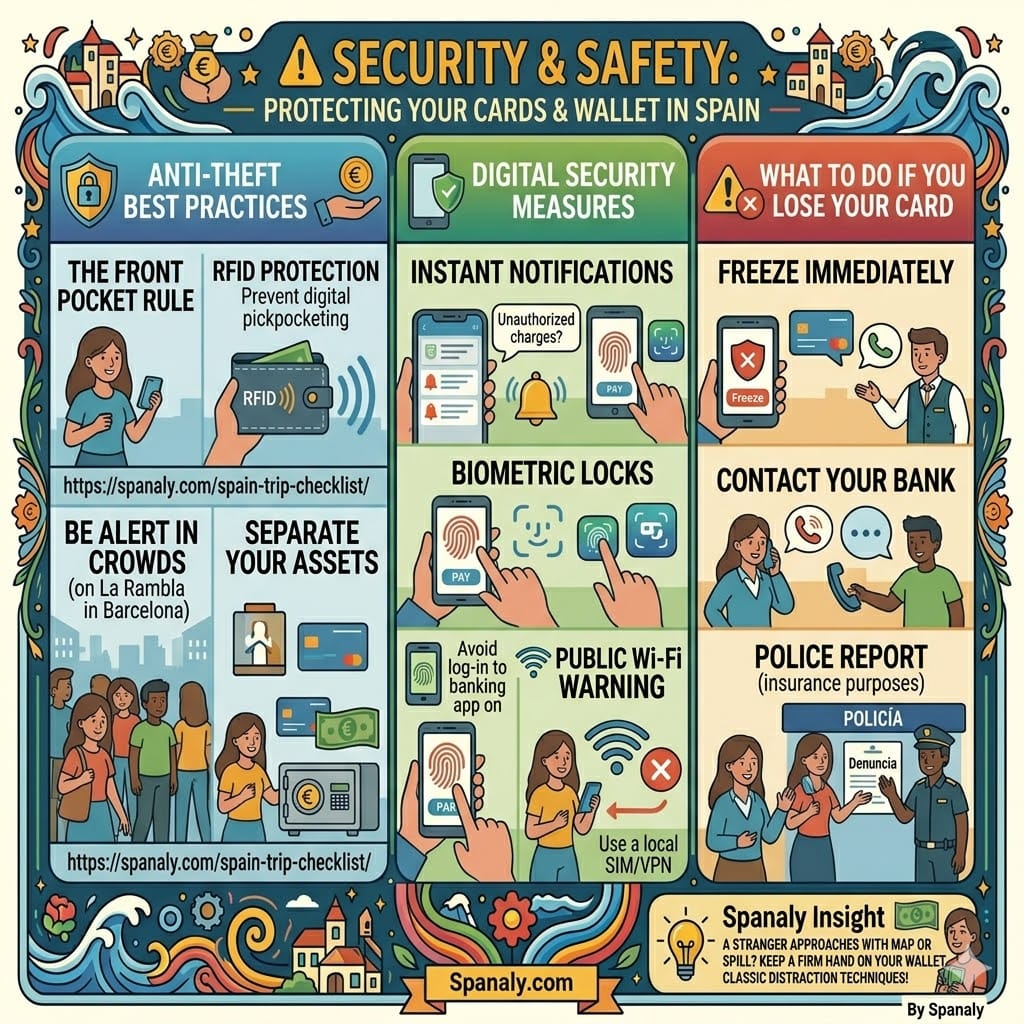
Spain is generally a very safe country, but like any major tourist destination, it has its share of “professional” pickpockets. Protecting your financial assets requires a mix of common sense and modern digital tools. Following these steps is a core part of any Spain trip checklist.
🛡️ Anti-Theft Best Practices
The Front Pocket Rule: Never keep your wallet in your back pocket. Use a front pocket or a cross-body bag with a secure zipper.
RFID Protection: Use an RFID-blocking wallet or sleeve to prevent “digital pickpocketing,” where thieves try to scan your contactless cards in crowded areas.
Be Alert in Crowds: Stay extra vigilant in high-traffic spots like La Rambla in Barcelona or crowded Metro stations.
Separate Your Assets: Never carry all your cash and cards in one place. Keep a backup card and emergency Euro notes in your hotel safe.
📱 Digital Security Measures
Instant Notifications: Enable push notifications for every transaction on your banking app. This allows you to spot unauthorized charges immediately.
Biometric Locks: Ensure your Apple Pay or Google Wallet requires FaceID or a fingerprint to authorize any payment.
Public Wi-Fi Warning: Never log into your banking app using unsecured public Wi-Fi. Use a local SIM card or a VPN for a secure connection.
🚨 What to Do if You Lose Your Card
Freeze Immediately: Use your banking app to freeze the card the second you realize it’s missing.
Contact Your Bank: Call your bank’s 24/7 emergency line to report the loss and request a replacement.
Police Report: If stolen, visit the nearest Policía Nacional station to file a “Denuncia” for insurance purposes.
Spanaly Insight: If a stranger approaches you with a map or tries to “help” you clean a spill on your clothes, keep a firm hand on your wallet. These are classic distraction techniques used by street thieves to grab your valuables!
📊 Spanaly Money Cheat Sheet: Quick Reference Table
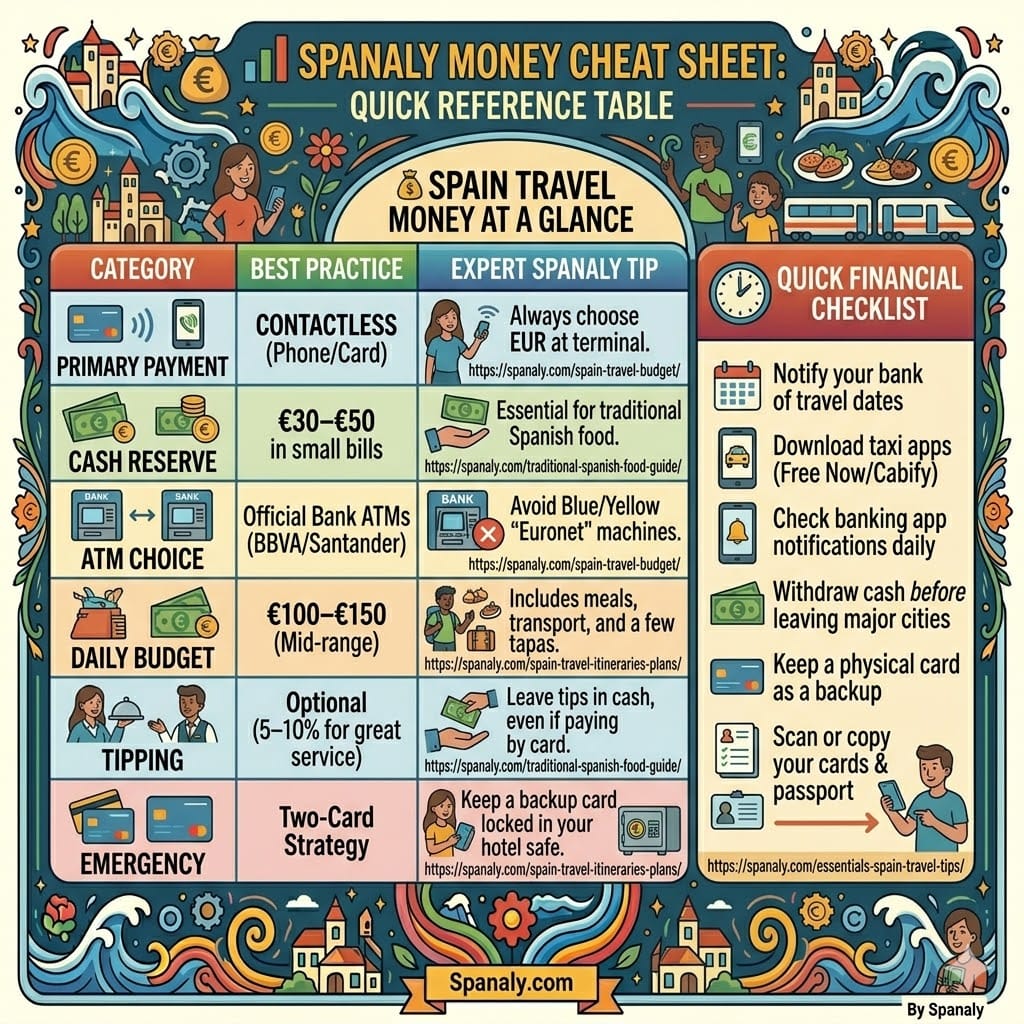
Planning your Spain travel budget doesn’t have to be complicated. To help you make fast decisions while on the go, we have summarized the most essential money rules into this quick-access table. Bookmark this page or take a screenshot before you head out!
💰 Spain Travel Money at a Glance
| Category | Best Practice | Expert Spanaly Tip |
| Primary Payment | Contactless (Phone/Card) | Always choose EUR at the terminal. |
| Cash Reserve | €30–€50 in small bills | Essential for traditional Spanish food spots. |
| ATM Choice | Official Bank ATMs (BBVA/Santander) | Avoid Blue/Yellow “Euronet” machines. |
| Daily Budget | €100–€150 (Mid-range) | Includes meals, transport, and a few tapas. |
| Tipping | Optional (5–10% for great service) | Leave tips in cash, even if paying by card. |
| Emergency | Two-Card Strategy | Keep a backup card locked in your hotel safe. |
🕒 Quick Financial Checklist
Before You Leave: Notify your bank of your travel dates to Spain.
On Arrival: Download a taxi app like Free Now or Cabify for secure card payments.
Daily Habit: Check your banking app for any “unauthorized” push notifications.
In Small Towns: Withdraw your cash before leaving major cities.
Spanaly Insight: If you’re traveling between cities, such as taking the train from Madrid to Seville, you can use your contactless card for almost everything at the stations. However, keep a €1 coin handy for luggage lockers or public restrooms—they are the last “cash-only” holdouts!
💡 Spanaly Pro Tips: Save More, Travel Smarter
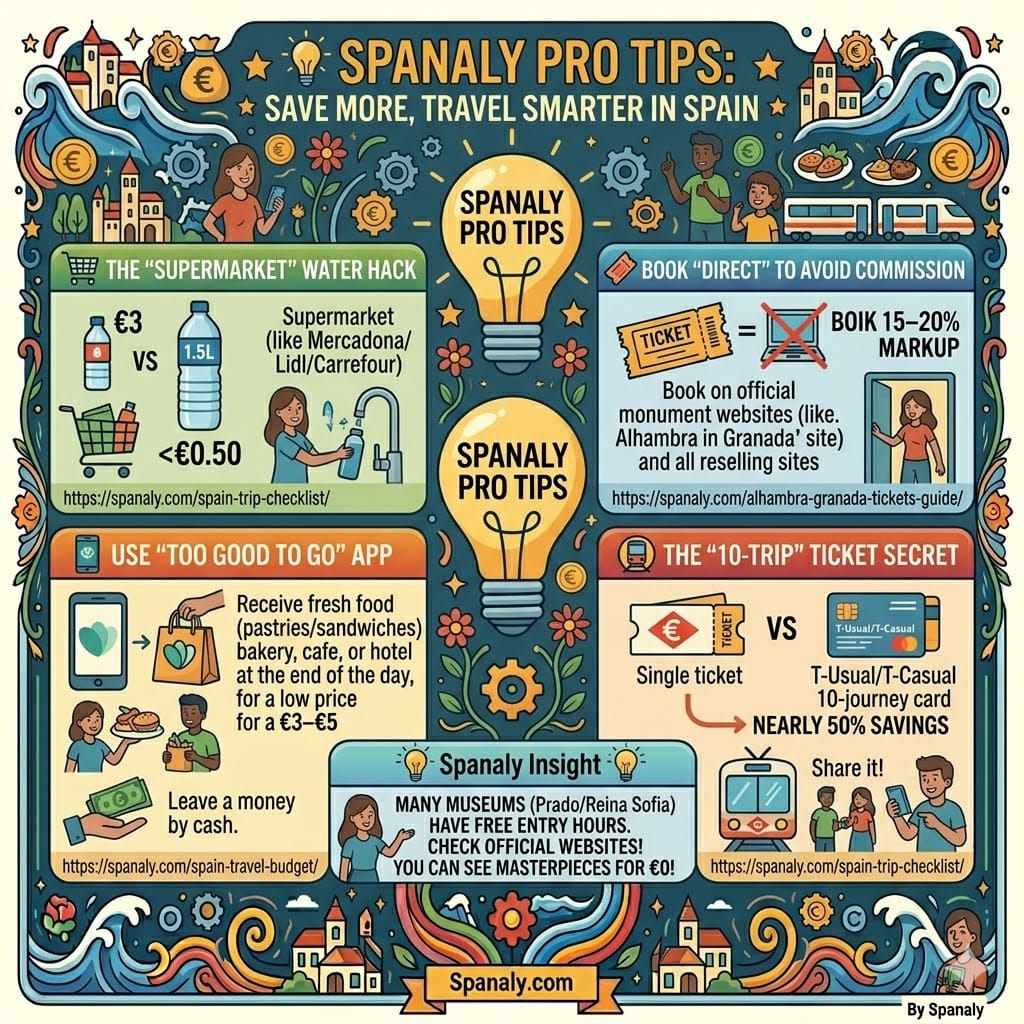
Beyond the basics of cash and cards, these insider secrets will help you navigate Spain’s financial landscape like a local. Incorporating these into your Spain trip checklist can save you hundreds of Euros over a two-week vacation.
🛒 The “Supermarket” Water Hack
Avoid buying water bottles at kiosks near major monuments like the Prado Museum or Sagrada Familia, where a small bottle can cost €3. Instead, head to a local supermarket like Mercadona, Lidl, or Carrefour. You can grab a 1.5L bottle for less than €0.50. Spain’s tap water is safe to drink in almost all cities, so bring a reusable bottle and refill for free!
🎟️ Book “Direct” to Avoid Commission
Third-party booking sites often add a 15–20% markup on tours and tickets. Always try to book directly through official monument websites. For example, when visiting the Alhambra in Granada, buying from the official Patronato site is significantly cheaper than “skip-the-line” resellers who dominate Google search results.
📱 Use “Too Good To Go” for Cheap Eats
Download the Too Good To Go app. It’s huge in Spain. Local bakeries, cafes, and even some high-end hotels sell “Surprise Bags” of leftover fresh food at the end of the day for €3–€5. It’s a fantastic way to enjoy high-quality Spanish pastries or sandwiches while sticking to a tight Spain travel budget.
🚇 The “10-Trip” Ticket Secret
Don’t buy single metro or bus tickets. In cities like Madrid (Multi Card) and Barcelona (T-Usual or T-Casual), buying a 10-journey pass reduces the cost per trip by nearly 50%. These cards are contactless and can often be shared between two people traveling together.
Spanaly Insight: Many museums in Spain (like the Reina Sofia or the Prado) have Free Entry Hours (usually in the last 2 hours of operation). Check their official websites before paying the full €15–€20 fee. If you time it right, you can see the masterpieces for absolutely €0!
🏧 Visitor FAQs – Spain Banking & Money Guide 2026
💳 Is it safe to use my physical card for "Contactless" payments on public transport?
Yes, in 2026, Spain’s transport network is highly secure. Tapping your physical card or phone on buses and metros in cities like Madrid and Valencia is the standard. However, to prevent "overcharging" or accidental taps, we recommend keeping your card in an RFID-blocking sleeve when not in use.
💶 What should I do if an ATM swallows my card after hours?
Don't panic, but freeze your card immediately via your banking app. In 2026, Spanish banks like CaixaBank or BBVA cannot return cards once the branch is closed for security reasons. You will likely need to use your backup card from your hotel safe and request a new one from your home bank.
📱 Are mobile wallets like Apple Pay and Google Pay accepted in small Pueblos?
It is a hit or miss. While 2026 has seen a digital surge, many rural family-run shops still use older terminals that lack NFC technology. We always recommend carrying a physical chip-and-pin card and at least €50 in cash when exploring rural Spain or hiking the Camino.
🏛️ Can I pay for "Free Walking Tours" with a credit card?
In 2026, some guides carry portable card readers (SumUp), but it is not guaranteed. Tips for free tours are still overwhelmingly cash-based. To avoid an awkward moment at the end of a great tour, ensure you have a €10 or €20 bill ready to show your appreciation.
🏦 Where is the best place to exchange physical cash if I forgot to do it?
Avoid airport exchange booths at all costs! In 2026, the best rates are found at official bank branches in city centers. Alternatively, look for "Change" offices in non-tourist neighborhoods. Always compare their rate with the "Mid-market" rate on Google to ensure you aren't losing 10-15% in fees.
Money & Banking Guide last updated for 2026 by Spanaly.com
Navigating money in Spain in 2026 is all about finding the perfect balance. Whether you are tapping your phone in a Madrid boutique or counting coins in a mountain village, being prepared is your best travel asset.
💳 Go Digital First: Use your contactless card for 90% of your daily expenses.
💶 Keep a “Pueblo” Fund: Always have some cash for small towns and traditional bars.
🛡️ Stay Security-Smart: Keep your backup card safe and watch for distraction techniques.
🎟️ Book in Advance: Don’t let high commissions ruin your budget! Check our Spain Attraction Tickets Guide to save money on every entry.
One Last Spanaly Tip: Traveling is about the memories, not the math. Set up your travel card, stash some Euros, and focus on what really matters—the tapas, the sunsets, and the vibrant Spanish soul!