Table of Contents
Toggle🏛️ Oviedo
Walk through cobblestone streets where the rhythmic splash of fresh cider fills the air. This Asturian capital serves as the majestic gateway to España Verde, blending ancient Pre-Romanesque wonders with a sophisticated modern pulse. Whether you are following in the footsteps of Woody Allen or starting your own journey, Oviedo offers a fairy-tale escape into the heart of Northern Spain.
🏰 Historic Gems: Explore UNESCO-listed Pre-Romanesque architecture hidden in the lush hills.
🥘 Culinary Delights: Taste legendary Fabada bean stew in traditional cider houses.
👣 The First Way: Stand at the historic starting point of the ancient Camino Primitivo pilgrimage.
🌦️ Real Weather: Prepare for sudden rain showers that keep the landscape brilliantly emerald.
Before diving deep, check our Ultimate Northern Spain Travel Guide to see how Oviedo fits your regional itinerary.
📌 Oviedo Travel Snapshot: Essential Trip Details
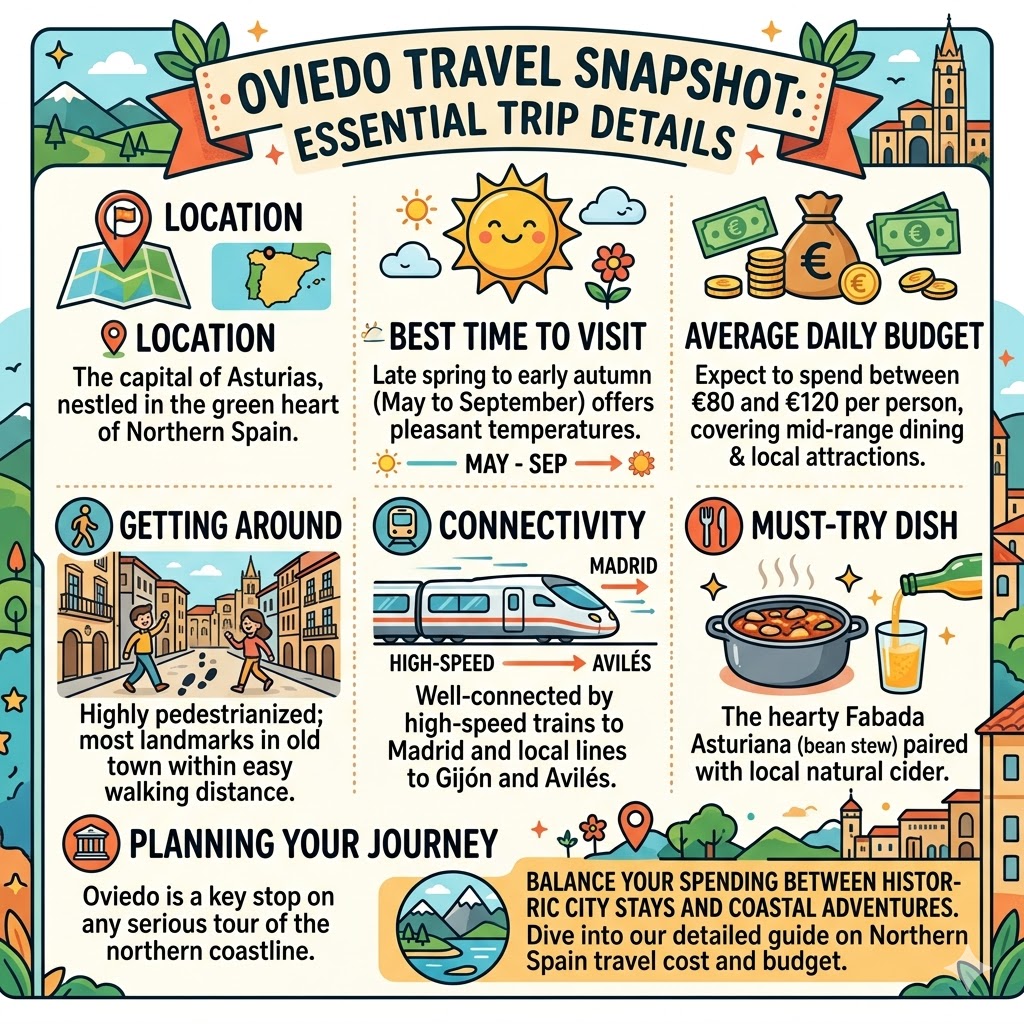
Need the vital facts for your journey to the heart of Asturias? Here is a quick breakdown of everything you need to know about Oviedo at a glance.
📍 Location: The capital of Asturias, nestled in the green heart of Northern Spain.
⛅ Best Time to Visit: Late spring to early autumn (May to September) offers the most pleasant temperatures for exploring.
💶 Average Daily Budget: Expect to spend between €80 and €120 per person, covering mid-range dining and local attractions.
🚶 Getting Around: Highly pedestrianized; most major landmarks in the old town are within easy walking distance.
🚆 Connectivity: Well-connected by high-speed trains to Madrid and local lines to nearby cities like Gijón and Avilés.
🍴 Must-Try Dish: The hearty Fabada Asturiana (bean stew) paired with local natural cider.
🏛️ Planning Your Journey
Oviedo is a key stop on any serious tour of the northern coastline. To see how to best manage your expenses while exploring this region, dive into our detailed guide on Northern Spain travel cost and budget. This will help you balance your spending between historic city stays and coastal adventures.
⚖️ Oviedo vs. Gijón: Which Asturian City Should You Choose?
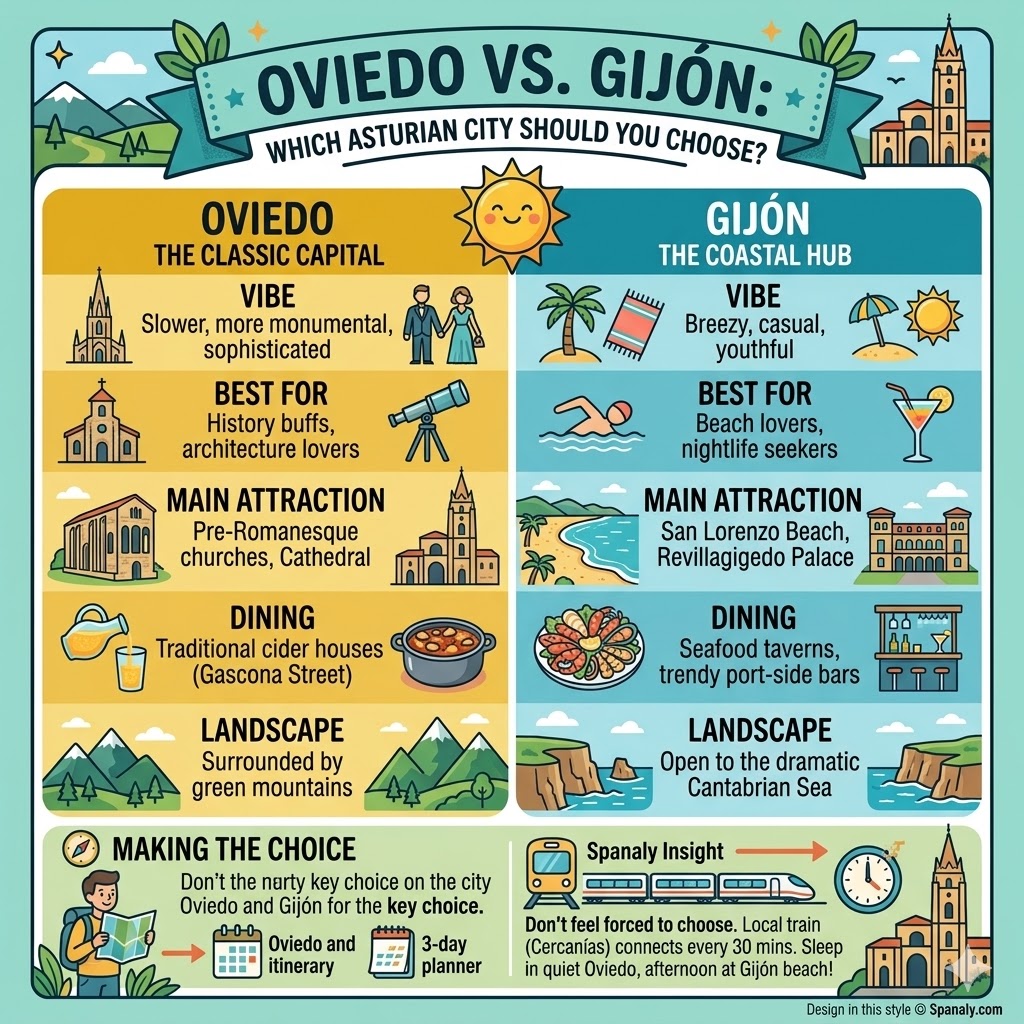
When exploring Asturias, the biggest debate is often between the historic elegance of Oviedo and the coastal energy of Gijón. While Oviedo serves as the inland cultural capital, Gijón is the vibrant sea-facing sibling just 30 minutes away.
| Feature | Oviedo (The Classic Capital) | Gijón (The Coastal Hub) |
| Vibe | Sophisticated, quiet, and monumental. | Casual, breezy, and youthful. |
| Best For | History buffs and architecture lovers. | Beach lovers and nightlife seekers. |
| Main Attraction | Pre-Romanesque churches & the Cathedral. | San Lorenzo Beach & the Revillagigedo Palace. |
| Dining | Traditional cider houses (Gascona Street). | Seafood taverns and trendy port-side bars. |
| Landscape | Surrounded by lush green mountains. | Open to the dramatic Cantabrian Sea. |
🧭 Making the Choice
If you prefer walking through medieval streets and visiting world-class museums, Oviedo is your winner. However, if you crave the salt air and a morning stroll on the sand, Gijón might steal your heart. Most travelers find that our Oviedo and Gijón 3-day itinerary is the perfect way to experience both without compromise.
Spanaly Insight: Don’t feel forced to choose just one. A local train (Cercanías) connects the two cities every 30 minutes, making it incredibly easy to sleep in the quiet of Oviedo and spend your afternoon at the beach in Gijón.
📍 Why Visit Oviedo?
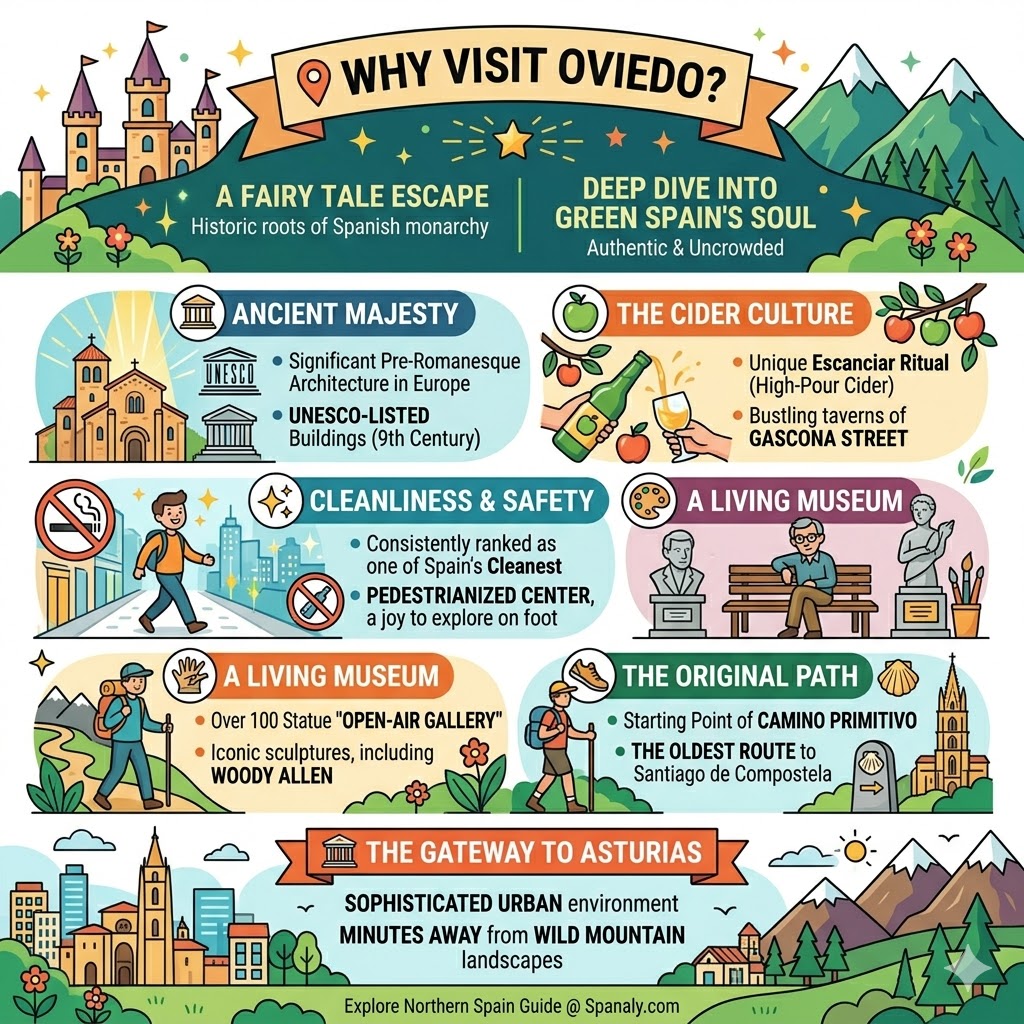
Oviedo is often described as a city pulled straight from a fairy tale, offering an authentic escape from the more crowded tourist hubs. It provides a deep dive into the roots of the Spanish monarchy and the ancient soul of España Verde.
Here is why this Asturian capital deserves a top spot on your itinerary:
Ancient Majesty: Home to the most significant Pre-Romanesque architecture in Europe, these UNESCO-listed buildings date back to the 9th century.
The Cider Culture: Experience the unique ritual of escanciar (high-pour cider) in the bustling taverns of Gascona Street.
Cleanliness and Safety: Consistently ranked as one of the cleanest cities in Spain, its pedestrianized center is a joy to explore on foot.
A Living Museum: The city is famous for its “open-air gallery” of over 100 statues, including the iconic life-sized sculpture of Woody Allen.
The Original Path: It marks the starting point of the Camino Primitivo, the oldest route leading to the Cathedral of Santiago de Compostela.
🏛️ The Gateway to Asturias
Visiting Oviedo allows you to immerse yourself in a sophisticated urban environment while remaining minutes away from wild mountain landscapes. To understand why this region stands out from the rest of the country, explore our guide on why visit Spain to see how the northern “Green Spain” provides a refreshing contrast to the sunny south.
Spanaly Insight: Many visitors overlook the city’s hidden squares. Head to Plaza de Trascorrales at dusk; the golden lighting against the colorful buildings creates a magical atmosphere that most guidebooks fail to mention.
🏰 Top 5 Must-See Landmarks (The Icons)
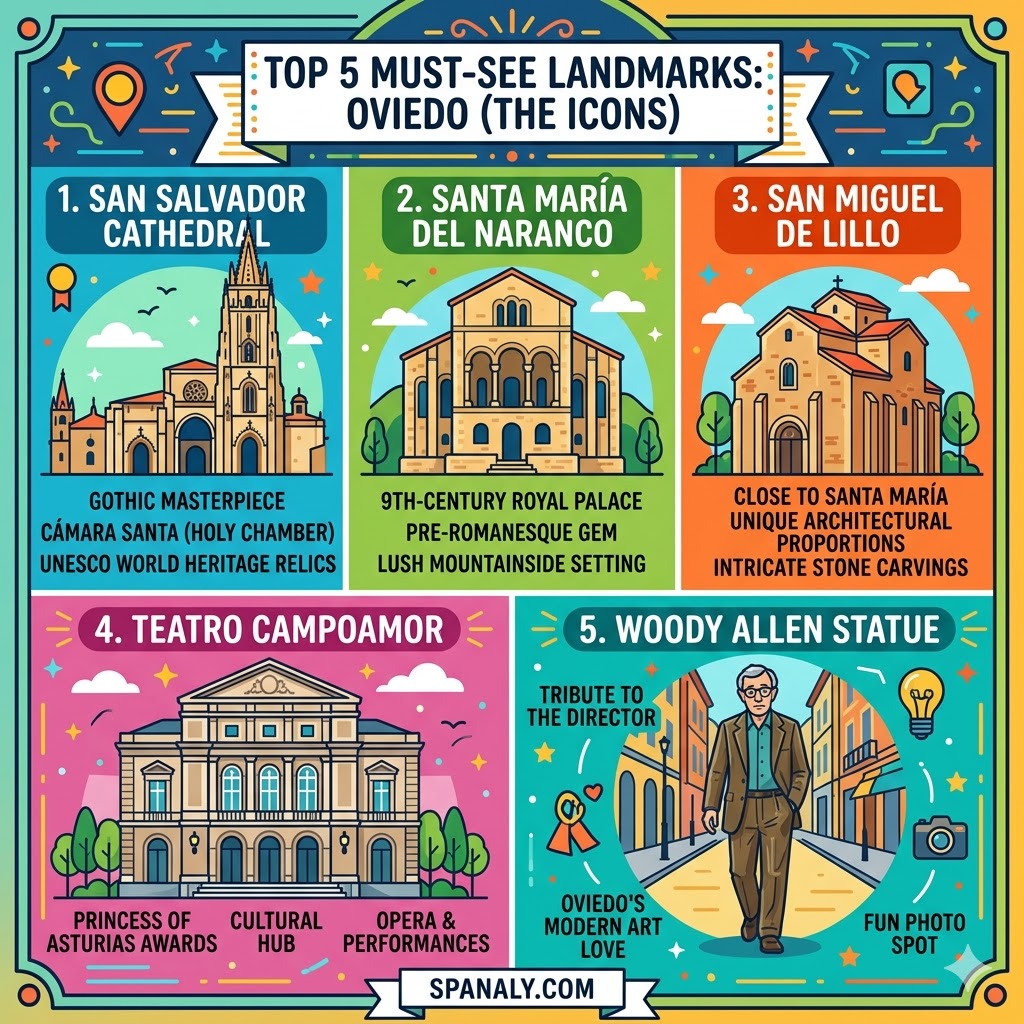
Oviedo is a city defined by its stone monuments and royal history. To truly understand its soul, you must visit these five iconic landmarks that represent the pinnacle of Asturian heritage.
San Salvador Cathedral: This Gothic masterpiece houses the Holy Chamber (Cámara Santa), a UNESCO World Heritage site containing sacred relics like the Victory Cross.
Santa María del Naranco: Originally a royal palace built in the 9th century, this building is the crown jewel of Pre-Romanesque architecture in Spain.
San Miguel de Lillo: Located just steps from Santa María, this church features intricate stone carvings and unique architectural proportions from the early Asturian monarchy.
Teatro Campoamor: An elegant 19th-century theater famous for hosting the prestigious Princess of Asturias Awards, drawing global icons to the city.
The Woody Allen Statue: A tribute to the director who made Oviedo famous worldwide; it stands as a symbol of the city’s modern, art-loving personality.
🏛️ Deep Dive into Spanish History
These landmarks are not just buildings; they are the physical remains of the Kingdom of Asturias, the birthplace of modern Spain. If you are fascinated by such monumental history, our guide to the most famous Spanish Attractions will show you how Oviedo’s icons rank alongside the Alhambra or the Sagrada Familia.
🎨 Hidden Gems & Local Secrets (The Spanaly Edge)
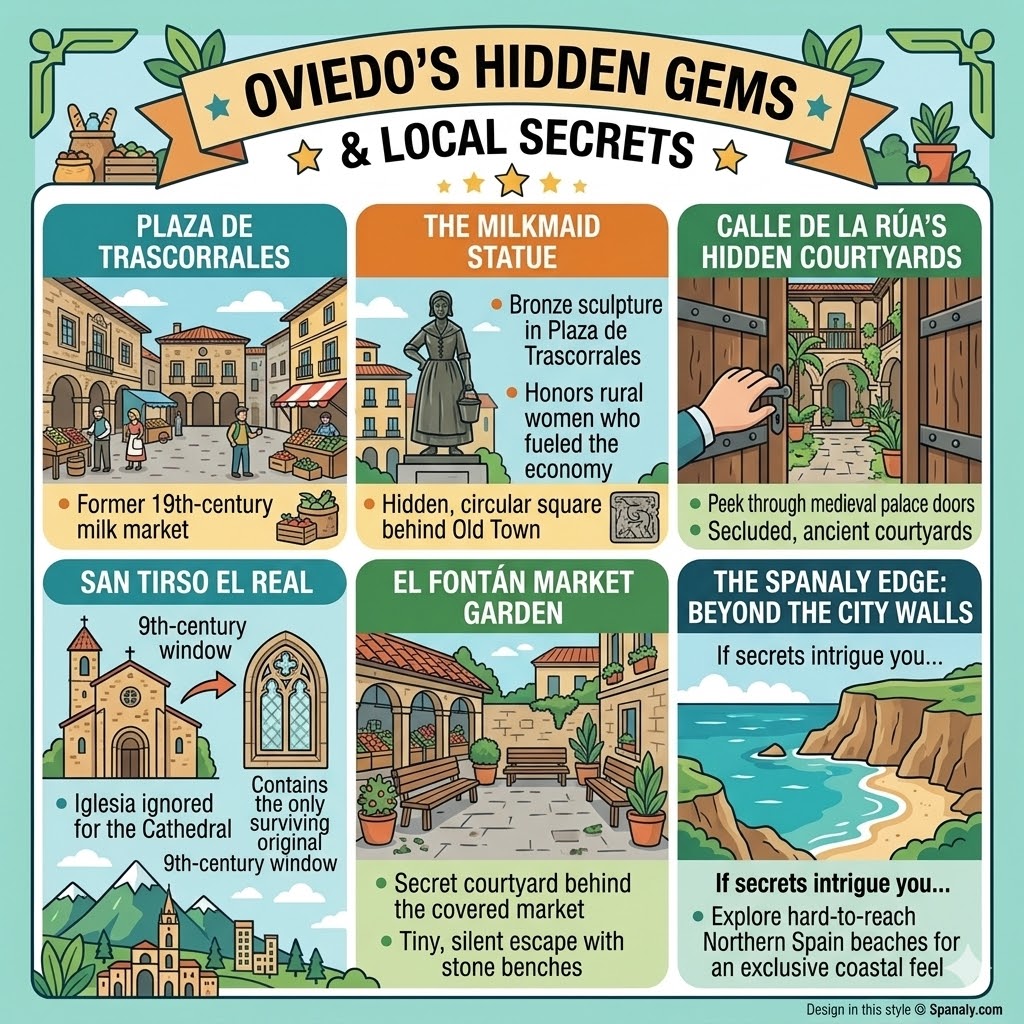
To find the true soul of Oviedo, you must step away from the Cathedral’s shadow. These “hidden gems” are the spots locals cherish but rarely share with the average tourist.
Plaza de Trascorrales: Once a 19th-century milk market, this circular hidden square is tucked behind the Old Town buildings.
The Milkmaid Statue: Look for the bronze La Lechera in Trascorrales; it honors the rural women who fueled the city’s early economy.
Calle de la Rúa’s Hidden Courtyards: Peek through the open heavy wooden doors of the medieval palaces to see secluded Asturian courtyards.
San Tirso el Real: Often ignored for its larger neighbor, this church contains the only surviving 9th-century window from the original Pre-Romanesque city.
El Fontán Market Garden: Behind the famous covered market lies a tiny, silent courtyard where locals sit on stone benches to escape the shopping rush.
🗺️ Beyond the City Walls
If these secret spots ignite your curiosity for the “unknown,” expand your horizon. Our guide to hard-to-reach beaches in Spain will lead you to coastal gems in the north that feel just as exclusive as Oviedo’s hidden squares.
Spanaly Insight: Most people take the main road to Mount Naranco. Instead, find the “Pista Finlandesa” a flat, lush woodland trail used by locals for jogging that offers a unique, ground-level view of the city’s green belt.
🥘 Asturias Cuisine in Oviedo: Best Places for Cider and Fabada
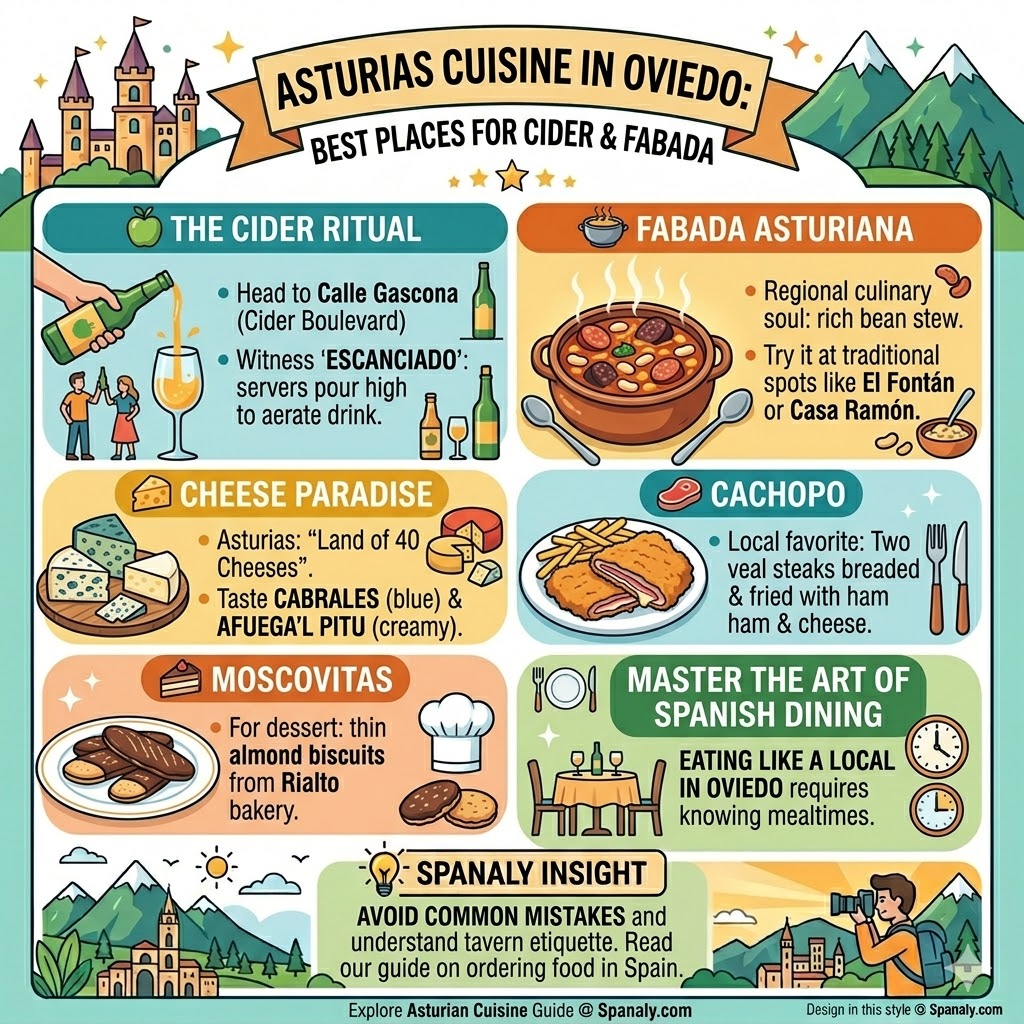
Dining in Oviedo is a sensory ritual where the sound of cider hitting the glass is as vital as the flavor. The city serves as the heart of Asturian gastronomy, offering rustic dishes that satisfy the soul.
🍏 The Cider Ritual: Head to Calle Gascona (Cider Boulevard) and visit legendary spots like Tierra Astur or La Pumarada to witness the escanciado.
🥘 Fabada Asturiana: Savor this rich bean stew at Casa Ramón in the historic Plaza del Fontán, where traditional recipes remain king.
🧀 Cheese Paradise: Sample intense Cabrales or creamy Afuega’l Pitu at the artisan stalls of Mercado El Fontán.
🥩 The Cachopo Challenge: Try this local favorite of breaded veal and ham at Sidrería El Ferroviario for an authentic Asturian experience.
🍪 Moscovitas: Visit the legendary Rialto bakery to grab these thin, chocolate-covered almond biscuits—the city’s most famous sweet.
📖 Master the Art of Spanish Dining Eating like a local requires knowing the unique rhythm of Asturian mealtimes. To avoid common mistakes and understand tavern etiquette, read our Guide how to order food like a local in Spain.
Spanaly Insight: When drinking cider, never pour it yourself; wait for the waiter to do it. Drink the small amount (the culín) immediately while it’s still sparkling to enjoy the full flavor profile.
🚌 How to Get to Oviedo: Transport from Asturias Airport and Madrid
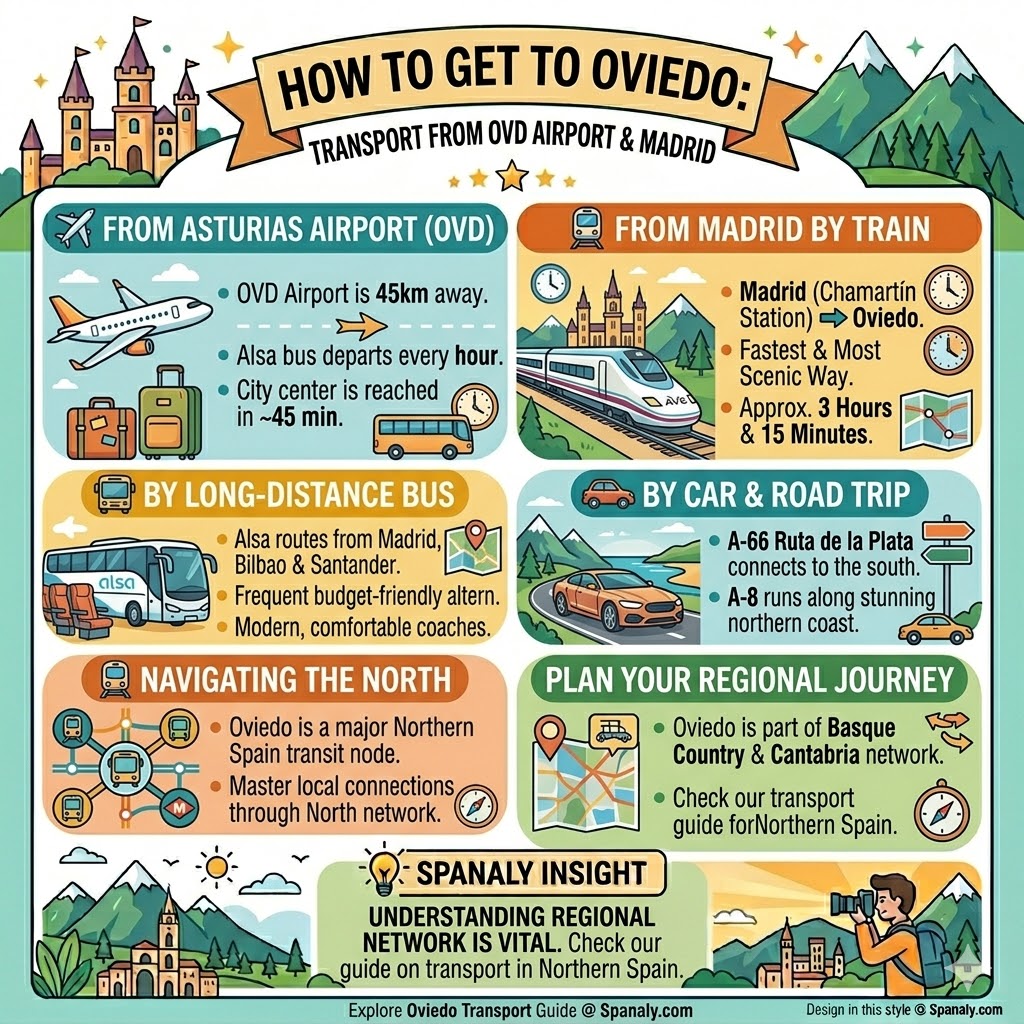
Getting to Oviedo is straightforward, whether you are arriving from international hubs or traveling within the northern coast. The city is a major transit node for North Spain, making it highly accessible.
✈️ From Asturias Airport (OVD): The airport is located 45km away. The “Alsa” bus departs every hour, reaching the city center in about 45 minutes.
🚆 From Madrid by Train: The high-speed AVE train connects Madrid (Chamartín Station) to Oviedo in approximately 3 hours and 15 minutes. It is the fastest and most scenic way to arrive.
🚌 By Long-Distance Bus: Alsa operates frequent routes from Madrid, Bilbao, and Santander. This is a budget-friendly alternative with modern, comfortable coaches.
🚗 By Car: If you are on a road trip, the A-66 (Ruta de la Plata) connects Oviedo to the south, while the A-8 runs along the stunning northern coast.
🚇 Navigating the North
If Oviedo is just one stop on your journey through the Basque Country and Cantabria, understanding the regional network is vital. Check our specific guide on transport in Northern Spain to master the local train and bus connections between major cities.
Spanaly Insight: If you arrive at the airport, don’t take a taxi unless you are in a massive rush; they can be quite expensive. The airport bus is incredibly reliable, drops you at the central station, and costs a fraction of the price.
🏨 Where to Stay in Oviedo: Best Neighborhoods and Hotels
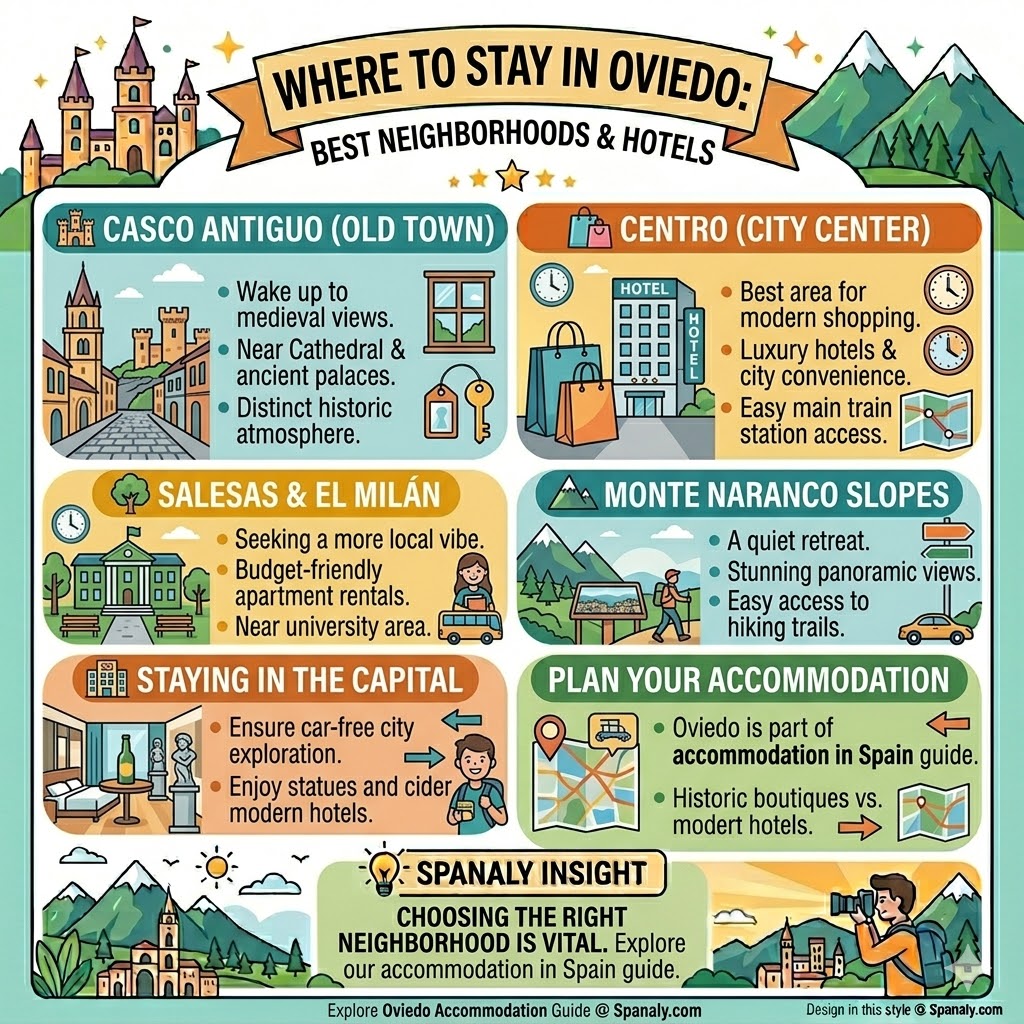
Choosing the right base in Oviedo depends on whether you want to wake up to medieval views or enjoy modern convenience. The city is compact, but each district offers a distinct atmosphere.
🏰 Casco Antiguo (Old Town): Stay at Hotel de la Reconquista or Eurostars Hotel de la Reconquista to be steps away from the San Salvador Cathedral and ancient palaces.
🛍️ Centro (City Center): Book a room at Barceló Oviedo Cervantes or NH Oviedo Principado for high-end shopping on Calle Uría and easy access to the main train station.
🌳 Salesas & El Milán: Ideal for a local vibe; look for apartments near Campus del Milán or stay at Hotel ibis Oviedo for a budget-friendly option near the university area.
🏔️ Monte Naranco Slopes: Choose Castillo del Bosque La Zoreda (located just a short drive away) or local rural villas for a quiet retreat with stunning panoramic views.
🛌 Staying in the Capital Selecting the right neighborhood ensures you can explore the city’s statues and cider houses on foot. For more tips on choosing between historic boutique stays and modern hotels, see our Guide accommodation in Spain.
Spanaly Insight: If you are a light sleeper, avoid staying directly on Calle Gascona. While iconic, the late-night cider pouring and social buzz at taverns like Tierra Astur can be quite loud well into the early hours.
🌦️ Best Time to Visit Oviedo: Weather and Local Festivals
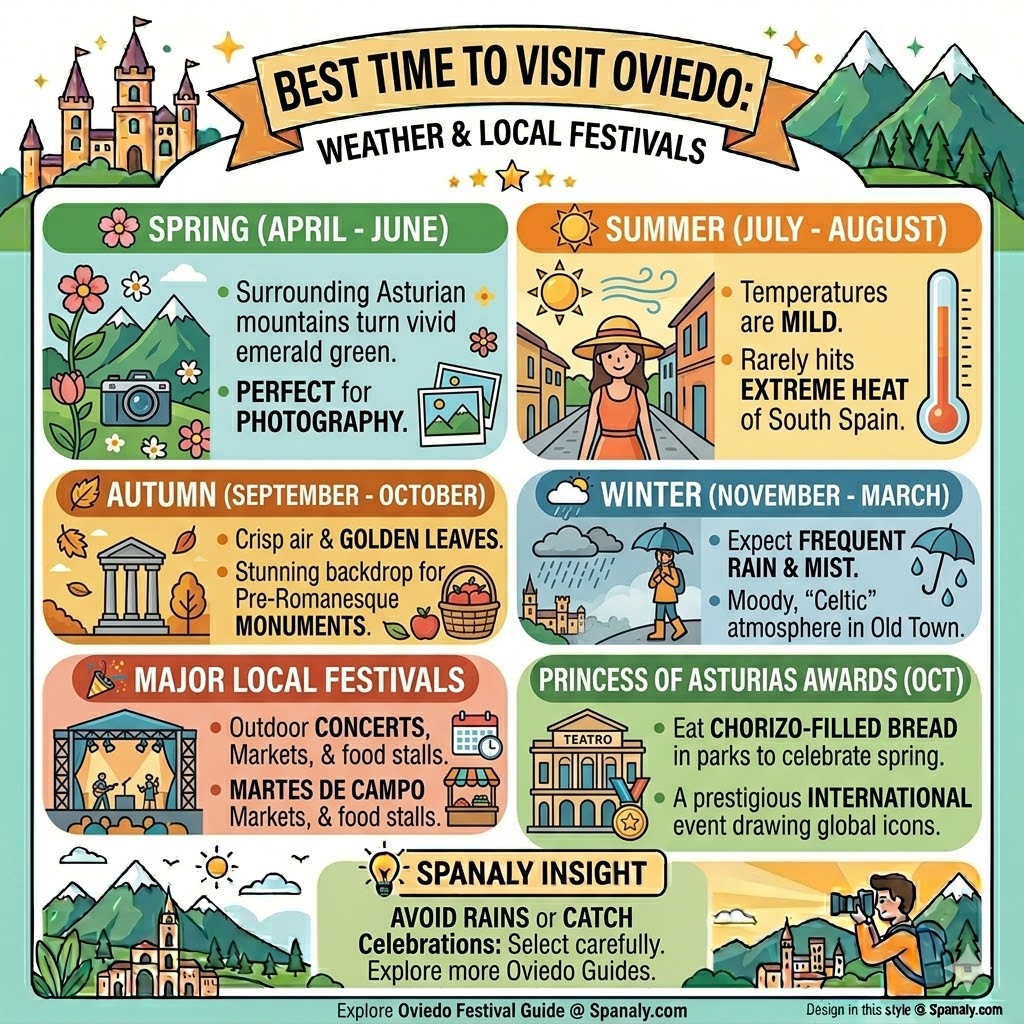
Oviedo’s charm shifts with the seasons, but timing your visit is crucial to avoid the heaviest rains or to catch the city’s most vibrant cultural celebrations.
🌸 Spring (April – June): The surrounding Asturian mountains turn a vivid emerald green, making it perfect for photography.
☀️ Summer (July – August): Temperatures are mild and rarely hit the extreme heat found in Southern Spain.
🍂 Autumn (September – October): Crisp air and golden leaves provide a stunning backdrop for the Pre-Romanesque monuments.
🌦️ Winter (November – March): Expect frequent rain and mist, which creates a moody, “Celtic” atmosphere in the Old Town.
🎉 Major Local Festivals
Fiestas de San Mateo (September): The city’s biggest celebration, featuring outdoor concerts, traditional markets, and “chiringuitos” (food stalls) in the plazas.
Martes de Campo (May): Also known as “Bollu” Tuesday, locals head to the parks to eat chorizo-filled bread and celebrate spring.
Princess of Asturias Awards (October): A prestigious international event that brings global intellectual and artistic icons to the Teatro Campoamor.
📅 Seasonal Strategy
If you prefer dry weather for hiking and coastal day trips, late spring to early autumn is your best window. To understand how the northern climate differs from the rest of the peninsula, consult our guide on the best time to visit Northern Spain to plan your regional route perfectly.
🎭 Culture & Art: The Open-Air Museum
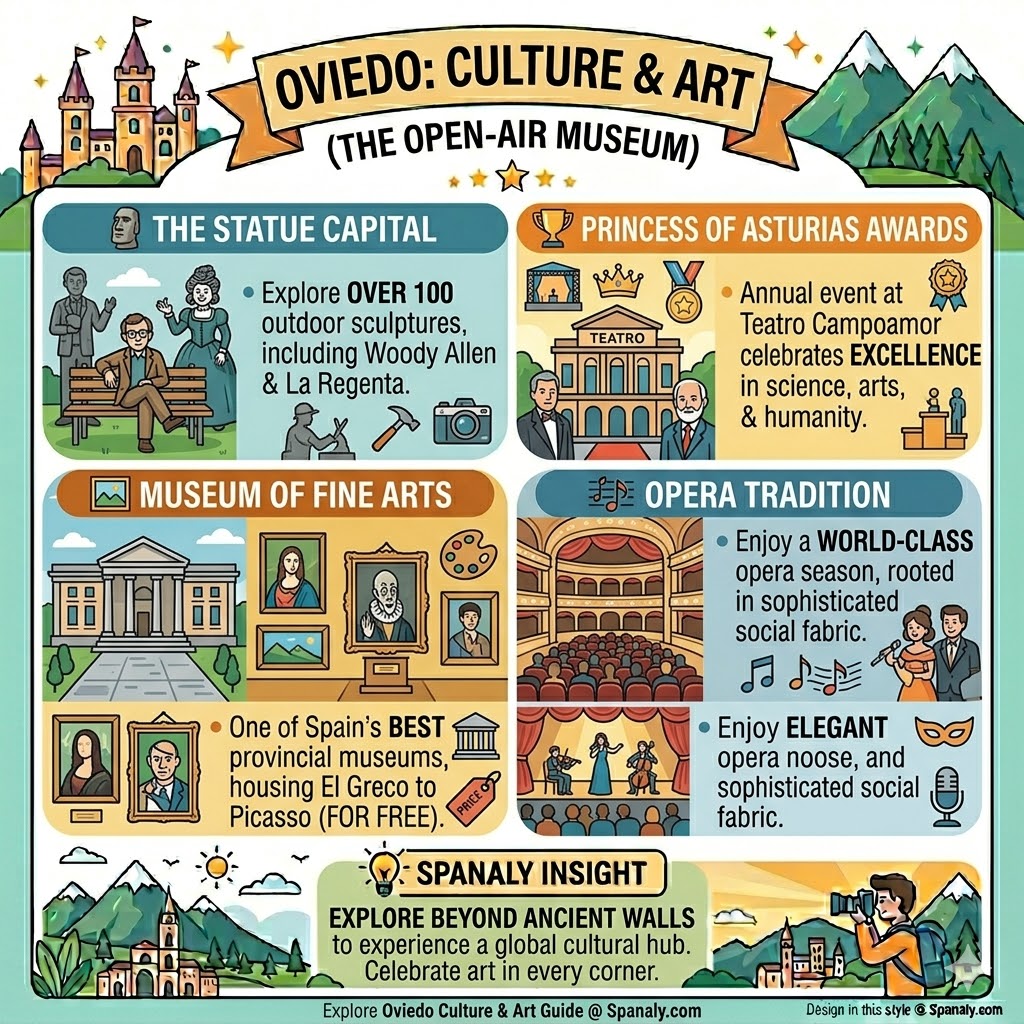
Oviedo is a city that breathes art, transforming every street corner into a gallery. Beyond its ancient walls, it is a global cultural hub known for its prestigious ceremonies and unique public sculptures.
🗿 The Statue Capital: Explore over 100 outdoor sculptures, including the life-sized Woody Allen and the quirky La Regenta.
🏆 Princess of Asturias Awards: This annual event at Teatro Campoamor celebrates global excellence in science, arts, and humanity.
🖼️ Museum of Fine Arts of Asturias: Visit one of Spain’s best provincial museums, housing works from El Greco to Picasso for free.
🎼 Opera Tradition: Enjoy a world-class opera season, a tradition deeply rooted in the city’s sophisticated social fabric.
🏛️ Cultural Context
The artistic depth of Oviedo is a testament to its role as a historic capital. If you are passionate about Spain’s grandest cultural landmarks, our guide to major Spanish festivals highlights how Asturian traditions stand alongside the country’s most famous celebrations.
Spanaly Insight: Don’t just look at the statues; look for the “Mafalda” sculpture in San Francisco Park. It is a favorite for locals and offers a perfect, whimsical photo opportunity that captures the city’s approachable artistic spirit.
🗺️ Day Trips from Oviedo: Gijón, Avilés, and Picos de Europa
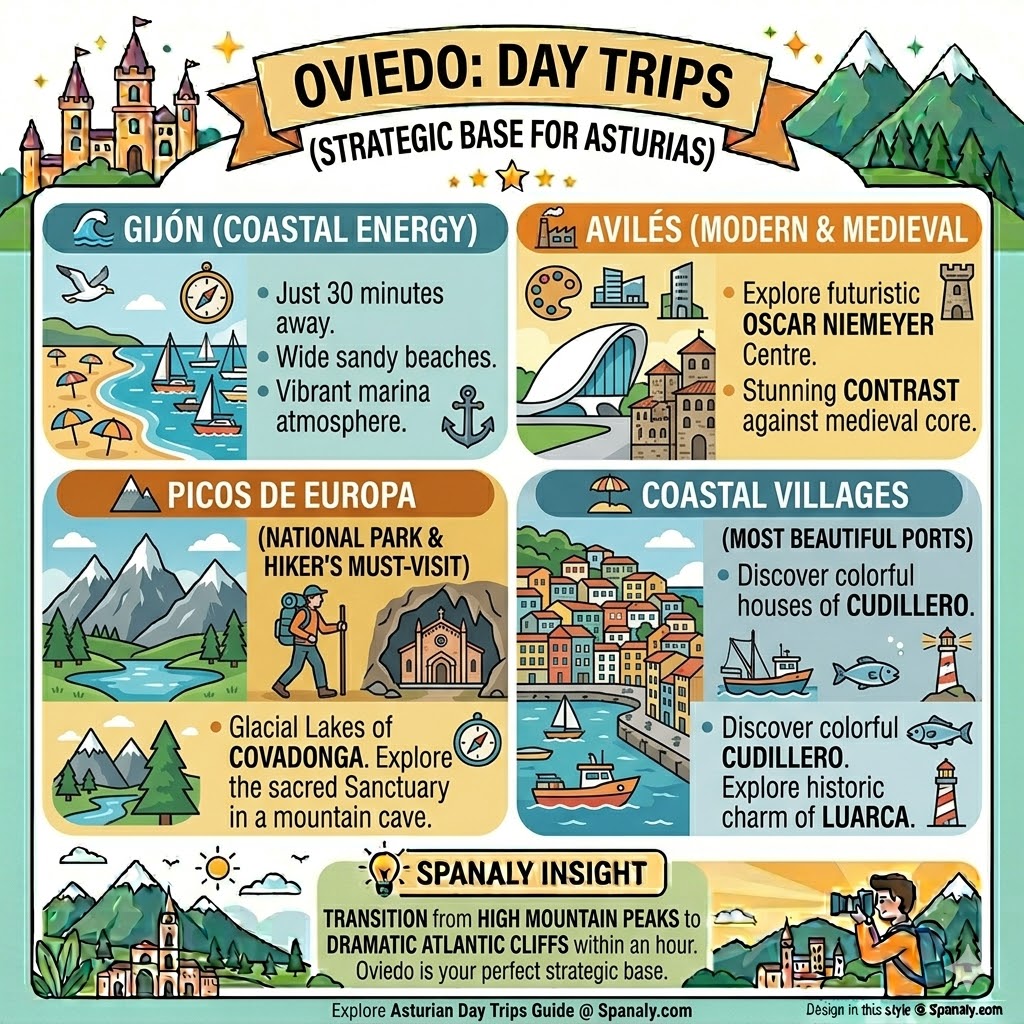
Oviedo serves as the perfect strategic base for exploring the diverse landscapes of Asturias. Within an hour, you can transition from high mountain peaks to dramatic Atlantic cliffs.
🌊 Gijón: Just 30 minutes away, this coastal city offers wide sandy beaches and a vibrant marina atmosphere.
🏭 Avilés: Visit the futuristic Oscar Niemeyer International Cultural Centre, which creates a stunning contrast against the city’s medieval core.
🏔️ Picos de Europa National Park: A must-visit for hikers; explore the glacial Lakes of Covadonga and the sacred Sanctuary hidden in a mountain cave.
🏖️ Coastal Villages: Discover the colorful houses of Cudillero or the historic charm of Luarca, often cited as the most beautiful ports in Northern Spain.
🚗 Planning Your Excursions
Most of these destinations are reachable via the local train network, but a car offers the freedom to find hidden viewpoints. If you are planning a coastal adventure, our Northern Spain road trip guide provides the best routes to connect these iconic stops.
🎒 Oviedo Itinerary: How to Spend 1 or 2 Days
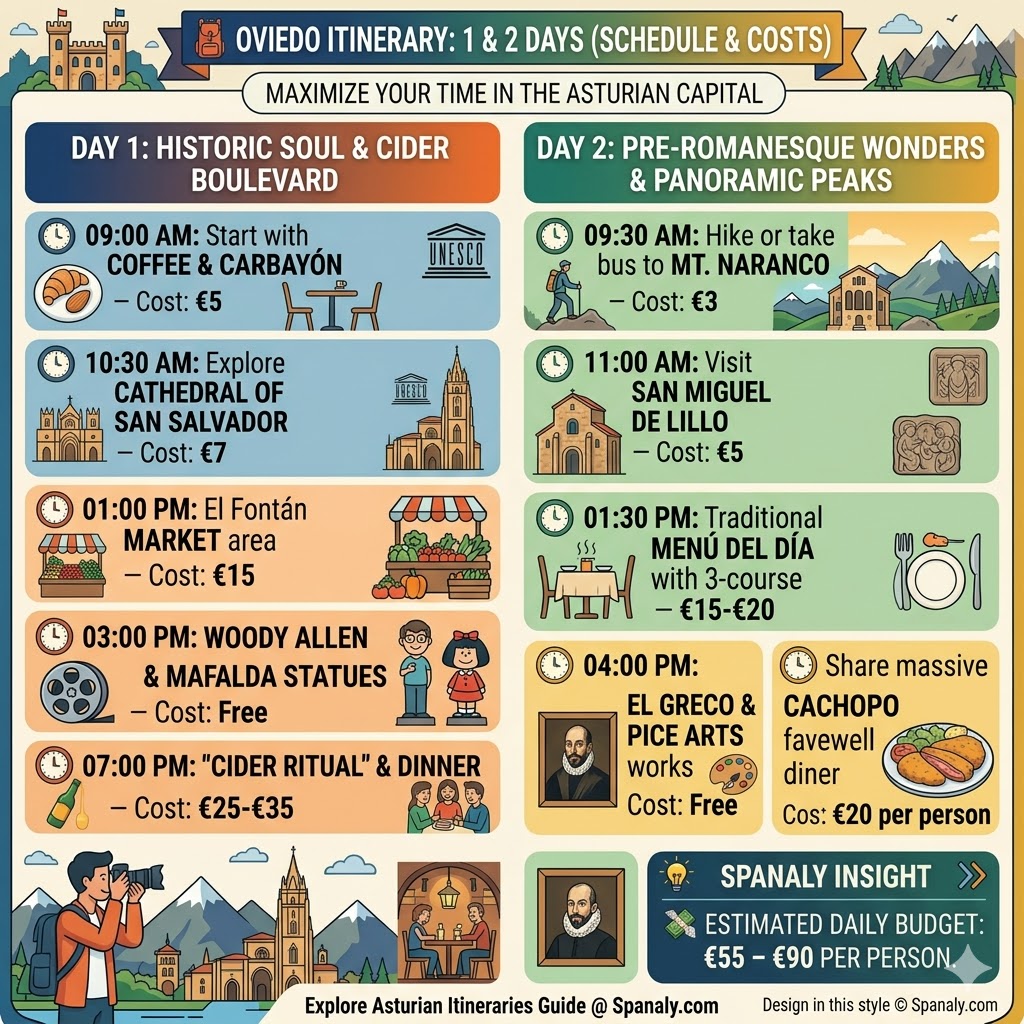
Maximize your time in the Asturian capital with this structured plan. We have integrated estimated costs directly into the schedule to help you manage your Spain travel itineraries and plans with expert precision.
Day 1: The Historic Soul & The Cider Boulevard
09:00 AM: Start with a coffee and a Carbayón (almond pastry) at a local bakery — Cost: €5.
10:30 AM: Explore the Cathedral of San Salvador and the UNESCO-listed Holy Chamber — Cost: €7.
01:00 PM: Lunch at the colorful El Fontán Market area for authentic tapas — Cost: €15.
03:00 PM: Wander through the Old Town to find the Woody Allen and Mafalda statues — Cost: Free.
07:00 PM: Experience the “high pour” cider ritual and dinner on Calle Gascona — Cost: €25-€35.
Day 2: Pre-Romanesque Wonders & Panoramic Peaks
09:30 AM: Take the local bus or hike up Mount Naranco to see Santa María del Naranco — Cost: €3.
11:00 AM: Visit San Miguel de Lillo to see its rare 9th-century stone carvings — Cost: €5.
01:30 PM: Enjoy a traditional Menú del Día (three-course lunch) near the city center — Cost: €15-€20.
04:00 PM: Visit the Museum of Fine Arts of Asturias to see works by El Greco and Picasso — Cost: Free.
08:00 PM: Share a massive Cachopo (breaded veal and ham) for your farewell dinner — Cost: €20 per person.
💡 Spanaly Tips: Insider Secrets for a Perfect Trip
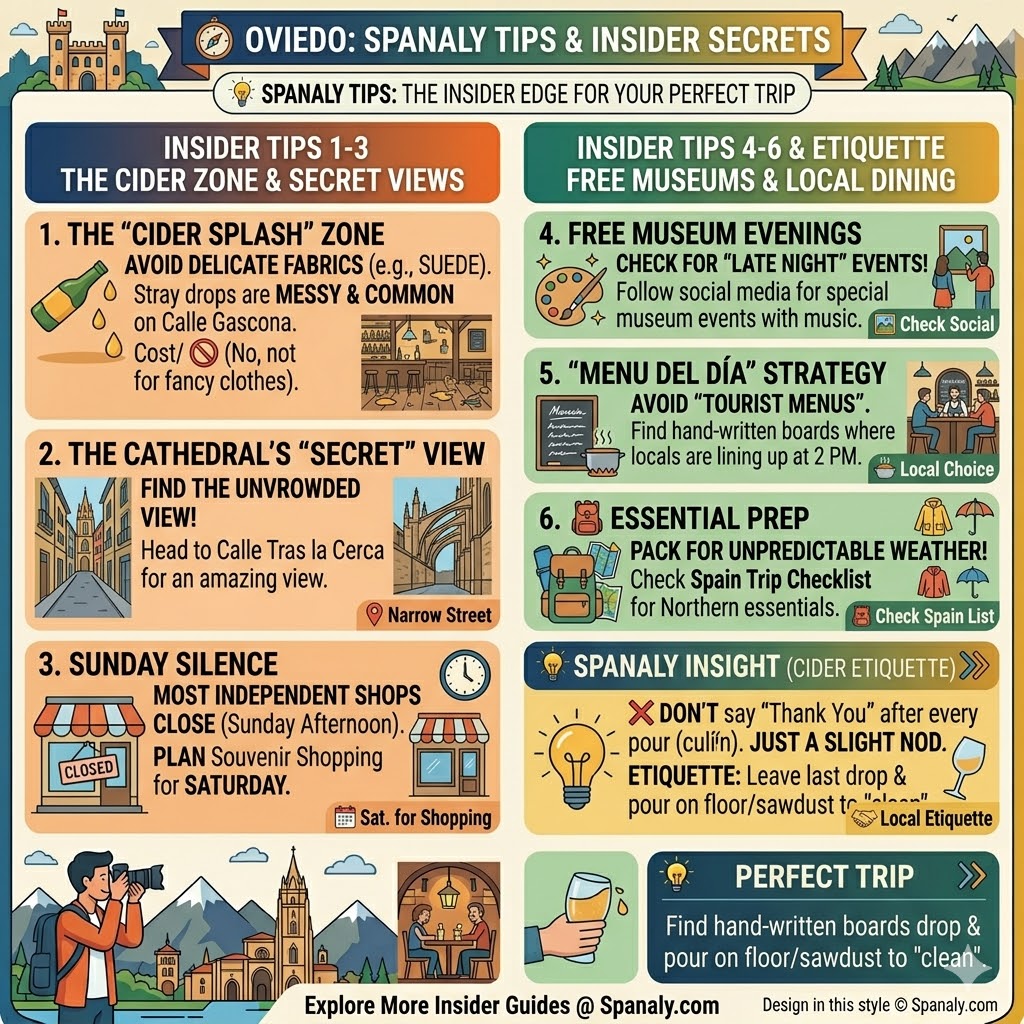
To give your journey the “Spanaly Edge,” I’ve gathered these elite tips from local discussions and travel subreddits. These are the small details that transform a good trip into an unforgettable one.
The “Cider Splash” Zone: When visiting Calle Gascona, avoid wearing suede or delicate fabrics. The ritual of escanciar is messy by design, and stray drops of cider are a badge of honor you might not want on your expensive jacket.
The Cathedral’s “Secret” View: Instead of just looking at the Cathedral from the front, head to the narrow Calle Tras la Cerca. You will get a breathtaking, uncrowded view of the flying buttresses that looks like a scene from a dark fantasy novel.
Sunday Silence: Most of Oviedo’s independent shops and even some cider houses close on Sunday afternoons. Plan your “shopping for souvenirs” or specific dining experiences for Saturday to avoid wandering into a sleepy city.
Free Museum Evenings: While the Museum of Fine Arts is generally free, always check their temporary exhibition schedule on social media. They often host “Late Night” events with live music that are never advertised on major tourism boards.
The “Menu del Día” Strategy: In Oviedo, the lunch deal is sacred. Avoid any place with a “Tourist Menu” sign. Look for the handwritten chalkboards where locals are lining up at 2:00 PM; that is where you will find the best Fabada for under €15.
🎒 Essential Prep
Before you head out to test these secrets, make sure your bags are packed for the unpredictable Asturian weather. Check our Spain trip checklist to ensure you haven’t forgotten any essentials for the northern climate.
Spanaly Insight: If you want to impress a local cider pourer, don’t say “Thank you” after every culín (pour). Just a slight nod is enough. The real etiquette is to leave the last tiny drop in the glass and pour it out on the floor (or the sawdust/trough) to “clean” the glass for the next round.
🛡️ Visitor FAQs – Oviedo Travel Guide
🛡️ Is Oviedo safe to explore alone late at night?
🚲 Can I rent a bike to visit the Pre-Romanesque churches on Mount Naranco?
💧 Is the tap water in Oviedo safe to drink?
🥘 How do I handle food allergies like Gluten or Dairy in Oviedo?
🏰 Is the city accessible for travelers with mobility issues?
Oviedo Guide by Spanaly.com
Oviedo isn’t just a destination; it is a living bridge between Spain’s royal origins and its vibrant, modern pulse. From the silent majesty of 9th-century stone walls to the rhythmic splash of cider in a local tavern, this city leaves a lasting mark on every soul.
🏛️ Historic Depth: You have walked through the birthplace of the Spanish monarchy and stood before UNESCO wonders.
🍏 Sensory Delight: You have mastered the art of the cider pour and tasted the richest stews in the north.
🎨 Artistic Spirit: You have explored a city that treats its streets like a grand, open-air art gallery.
🌿 Gateway to Nature: You have seen how perfectly urban sophistication blends with the wild, green mountains of Asturias.
🛫 Continuing Your Northern Adventure If Oviedo is your first stop in Green Spain, you might be planning to fly out or head toward other regional hubs. To ensure a smooth transition, check our Santiago de Compostela Airport (SCQ) Guide for expert tips on navigating the north’s most important travel gateway.