Table of Contents
Toggle⚔️ Master the Best Things to Do in Ronda
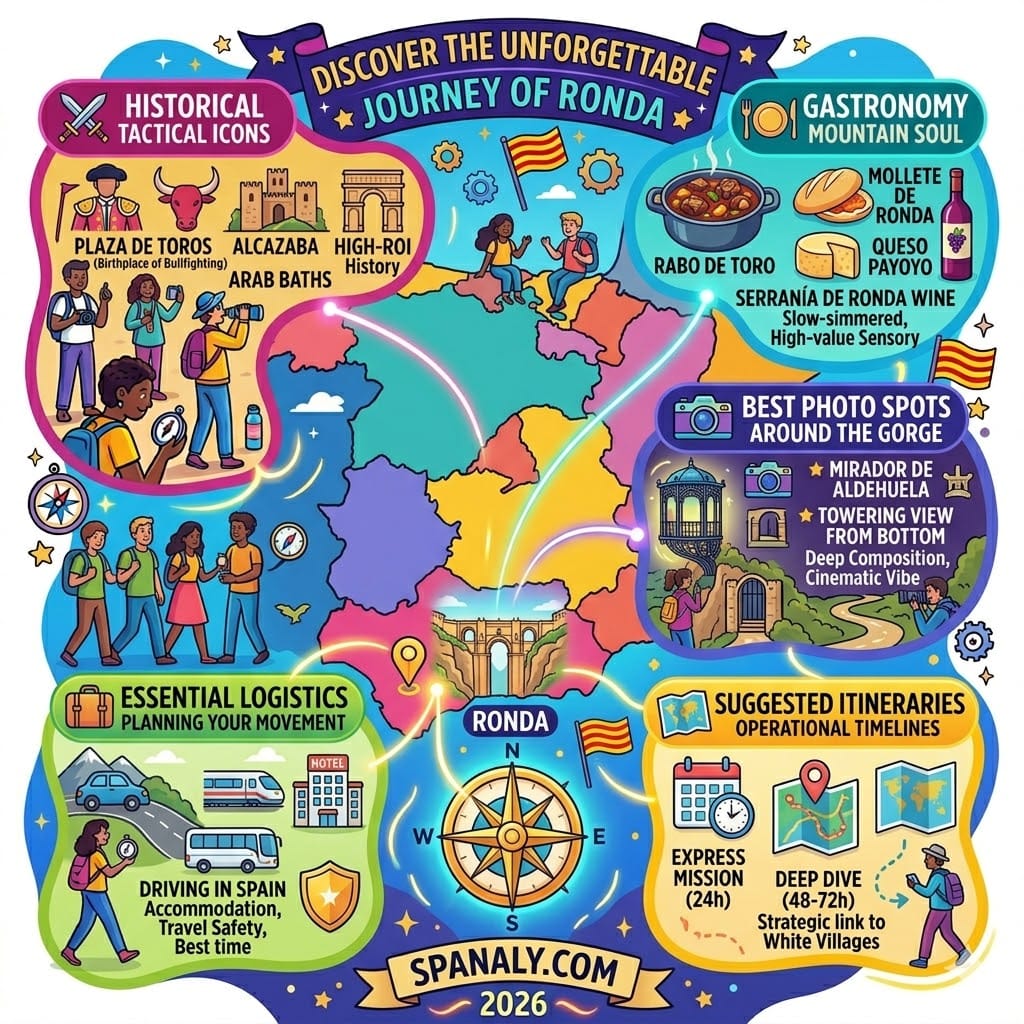
If you are hunting for the absolute best things to do in Ronda, your journey begins at the edge of a 120-meter limestone chasm. In fact, this cliffside Andalusian gem is much more than a scenic stopover; it is a dramatic cultural powerhouse where Roman history, Moorish legends, and the world’s oldest bullring collide. Consequently, to truly capture its soul, you must look beyond the famous bridges and discover the hidden gardens and ancient secrets carved into the rock.
✨ The Vibe Check
The Energy: Intense, dramatic, and deeply romantic.
The Look: White-washed houses perched precariously on sheer cliffs above a massive gorge.
The Experience: Walking across architectural marvels while feeling the raw power of the Tajo canyon.
📊 Travel Briefing: Ronda at a Glance
| Feature | Expert Recommendation |
| Primary Objective | Crossing the Puente Nuevo and exploring the Tajo Gorge. |
| Main Highlight | Descending the Water Mine at the Moorish King’s House. |
| Logistics Score | 8/10 (Compact city; best accessed by car or bus from Seville/Malaga). |
| Culinary Reward | High. Target the Rabo de Toro (Oxtail) and local mountain wines. |
| Ideal Duration | 24h for the icons; 48h-72h for a complete regional immersion. |
💡 Spanaly Insight: Specifically, if you want to master the surrounding white villages and deep mountain trails, we highly recommend consulting our Ultimate Ronda Travel Guide. Indeed, it provides the perfect tactical structure for those who want a rewarding, high-value adventure beyond the main tourist paths.
📍 Why Visit Ronda? The Strategic Advantage
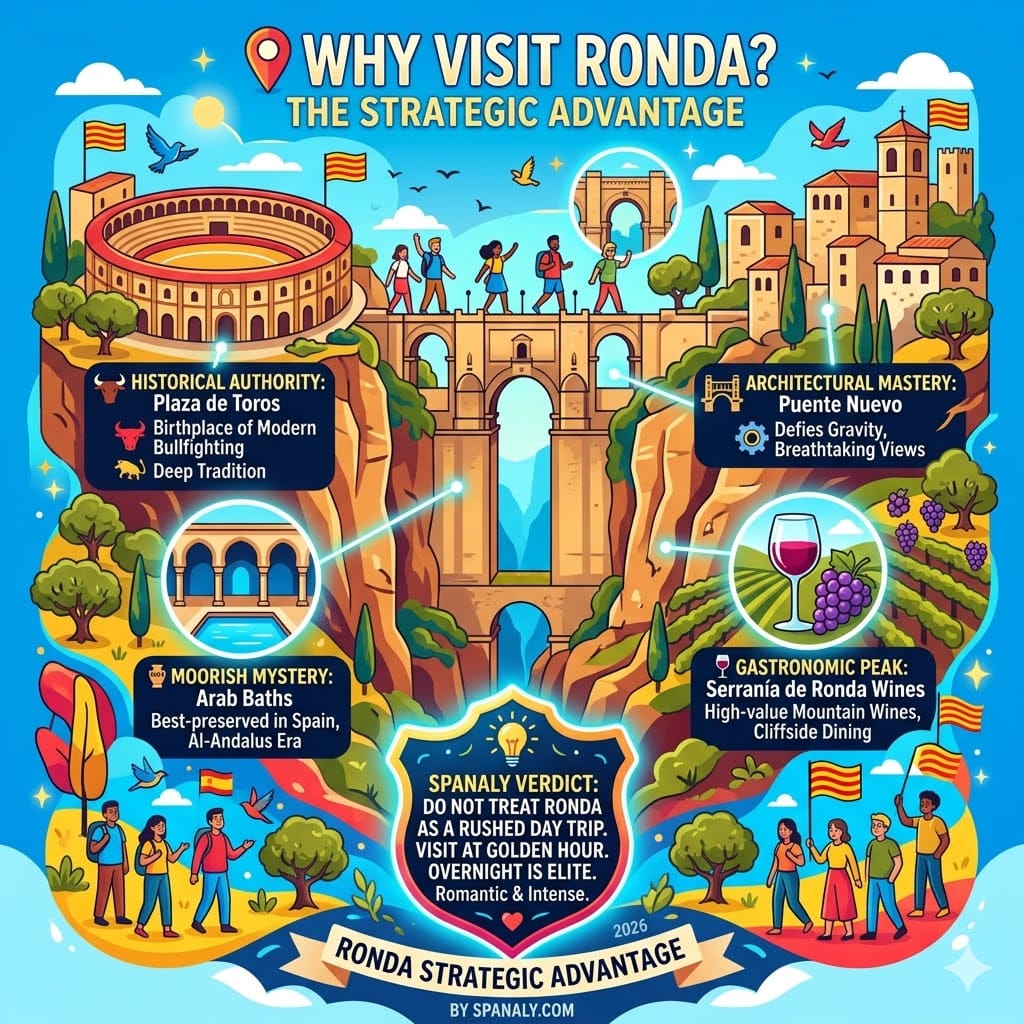
Mastering the best things to do in Ronda provides a level of dramatic beauty that very few cities in the world can replicate. While many tourists visit as a quick stop from the coast, in fact, Ronda stands as a true powerhouse of Andalusian culture and geological wonder.
🌉 Architectural Mastery: It features the Puente Nuevo, an 18th-century stone bridge that defies gravity. Specifically, standing in the center of this marvel offers a breathtaking view of the Tajo Gorge that is simply incomparable.
🐂 Historical Authority: As the birthplace of modern Spanish bullfighting, the city vibrates with a deep sense of tradition. Consequently, exploring the Plaza de Toros is a mandatory experience for anyone seeking the “DNA” of Spain.
🏺 Moorish Mystery: Home to the best-preserved Arab Baths in Spain, Ronda offers a profound immersion into the Al-Andalus era. Therefore, walking its ancient water mines is an essential journey for history enthusiasts.
🍷 Gastronomic Peak: Additionally, the surrounding Serranía de Ronda produces some of Spain’s most high-value mountain wines. Indeed, dining at a cliffside tavern is a rewarding experience that stays with you forever.
💡 Spanaly Verdict: Ultimately, do not treat Ronda as a rushed day trip. Its true magic is revealed during the “Golden Hour” when the limestone cliffs turn deep orange. In fact, for an elite experience, you should stay overnight. Specifically, once the tour buses depart, the city’s romantic and intense atmosphere becomes much more rewarding.
🏛️ Top 5 Must-See Landmarks: The Icons of Ronda
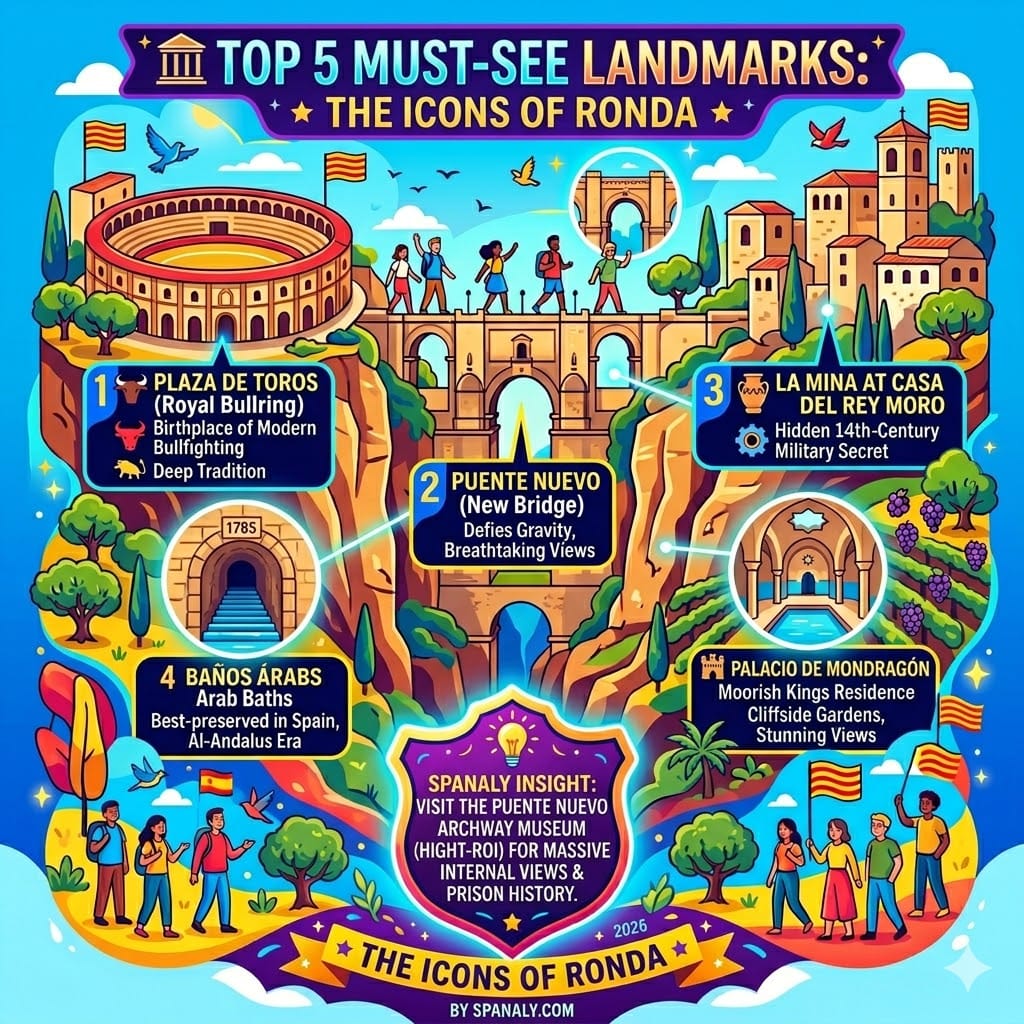
To truly appreciate the best things to do in Ronda, you should focus your journey on these five legendary landmarks. Furthermore, for a deeper understanding of the region’s royal and architectural past, these sites are essential components of our comprehensive Spain Historical Monuments Guide.
🌉 Puente Nuevo (The New Bridge):
In fact, this 18th-century stone masterpiece is the definitive symbol of Ronda, spanning the 120-meter deep Tajo Gorge.
Moreover, you should descend the walking paths to the base of the canyon. Consequently, you will capture the most dramatic upward perspective of this gravity-defying feat.
🐂 Plaza de Toros (The Royal Bullring):
Specifically, this is one of the oldest and most beautiful bullrings in Spain, built entirely of stone in 1785.
Therefore, visiting the onsite museum provides a profound look into the equestrian traditions that shaped Andalusian identity.
🏺 La Mina at Casa del Rey Moro:
In essence, this is a hidden 14th-century military secret—a vertical tunnel carved into the rock to reach the river during sieges.
While the 200+ steps are steep, they offer a deep, atmospheric immersion into Ronda’s defensive Moorish history.
🛁 Baños Árabes (Arab Baths):
Interestingly, these are the best-preserved Islamic thermal baths in the entire Iberian Peninsula.
As a result, standing under the star-shaped skylights allows you to witness the architectural genius of the Al-Andalus era.
🏰 Palacio de Mondragón:
Actually, once the residence of Moorish kings, this palace features stunning Mudejar courtyards and water gardens.
Notably, the cliffside balconies offer an exceptional view of the surrounding mountain ranges and white-washed outskirts.
✨ Bonus Highlights Worth Visiting:
Puente Viejo (The Old Bridge): A charming 16th-century crossing that offers a quieter, more intimate perspective of the river.
Jardines de Cuenca: Additionally, these terraced gardens wrap around the cliffside, providing the perfect zone for a panoramic sunset walk.
💡 Spanaly Insight: Ultimately, do not rush your visit to the Puente Nuevo. Indeed, there is a small museum hidden inside the central arch (once a prison). Specifically, it offers a rare internal view of the bridge’s massive structure that most travelers completely overlook.
🎨 Hidden Gems & Local Secrets: The Spanaly Edge
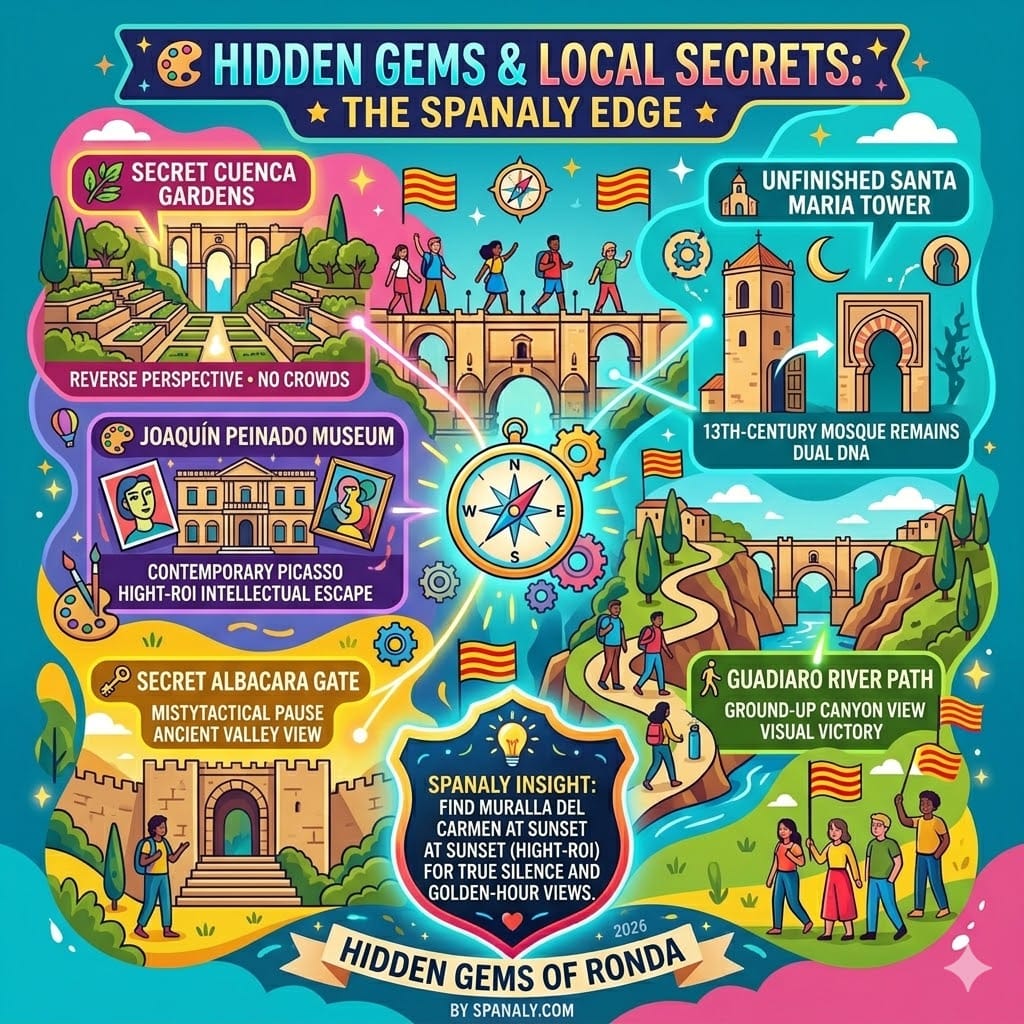
Beyond the cliffside icons, Ronda hides extraordinary “Low-Profile Assets” that offer a much deeper connection to its soul. In fact, to master the true spirit of this mountain fortress, you must look for the stories etched into its quieter corners.
🌿 The Secret Gardens of Cuenca (Night View):
While many walk here during the day, the real magic happens at dusk.
Specifically, these terraced gardens offer a “Reverse Perspective” of the Puente Nuevo. Consequently, you avoid the main bridge crowds and secure a silent, panoramic victory over the horizon.
⛪ The Unfinished Tower of Santa Maria la Mayor:
Interestingly, this church was built over a 13th-century mosque.
Instead of just looking at the facade, search for the original Arabic mihrab inside. Indeed, it is a rare, high-value glimpse into the city’s dual spiritual DNA that most visitors overlook.
🗝️ The Secret Gate of Albacara:
Notably, tucked away at the bottom of the Old Town, this massive stone gate once protected the city’s productive valley.
Actually, standing here gives you a visceral sense of Ronda’s defensive supremacy. Therefore, it is the perfect spot for a quiet “Tactical Pause” away from the urban noise.
🎨 The Joaquín Peinado Museum:
Hidden in the Palacio de los Marqueses de Moctezuma, this gallery is dedicated to a local contemporary of Picasso.
Because it is rarely crowded, it offers a high-ROI intellectual escape. Moreover, the palace itself belongs to the descendants of the Aztec Emperor Moctezuma II.
🚶 The Path to the Guadiaro River:
Specifically, follow the dirt path starting from the Barrio de San Francisco.
It leads to an ancient stone bridge where you can see the canyon from a completely vertical, ground-up perspective. Thus, achieving a visual victory that 99% of tourists miss.
💡 Spanaly Insight: find the “Muralla del Carmen” during sunset. Indeed, while everyone is fighting for a spot on the main bridge, this medieval wall section offers a peaceful, golden-hour view of the olive groves below. Notably, it is the ultimate spot to witness the true silence of Andalusia.
🍽️ Gastronomy: The Mountain Soul of Andalusia
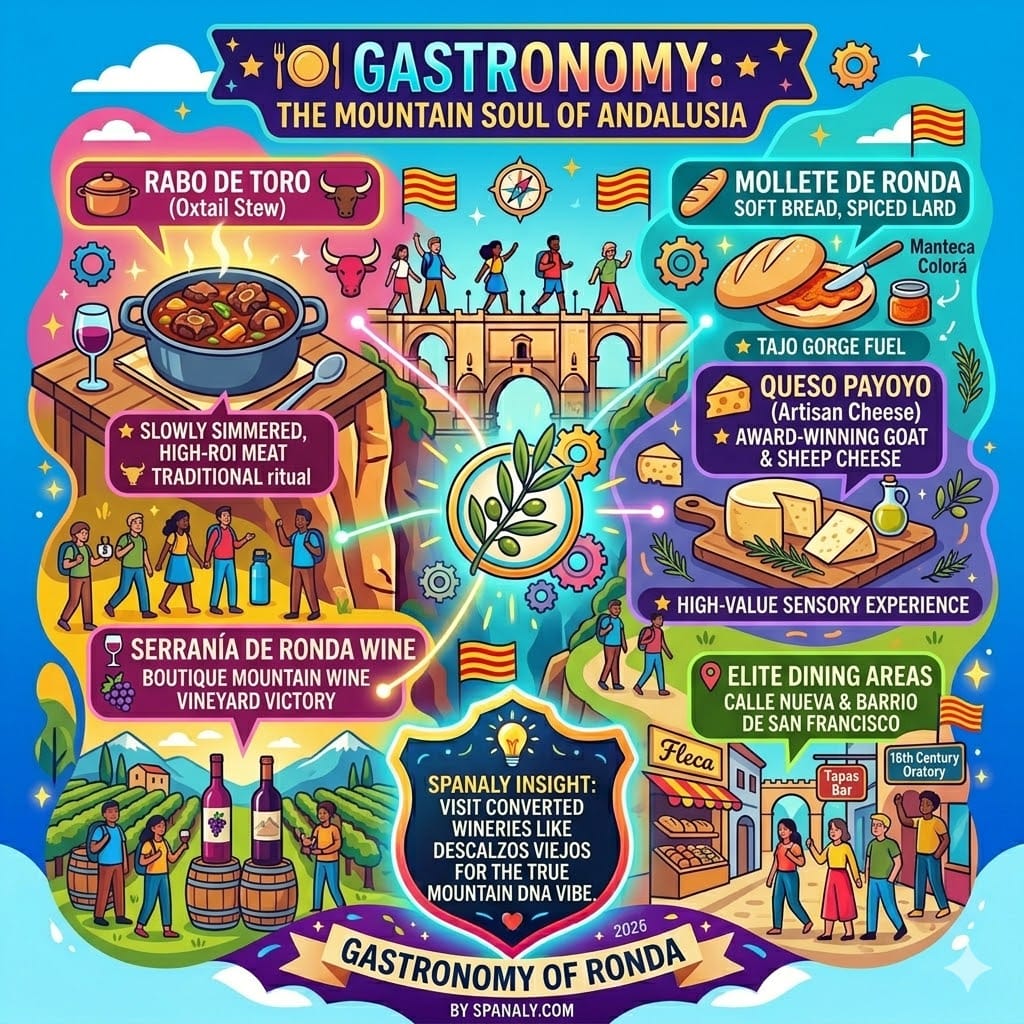
To truly appreciate the best things to do in Ronda, you should fuel your journey with the legendary flavors of the Serranía. Unlike the lighter seafood of the coast, Ronda’s culinary identity is defined by hearty, rustic dishes and world-class mountain wines. Furthermore, for a broader strategic perspective on these regional flavors, make sure to explore our comprehensive Spanish Cuisine Guide before your arrival.
🍲 Must-Try Dish: Rabo de Toro (Oxtail Stew):
This is the definitive culinary icon of the city, slowly simmered in rich red wine until the meat becomes tender.
Indeed, enjoying this dish in a traditional tavern near the historic bullring is a mandatory ritual for any food lover seeking authentic Andalusian DNA.
🥖 Local Specialty: Mollete de Ronda:
Unlike other regional versions, Ronda’s mollete (soft bread roll) is traditionally served with Manteca Colorá (spiced lard).
In fact, it is the ultimate high-energy breakfast for those planning to hike down into the depths of the Tajo Gorge.
🧀 Artisan Asset: Queso Payoyo:
Produced in the nearby Grazalema mountains, this award-winning cheese is a highlight of the local gastronomy.
Specifically, look for versions cured in rosemary or Iberian lard to experience the most authentic mountain textures.
📍 Elite Dining Areas:
Calle Nueva & Calle La Bola: These vibrant pedestrian streets are perfect for a classic tapas crawl. Specifically, look for family-run bodegas where locals gather for a glass of Vino de la Tierra.
Barrio de San Francisco: Located just outside the ancient stone walls, this neighborhood offers a quieter atmosphere. Consequently, it is the best zone for finding traditional “Slow Food” away from the main tourist bridges.
💡 Spanaly Insight: Ultimately, do not leave without visiting a local winery (Bodega). The Serranía de Ronda is a boutique wine-growing region with a long history. Indeed, many wineries are located in converted 16th-century buildings, offering a visual and culinary victory that is unique to this high-altitude terrain.
📸 Best Photo Spots: Framing the Abyss
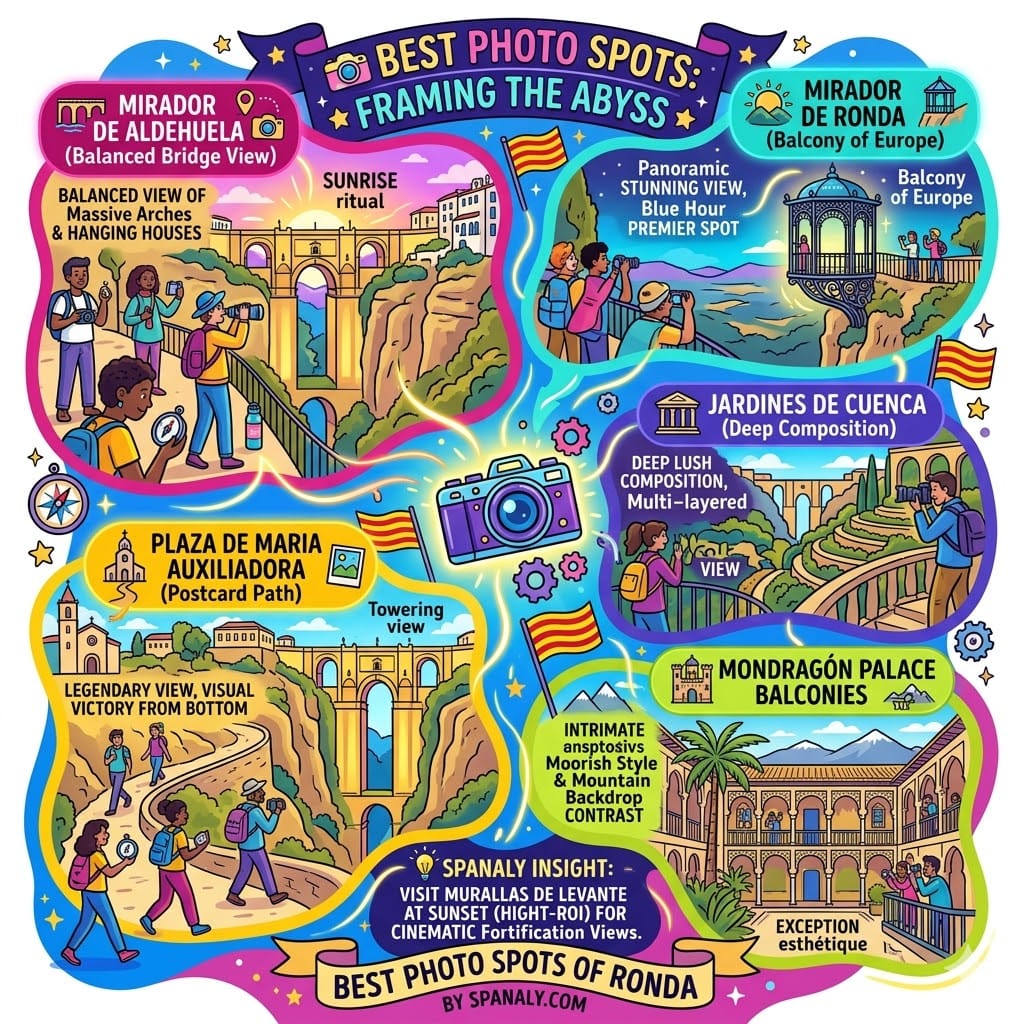
To truly master the best things to do in Ronda, you must capture its gravity-defying beauty from the right perspectives. The city’s unique position atop the Tajo Gorge offers visual rewards that are world-class, provided you know where to stand.
🌉 Mirador de Aldehuela:
Located right next to the Puente Nuevo, this is the classic, high-energy shot.
Specifically, it offers the most balanced view of the bridge’s massive arches and the white houses hanging over the cliffside. Indeed, arriving here at sunrise ensures you avoid the crowds and capture the softest light.
🌄 Mirador de Ronda (The Gazebo):
Often called the “Balcony of Europe” by locals, this iron-wrought viewpoint hangs directly over the abyss.
In fact, it provides a stunning panoramic view of the mountain ranges. Consequently, it is the premier spot for wide-angle landscape photography during the “Blue Hour.”
🏛️ The Archway at Jardines de Cuenca:
Specifically, shoot from the terraced gardens looking back toward the Puente Nuevo.
This angle includes the lush greenery of the gardens in the foreground, creating a deep, multi-layered composition that most day-trippers miss.
⛪ Plaza de Maria Auxiliadora (The Path Down):
This is the starting point for the trail that leads to the bottom of the gorge.
Actually, if you follow the path for 10 minutes, you will find the “Postcard View”—the legendary angle where the entire bridge towers over the valley floor. Thus, achieving a visual victory that is the highlight of any trip.
🏰 The Balconies of Mondragón Palace:
These Moorish-style balconies offer a more intimate and historical frame.
Notably, the contrast between the intricate Mudejar architecture and the wild mountain backdrop provides an exceptional, high-value aesthetic for your collection.
💡 Spanaly Insight: Ultimately, don’t just focus on the bridge itself. Indeed, find the “Murallas de Levante” at sunset. Specifically, the way the light hits the ancient stone fortifications and the olive groves below creates a cinematic atmosphere that feels like a scene from a Spanish epic.
🗺️ Suggested Itineraries: Operational Timelines
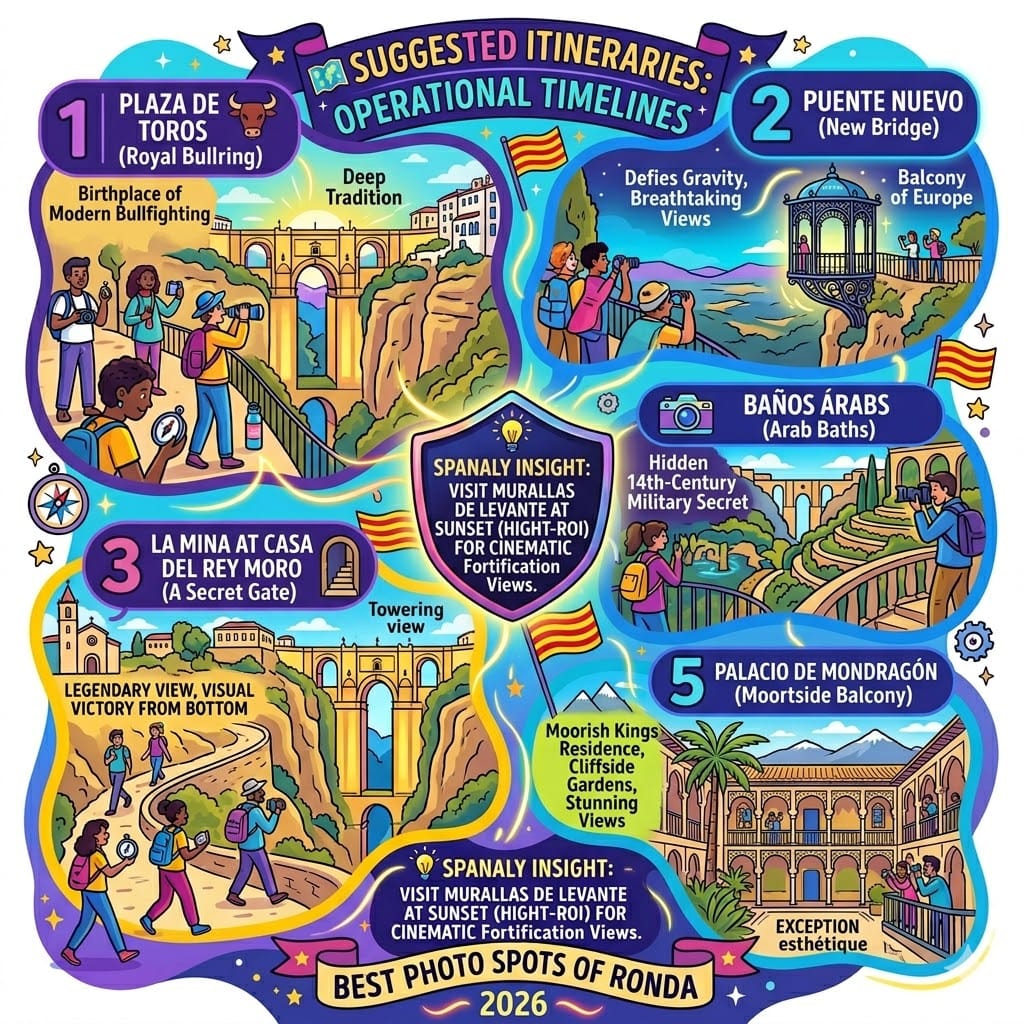
To truly appreciate the best things to do in Ronda, you must choose a timeline that fits your travel style. Whether you are coming for a quick look or a deep exploration of the mountains, planning your movement is essential. Furthermore, for many international travelers, your journey begins nearby; therefore, we recommend checking our Seville Airport (SVQ) Guide to ensure a smooth transition toward the white villages of Andalusia.
🕒 The “Express Mission” (24 Hours)
09:00 – 11:00: Begin by crossing the Puente Nuevo and exploring the Plaza de Toros before the large tour groups arrive.
11:00 – 13:00: Descend into the Water Mine at Casa del Rey Moro for a cool, underground experience.
13:00 – 15:00: Enjoy a traditional lunch in the Barrio de San Francisco to taste authentic Rabo de Toro.
15:00 – 18:00: Wander through the Jardines de Cuenca and the Old Bridge for a quieter perspective of the gorge.
Sunset: Finish at the Mirador de Ronda (The Gazebo) to witness the cliffs turning gold.
⏳ The “Deep Dive” (48-72 Hours)
Day 1: Complete the Express Mission above to capture the primary icons.
Day 2: Dedicate your morning to the Mondragón Palace and the Arab Baths. In the afternoon, hike down the La Hoya del Tajo path for the legendary ground-up view of the bridge.
Day 3: Use Ronda as your headquarters for a regional journey. Specifically, explore the nearby “Blue Village” of Júzcar or the prehistoric Cueva de la Pileta. Ultimately, returning to Ronda for a final evening walk ensures a complete cultural experience.
💡 Spanaly Insight: Ultimately, if you are visiting during the “Feria de Pedro Romero” in September, your schedule will be dominated by traditional costumes and bullfighting festivities. Indeed, while the atmosphere is electric, you should double your time estimates as the city becomes much more vibrant and crowded.
🧳 Essential Logistics: Planning Your Movement
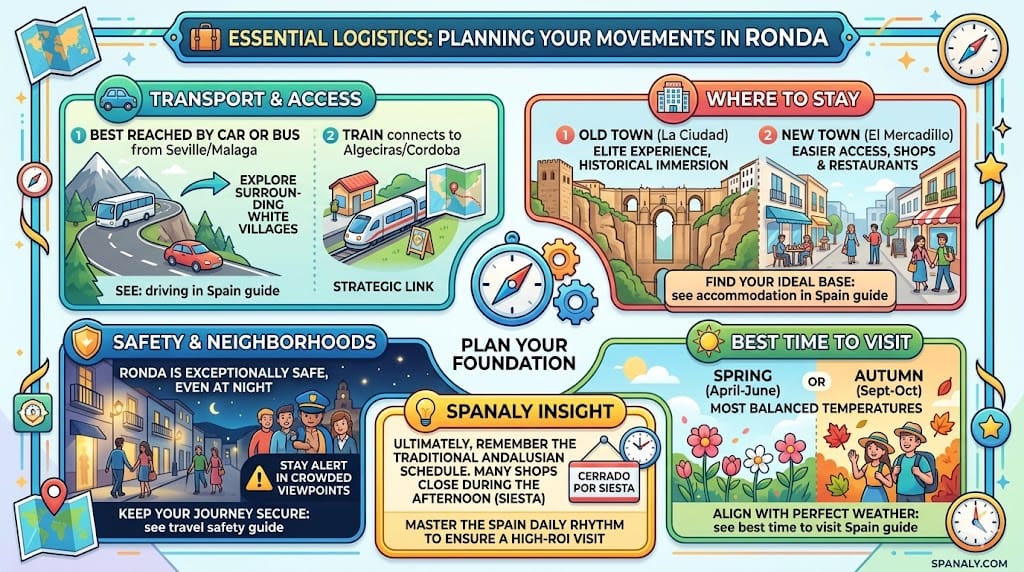
To truly master the best things to do in Ronda, you must ensure your logistical foundation is solid. Navigating the Andalusian mountains requires a bit more planning than a city break in Madrid. Furthermore, before you head into the hills, we recommend reviewing our essential Spain travel tips to guarantee a seamless and rewarding experience.
🚅 Transport & Access:
Ronda is best reached by car or bus from Seville or Malaga. Specifically, if you are planning to explore the surrounding white villages, we suggest checking our guide on driving in Spain to master the mountain roads.
Consequently, if you prefer public transport, the train station connects you to Algeciras and Cordoba, making it a strategic link in getting around Spain.
🏨 Where to Stay:
For an elite experience, stay in the Old Town (La Ciudad) for historical immersion. Instead, if you prefer easier access to shops and restaurants, the New Town (El Mercadillo) is your best asset.
Indeed, finding the right base is crucial; therefore, explore our insights on accommodation in Spain for the best high-value options.
🛡️ Safety & Neighborhoods:
Ronda is exceptionally safe, even at night. However, like any popular destination, staying alert in crowded viewpoints is wise.
Specifically, we recommend our briefing on travel safety in Spain to keep your journey secure and stress-free.
☀️ Best Time to Visit:
Spring (April–June) and Autumn (September–October) offer the most balanced temperatures. In fact, to align your trip with the perfect weather, consult our guide on the best time to visit Spain.
💡 Spanaly Insight: Ultimately, remember that Ronda follows the traditional Andalusian schedule. Specifically, many shops close during the afternoon. Indeed, mastering the Spain daily rhythm and siesta will help you avoid arriving at a closed monument and ensure a high-ROI visit.
⚔️ Tactical Comparison: The Decision Matrix
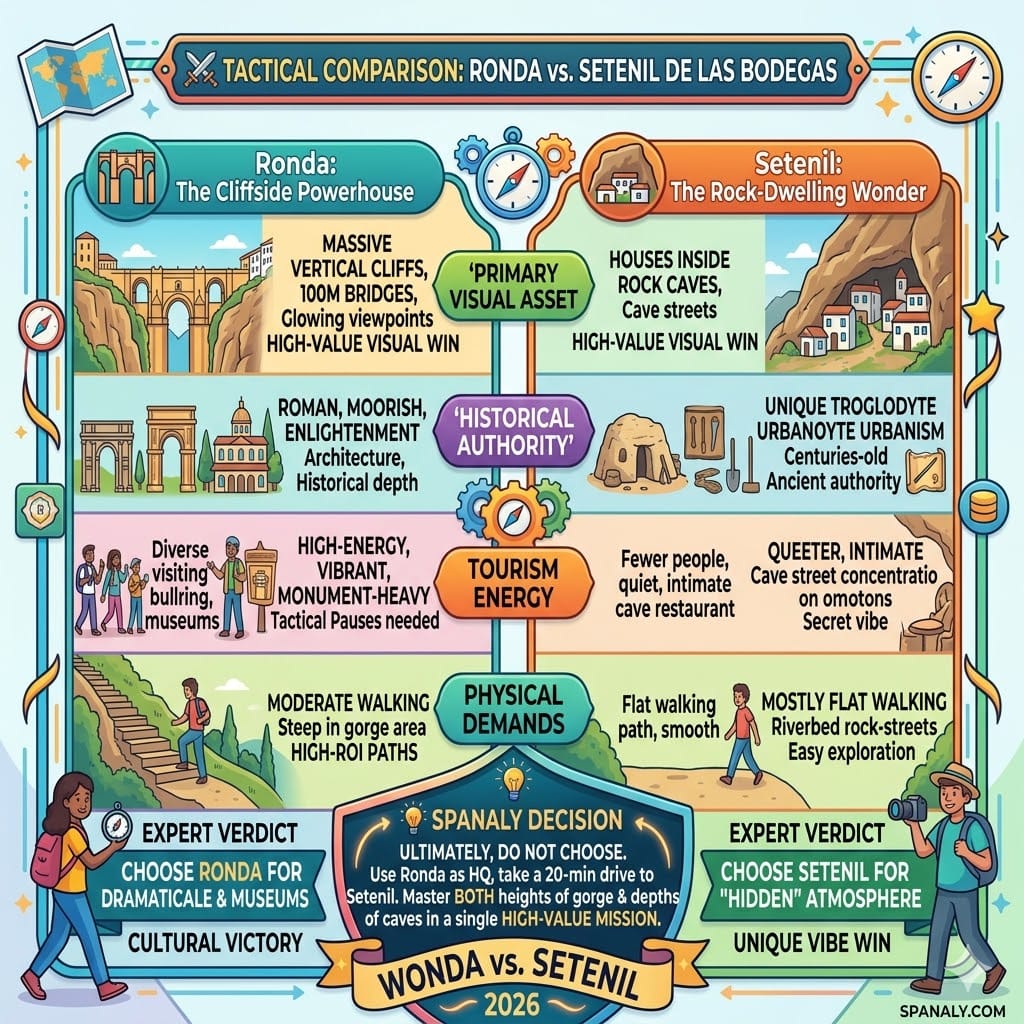
To truly master the best things to do in Ronda, you must understand how it differs from its neighbor, Setenil de las Bodegas. While both are icons of the “Pueblos Blancos” (White Villages) circuit, they offer fundamentally different visual and historical rewards.
| Strategic Feature | 🌉 Ronda: The Cliffside Powerhouse | 🪨 Setenil: The Rock-Dwelling Wonder |
| Primary Visual Asset | Massive vertical cliffs and 100m bridges. | Houses built directly into natural rock caves. |
| Historical Authority | Roman, Moorish, and Enlightenment era architecture. | Unique troglodyte urbanism dating back centuries. |
| Tourism Energy | High-energy, vibrant, and monument-heavy. | Quieter, intimate, and concentrated on two streets. |
| Physical Demands | Requires moderate walking; steep in the gorge area. | Mostly flat walking along the riverbed rock-streets. |
| Expert Verdict | Choose Ronda for dramatic scale and museums. | Choose Setenil for a unique, “hidden” atmosphere. |
📍 The Operational Verdict: Which One Wins?
The High-ROI Choice: If you only have one day, Ronda is your primary asset. Specifically, its architectural depth and monumental variety offer a much higher cultural return on your time.
The “Secret Gem” Choice: Instead, if you have already seen the main Andalusian cities, Setenil provides a visual victory that is incomparable. Indeed, dining under a massive rock overhang is a sensory experience you won’t find in Ronda.
💡 Spanaly Decision: Ultimately, do not choose. Specifically, the best strategy is to use Ronda as your headquarters and take a 20-minute drive to Setenil. Consequently, you master both the heights of the gorge and the depths of the caves in a single, high-value mission.
💡 Spanaly Insider Tips: Winning the Ronda Mission
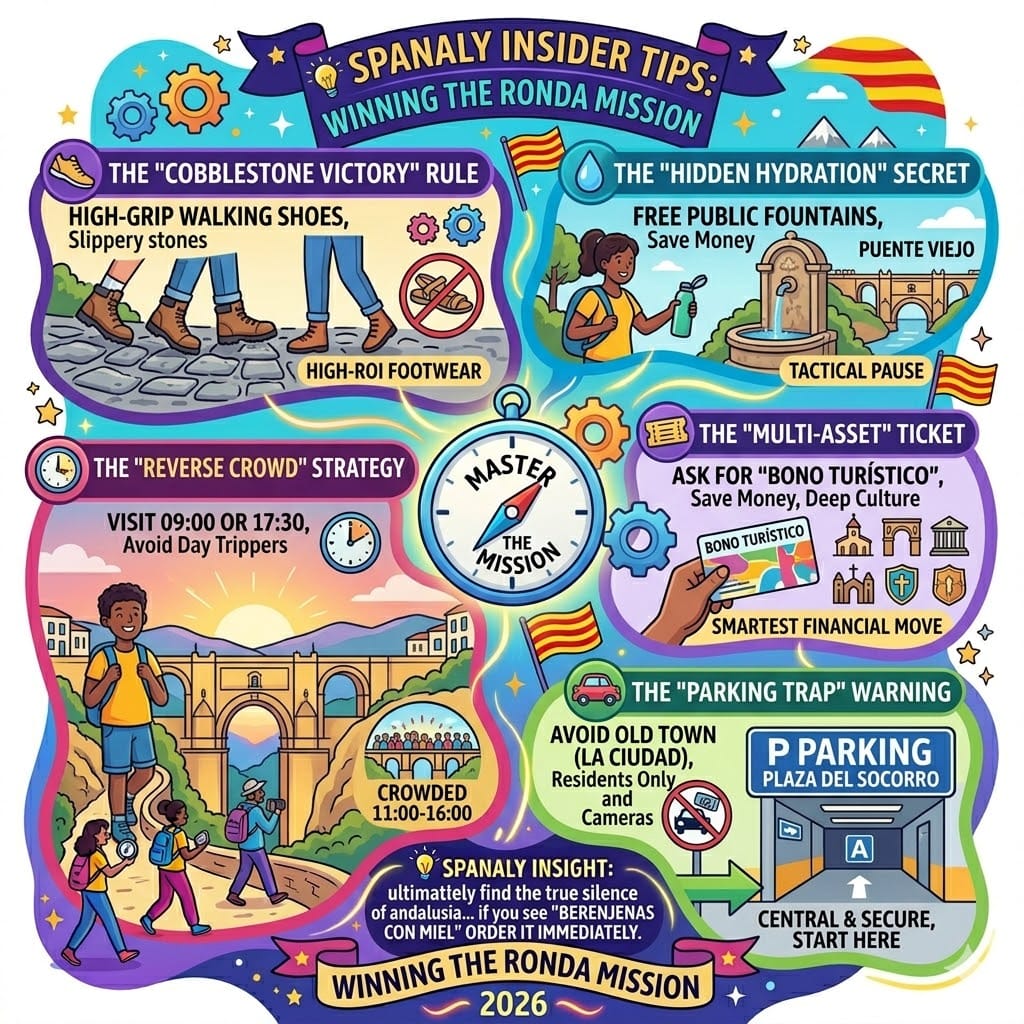
To truly master the best things to do in Ronda, you must look beyond the travel brochures. These high-value “Field Assets” will save you time, money, and physical effort, ensuring a high-ROI experience in the city of dreams.
👟 The “Cobblestone Victory” Rule:
Ronda’s Old Town is beautiful but brutal on your feet.
Specifically, do not wear flip-flops or formal leather soles. Indeed, the polished stones become incredibly slippery. Consequently, high-grip walking shoes are your primary asset for conquering the steep paths to the gorge.
💧 The “Hidden Hydration” Secret:
Instead of buying plastic water bottles at the bridge (where prices are at a premium), look for the “Fuentes” (public fountains).
In fact, the water flowing from the mountain springs is ice-cold and perfectly safe. Specifically, finding the stone fountain near the Puente Viejo offers a refreshing and free tactical pause.
🕒 The “Reverse Crowd” Strategy:
Most tour buses from Seville and Malaga arrive between 11:00 and 16:00.
Ultimately, your best strategy is to visit the major icons (like the Bullring) at 09:00 sharp or after 17:30. Indeed, you will have the Puente Nuevo almost to yourself, securing a visual victory without the background noise.
🎫 The “Multi-Asset” Ticket Advantage:
If you plan to visit several churches and museums, ask for the “Bono Turístico” (Tourist Pass).
Notably, it covers the main ecclesiastical sites at a significantly lower cost than individual entries. Therefore, it is the smartest financial move for a deep cultural dive.
🚗 The “Parking Trap” Warning:
Specifically, never try to drive into the Old Town (La Ciudad). The streets are narrow, and many are restricted to residents only (monitored by cameras).
Instead, use the large underground parking at Plaza del Socorro. It is central, secure, and places you exactly where the action begins.
💡 Spanaly Insight: Ultimately, if you see “Berenejenas con Miel” (Fried Eggplant with Honey) on a local menu, order it immediately. Specifically, Ronda’s mountain honey is world-class. Indeed, this simple dish is a high-value culinary reward that captures the sweet and savory DNA of Andalusia in one bite.
🛡️ Visitor FAQs – Essential Ronda Travel Logistics
🛡️ Is it safe to hike down to the bottom of the Tajo Gorge alone?
Yes, the main paths leading to the base of the Puente Nuevo are well-trodden and generally safe for solo travelers during daylight hours. However, the terrain is uneven and steep. We recommend finishing your ascent before sunset as the paths are not illuminated, and the mountain air cools down rapidly once the sun disappears.
🎫 Can I buy a combined ticket for all major monuments in Ronda?
Ronda offers a Bono Turístico (Tourist Voucher) which is an excellent high-value asset. It typically covers entry to the Municipal Museum (Mondragón Palace), the Arab Baths, and several historical churches. You can purchase this directly at the first monument you visit, saving you both time and money compared to individual tickets.
👗 What is the dress code for visiting Ronda’s churches and Bullring?
While Spain is modern, modest dress is appreciated when entering religious sites like the Santa María la Mayor. For the Bullring, casual wear is perfectly fine. The most critical "asset" in your wardrobe should be sturdy, closed-toe walking shoes; the ancient cobblestones of the Old Town are notoriously slippery and uneven.
🚑 Where can I find medical assistance in Ronda as a foreigner?
Ronda has a modern public hospital (Hospital de la Serranía) and several private clinics. For minor health issues, look for a Farmacia (green cross sign). Most central pharmacies have staff who speak basic English. In case of a serious emergency, dial 112, the universal emergency number in Spain, which offers multi-language support.
📶 Is public Wi-Fi available around the Puente Nuevo area?
While many cafes and hotels around Plaza de España offer free Wi-Fi, public signals can be weak near the bridge itself due to the stone structures and gorge depth. For a visual victory over your social media uploads, we recommend securing a local eSIM before arrival to ensure a stable high-speed connection while navigating the cliffs.
Ronda Travel Guide by Spanaly.com
Ronda is more than just a bridge; it is a timeless atmospheric masterpiece that stays with you long after you leave its ancient walls. By following this guide, you have secured the high-value insights needed to conquer the “City of Dreams” like a true expert.
🏔️ Beyond the Cliffs:
Whether you came for the dramatic architecture or the mountain air, Ronda delivers a visual victory every time.
🛡️ Master the Region:
Your journey through Spain’s history doesn’t have to end here.
In fact, for another unique coastal perspective, make sure to explore the Roman heritage in our guide on things to do in Tarragona.
🎒 Ready for the Mission?
Pack your walking shoes, charge your camera, and prepare for the ultimate Andalusian high-ground experience.
💡 Spanaly Insight: Ultimately, the best souvenir you will take from Ronda isn’t a postcard. Indeed, it is the silence of the gorge at sunset and the feeling of standing where history and nature meet in a perfect, gravity-defying embrace. 🛡️⚔️