Table of Contents
Toggle🏛️ Vigo & Rías Baixas
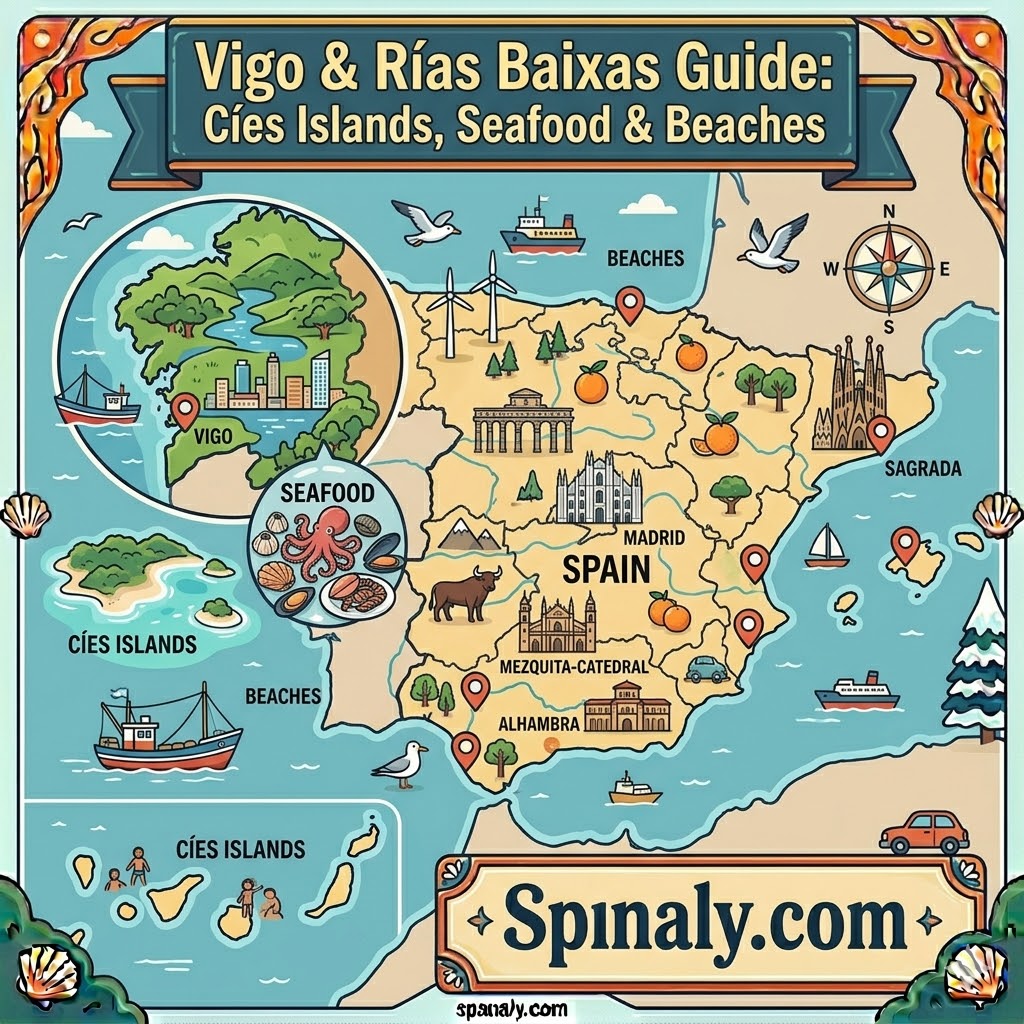
The Atlantic changes everything here, transforming a rugged coastline into a paradise of crystalline waters and granite cliffs. Vigo and the Rías Baixas represent the ultimate Galician escape, serving as the strategic gateway to the world-famous Cíes Islands and the finest seafood traditions in Spain. Whether you are hunting for hidden coves or world-class Albariño wine, this guide provides the essential tools to navigate the “Galician Caribbean” like an expert.
🏝️ Island Paradise: Master the complex permit system to visit the stunning Cíes Islands and their white-sand beaches.
🍷 Gastronomic Soul: Taste the freshest Atlantic oysters and Albariño wine in the historic heart of the city.
🚤 Coastal Strategy: Explore the legendary Rías Baixas, a series of coastal inlets defined by rugged beauty and Celtic roots.
🌍 Regional Depth: To see how these Atlantic gems fit into your broader journey, consult our Ultimate Northern Spain Travel Guide for expert regional insights.
Standing at the harbor’s edge, you realize that Vigo is not just a port; it is a vibrant connection between ancient maritime history and modern Galician life. Grab your camera and let the salt-tinged breeze lead you through the layers of the Atlantic’s most rewarding destination.
📍 Vigo & Rías Baixas: Essential Visitor Snapshot
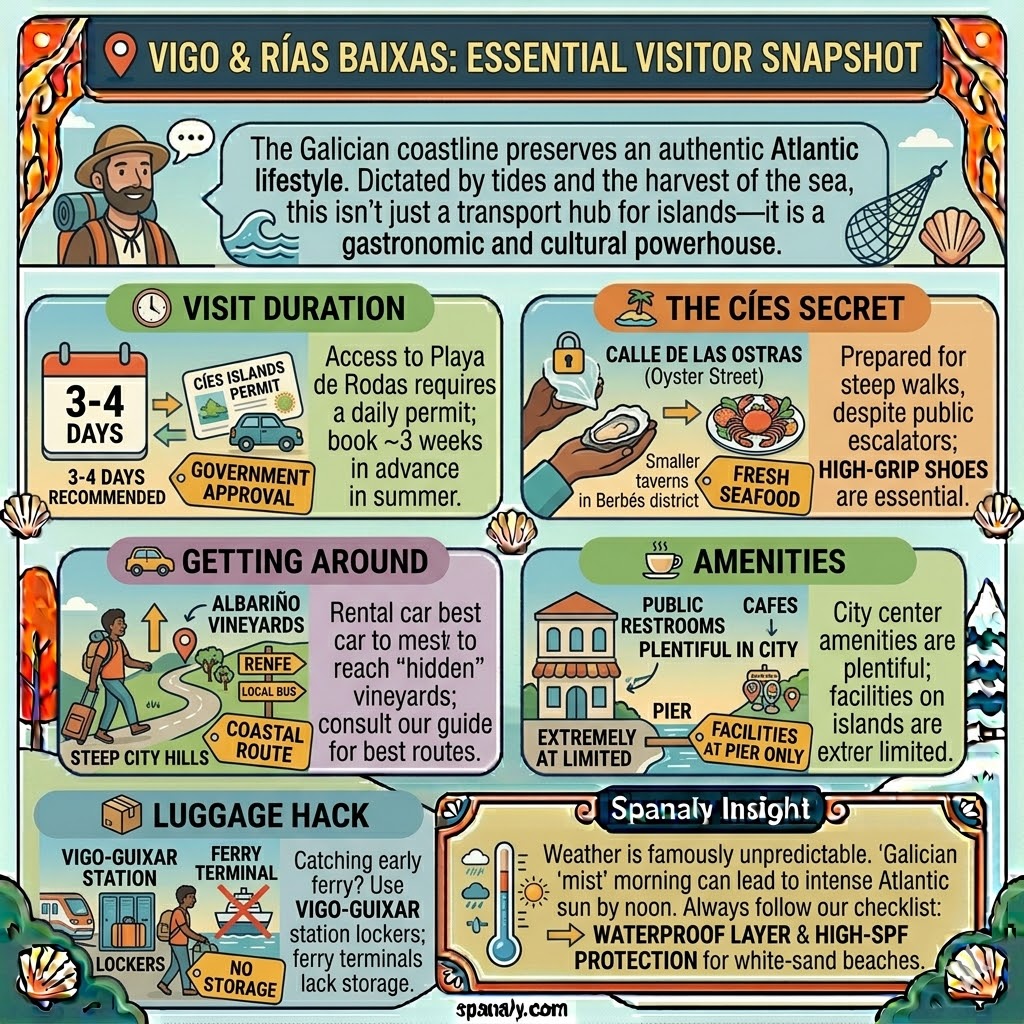
Few places in Europe preserve the authentic Atlantic lifestyle as purely as the Galician coastline. Approaching Vigo and the Rías Baixas, you quickly realize this isn’t just a transport hub for the islands—it is a gastronomic and cultural powerhouse where the daily rhythm is dictated by the tides and the harvest of the sea.
⏱️ Visit Duration: Dedicate at least 3 to 4 days to cover Vigo city, the Cíes Islands, and a road trip through the historic villages of the Rías Baixas.
🏝️ The Cíes Secret: Access to Playa de Rodas requires a government permit (limited daily); book at least 3 weeks in advance during summer to secure your spot.
🦀 Foodie Haven: The famous “Calle de las Ostras” (Oyster Street) is a must; however, for the best local price-to-quality ratio, explore the smaller taverns in the Berbés district.
🚶 Physical Demand: Vigo is known as the “City of Slopes.” While there are modern public escalators, be prepared for steep walks; comfortable, high-grip shoes are essential for both city hills and island trails.
🚗 Getting Around: While public transport is reliable, a rental car is the best way to reach the “hidden” Albariño vineyards; consult our Transport in Northern Spain guide for the best coastal routes.
☕ Amenities: Public restrooms and cafes are plentiful in Vigo’s center, but on the Cíes Islands, facilities are extremely limited and concentrated near the pier.
📦 Luggage Hack: If you are catching an early ferry to the islands, use the lockers at the Vigo-Guixar train station, as most ferry terminals do not offer storage.
Spanaly Insight: Galician weather shifts rapidly. A misty morning often turns into intense Atlantic sun by noon. Pack smart: bring a waterproof layer and high-SPF protection for the white-sand beaches as advised in our What to Pack for Spain guide.
🏝️ Ancient vs. Modern: How the Rías Baixas Compare
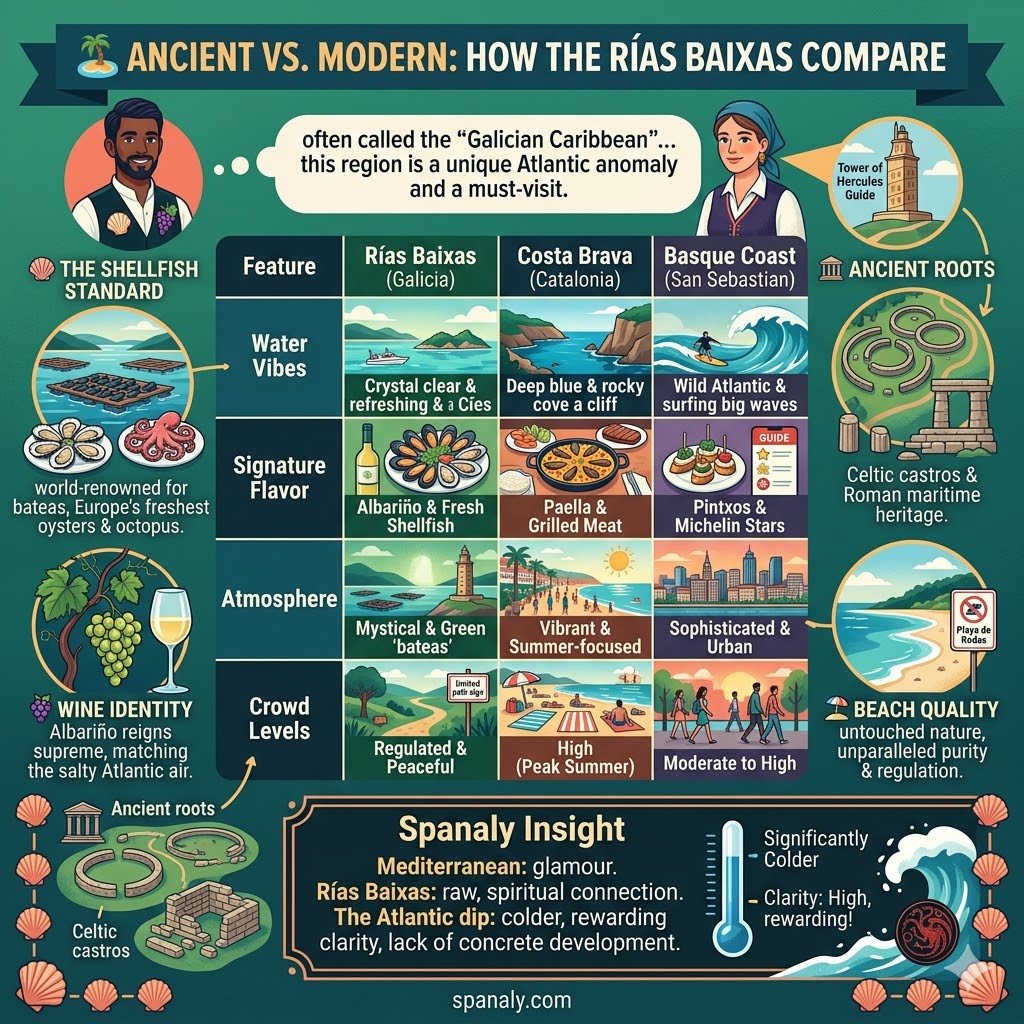
The true soul of a coastline is found in its diversity, and the Rías Baixas stand as a unique Atlantic anomaly. Often called the “Galician Caribbean” due to the turquoise waters of the Cíes Islands, this region offers a stark contrast to the Mediterranean’s calm or the Basque Country’s rugged cliffs. This comparison helps you understand why this corner of Galicia is a must-visit.
| Feature | Rías Baixas (Galicia) | Costa Brava (Catalonia) | Basque Coast (San Sebastian) |
| Water Vibes | Crystal clear & refreshing | Deep blue & rocky | Wild Atlantic & surfing |
| Signature Flavor | Albariño & Fresh Shellfish | Paella & Grilled Meat | Pintxos & Michelin Stars |
| Atmosphere | Mystical & Green | Vibrant & Summer-focused | Sophisticated & Urban |
| Crowd Levels | Regulated & Peaceful | High (Peak Summer) | Moderate to High |
🐚 The Shellfish Standard: Unlike other coastal regions, the Spanish Cuisine in Rías Baixas is world-renowned for its “bateas” (mussels platforms), offering the freshest oysters and octopus in Europe.
🍇 Wine Identity: While the south of Spain is famous for Sherry, here the Albariño grape reigns supreme, producing crisp white wines that perfectly match the salty Atlantic air.
🏛️ Ancient Roots: For those who love history, the region blends Celtic “castros” with Roman maritime heritage, similar to what you find in our Tower of Hercules Guide.
🏖️ Beach Quality: If you are looking for untouched nature, Playa de Rodas offers a level of purity and regulation that busy Mediterranean beaches simply cannot match.
🏝️ Cíes Islands: Planning Your Visit to Spain’s Best Beach
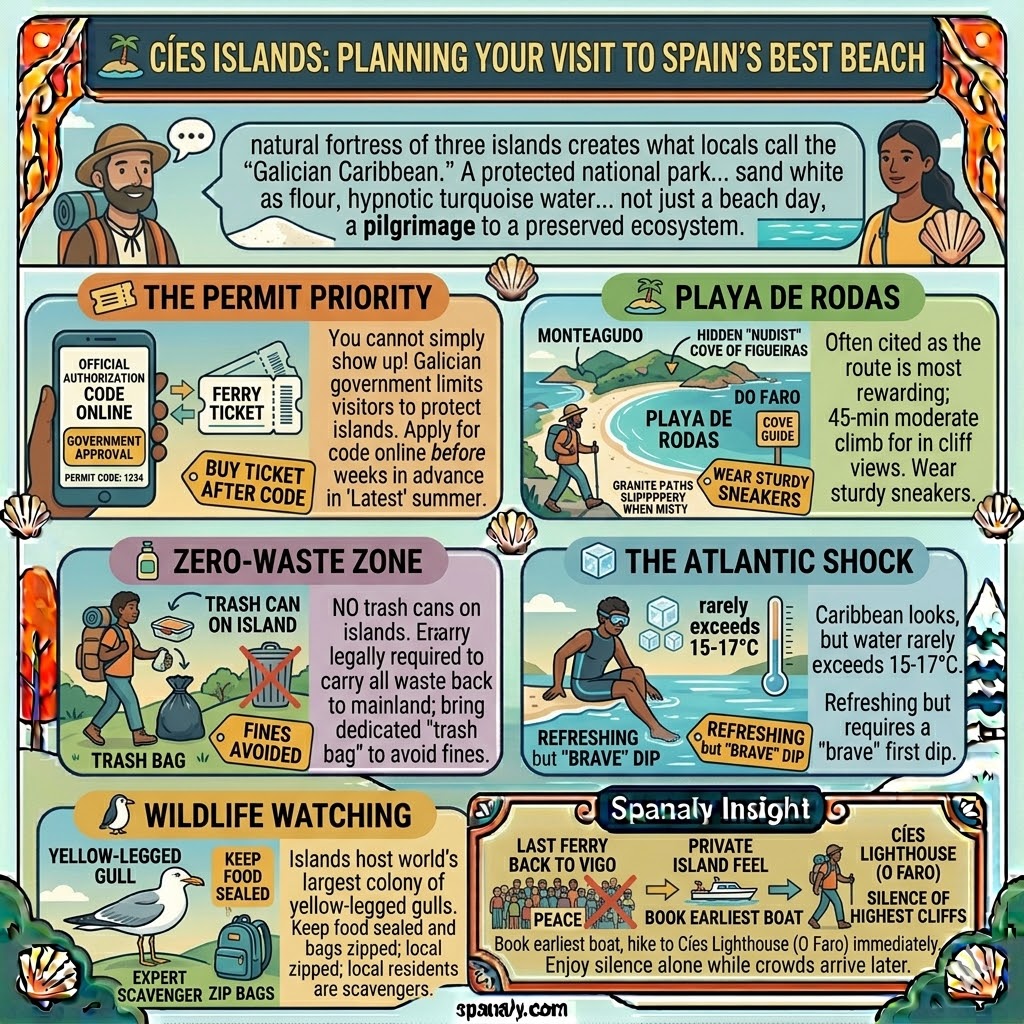
At the mouth of the Vigo estuary, a natural fortress of three islands creates what many locals call the “Galician Caribbean.” The Cíes Islands are a protected national park where the sand is as white as flour and the water is a hypnotic turquoise. This isn’t just a beach day; it is a pilgrimage to one of the most preserved ecosystems in Europe, where nature remains the absolute protagonist.
🎟️ The Permit Priority: Access is strictly regulated. You cannot simply show up, as the Galician government limits daily visitors to protect the ecosystem. Secure your spot early: you must apply for an official authorization code online before purchasing ferry tickets. Slots often fill up weeks in advance during the peak summer months.
🏖️ Playa de Rodas: Often cited as the best beach in the world, this crescent-shaped paradise connects the islands of Monteagudo and Do Faro. For a more secluded experience, explore our Ultimate Spain Beach Guide to find the hidden “Nudist” cove of Figueiras.
🥾 Hiking Trails: The “Alto do Príncipe” route is the most rewarding; it’s a 45-minute moderate climb that offers a bird’s-eye view of the cliffs—wear sturdy sneakers as the granite paths can be slippery when misty.
🧴 Zero-Waste Zone: There are no trash cans on the islands. You are legally required to carry all your waste back to the mainland; bring a dedicated “trash bag” in your daypack to avoid fines.
🧊 The Atlantic Shock: Don’t let the Caribbean looks fool you; the water temperature rarely exceeds 15-17°C. It is incredibly refreshing but requires a “brave” first dip.
🐧 Wildlife Watching: The islands host the world’s largest colony of yellow-legged gulls. Keep your food sealed and bags zipped, as these “local residents” are expert scavengers.
Spanaly Insight: The final ferry is always hectic. For a “private island” experience, book the earliest morning boat. Beat the crowds by hiking to the Cíes Lighthouse immediately; you’ll enjoy the silent cliffs while others scramble for beach space.
🏰 Casco Vello: Exploring the Historic Heart of Vigo
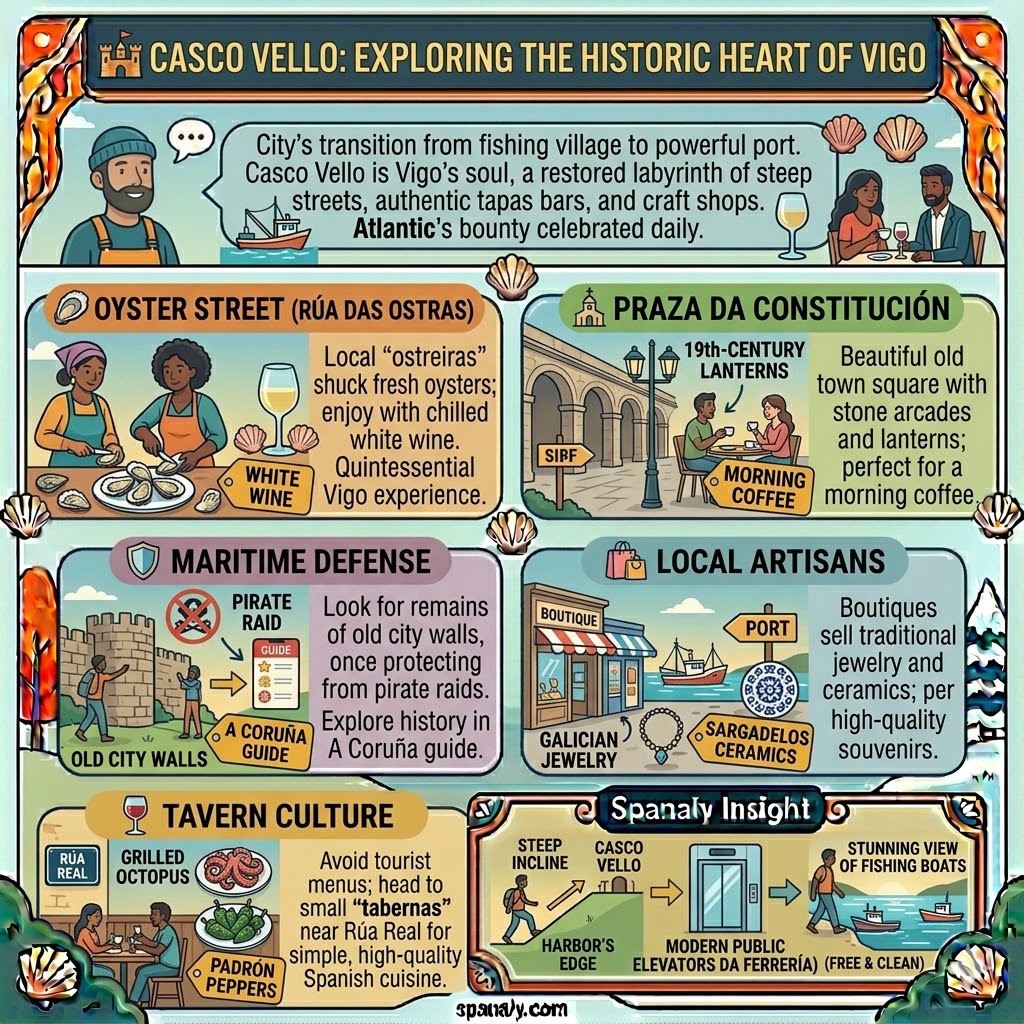
Walking through the narrow granite alleys, you can feel the city’s transition from a humble fishing village to a powerful maritime port. The Casco Vello is the soul of Vigo, a labyrinth of steep streets and hidden plazas that have been beautifully restored to house the city’s most authentic tapas bars and craft shops. It is here that the Atlantic’s bounty is celebrated every single day.
🦪 Oyster Street (Rúa das Ostras): This is the quintessential Vigo experience; watch local “ostreiras” skillfully shuck fresh oysters right in front of you—best enjoyed with a glass of chilled white wine.
⛪ Praza da Constitución: The most beautiful square in the old town, characterized by its stone arcades and 19th-century lanterns; it’s the perfect spot for a morning coffee while watching the city wake up.
🛡️ Maritime Defense: Look for the remains of the old city walls that once protected Vigo from pirate raids, a reminder of the “rugged” history you can also explore in our A Coruna Travel Guide.
🛍️ Local Artisans: The lower part of the old town, near the port, is filled with small boutiques selling traditional Galician jewelry and “Sargadelos” ceramics—perfect for high-quality souvenirs.
🍷 Tavern Culture: Avoid the tourist-heavy menus and head to the smaller “tabernas” near the Rúa Real, where the focus is on simple, high-quality Northern Spain Food like grilled octopus and Padrón peppers.
⛪ Santa María Collegiate Church: A neoclassical masterpiece built on the site of an older Gothic church, housing the famous “Christ of the Victory,” a symbol of the city’s resistance against Napoleon.
Spanaly Insight: From the harbor’s edge, the climb into the Casco Vello can be deceptive. While the streets look short on a map, the incline is significant. Use the modern public elevators (Ascensor da Ferrería) to save your legs; they are free, clean, and offer a sudden, stunning view of the fishing boats as you rise above the rooftops.
🦀 Rías Baixas Gastronomy: Seafood & Albariño Wine Guide
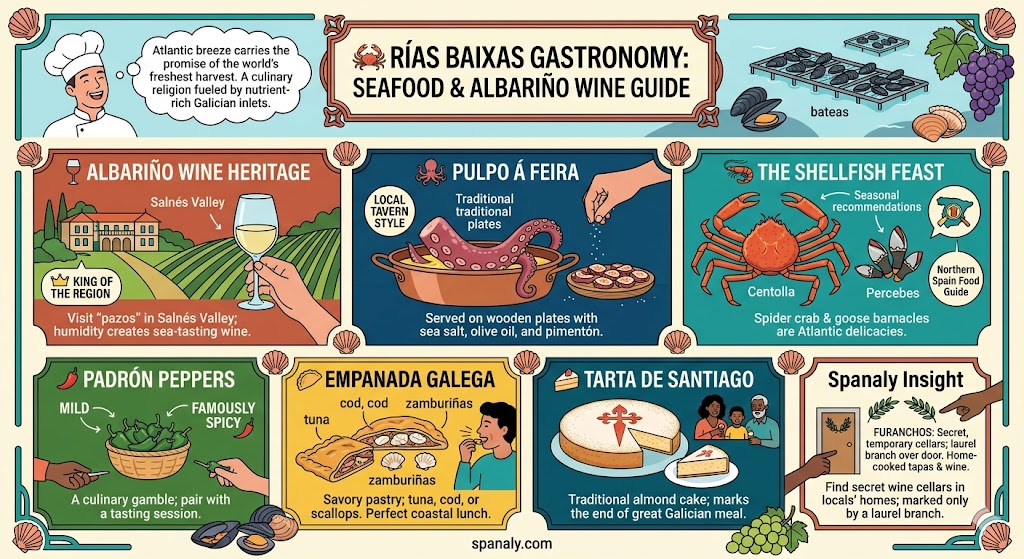
The Atlantic breeze carries more than salt; it carries the promise of the freshest seafood harvest in the world. Rías Baixas gastronomy is a religion here, where the cold, nutrient-rich waters of the Galician inlets produce shellfish of unparalleled quality. From the “bateas” (floating mussel farms) to the sun-drenched vineyards, every bite and sip tells the story of this rugged coast.
🍷 Albariño Wine Heritage: This crisp, aromatic white wine is the undisputed king of the region. Visit the “pazos” (manor houses) in the Salnés Valley to see how the Atlantic humidity creates a wine that tastes like the sea itself.
🐙 Pulpo á Feira: While common across Spain, eating octopus in Galicia is a different league. Look for the copper pots in local taverns where it’s served on wooden plates with sea salt, olive oil, and pimentón.
🦐 The Shellfish Feast: Don’t miss the “Centolla” (spider crab) and “Percebes” (goose barnacles). For a deep dive into these Atlantic delicacies, explore our Northern Spain Food Guide for seasonal recommendations.
🌶️ Padrón Peppers: Grown just north of Vigo, these small green peppers are a culinary gamble—most are mild, but some are famously spicy. Pair them with a local Pimientos de Padron tasting session.
🥟 Empanada Galega: A savory pastry filled with tuna, cod, or even scallops (zamburiñas), perfect for a quick lunch while exploring the coastal villages.
🍰 Tarta de Santiago: A traditional almond cake that marks the end of any great Galician meal, often decorated with the Cross of Saint James.
Spanaly Insight: Elite seafood hides in plain sight. Look for “Furanchos” temporary home-cellars selling surplus wine and authentic tapas. The secret signal is a simple laurel branch hanging over the door; find one to experience the true soul of Galicia.
🚢 Ferry Routes & Transport: How to Reach Vigo and the Islands
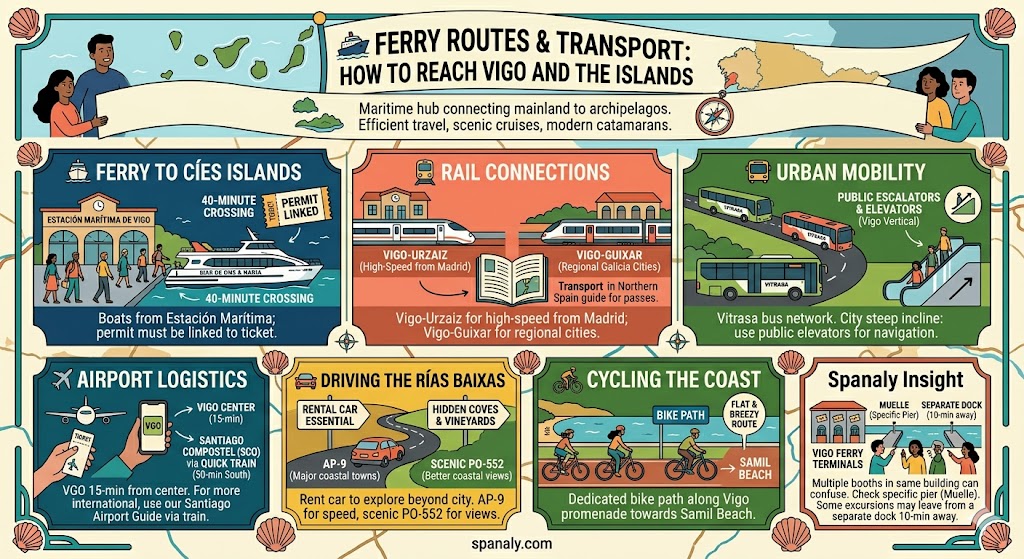
The reality of the journey is that reaching this Atlantic paradise is remarkably efficient, provided you understand the rhythm of the ferry schedules and the city’s unique topography. Vigo and the Rías Baixas serve as a major maritime hub, connecting the mainland to the pristine archipelagos with a fleet of modern catamarans that turn a simple commute into a scenic cruise.
⛴️ Ferry to Cíes Islands: Boats depart primarily from the Estación Marítima de Vigo; several companies (like Mar de Ons and Nabia) operate the 40-minute crossing—ensure your permit is linked to your ticket.
🚉 Rail Connections: The Vigo-Urzaiz station handles high-speed trains from Madrid, while Vigo-Guixar is your gateway to regional Galician cities like Santiago; consult our Transport in Northern Spain for the best rail passes.
🚌 Urban Mobility: Vigo’s “Vitrasa” bus network is extensive, but the city’s steep incline makes the escalators and public elevators (Vigo Vertical) your best friend for navigating between the port and the upper districts.
✈️ Airport Logistics: Vigo Airport (VGO) is just 15 minutes from the center, but for more international options, many travelers use our Santiago Compostela Airport Guide and take a quick 50-minute train south.
🚗 Driving the Rías Baixas: To explore the hidden coves and vineyards beyond the city, renting a car is essential; the AP-9 highway connects all major coastal towns, though the scenic PO-552 coastal road offers better views.
🚴 Cycling the Coast: A dedicated bike path runs along the Vigo promenade toward Samil Beach, providing a flat and breezy route for those who prefer two wheels.
Spanaly Insight: Vigo’s ferry terminals can be chaotic. Multiple companies operate from the same building, each with its own booth. Verify your specific pier (Muelle) early; special excursions to Ons or San Simón often depart from separate docks located 10 minutes away.
🏖️ Best Beaches in Rías Baixas: Beyond the Cíes Archipelago
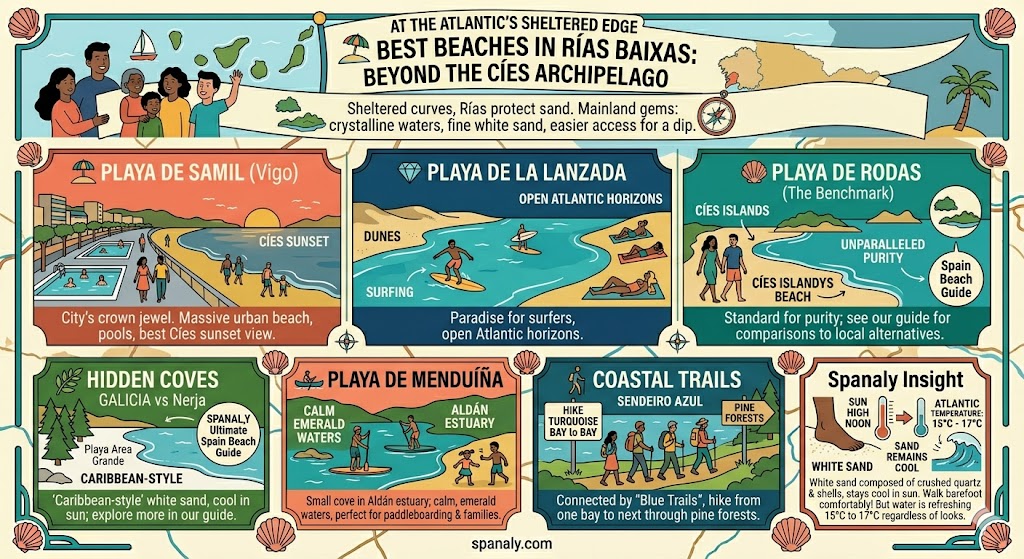
The Atlantic reveals its softest side along the sheltered curves of the Galician coastline, where the “Rías” protect the sand from the harshest ocean swells. While the Cíes Islands grab the headlines, the Rías Baixas are dotted with mainland beaches that offer crystalline waters, fine white sand, and much easier access for a spontaneous afternoon dip.
🏖️ Playa de Samil (Vigo): The city’s crown jewel; a massive urban beach featuring a scenic promenade, public swimming pools, and the best sunset views over the Cíes archipelago.
💎 Playa de la Lanzada: Located between Sanxenxo and O Grove, this 2.5km stretch of wild dunes and turquoise water is a paradise for surfers and those seeking open Atlantic horizons.
🐚 Playa de Rodas (The Benchmark): Even when exploring the mainland, Playa de Rodas remains the standard for purity; check our guide for how it compares to these local alternatives.
🌿 Hidden Coves of Nerja vs. Galicia: While the south has rocky enclaves, the Rías Baixas offer “Caribbean-style” white sand that stays cool even under the summer sun—explore more in our Ultimate Spain Beach Guide.
🛶 Playa de Menduíña: A smaller, sheltered cove in the Aldán estuary known for its calm, emerald waters, making it perfect for paddleboarding and families with young children.
🚶 Coastal Trails: Many of these beaches are connected by “Sendeiros Azuis” (Blue Trails), allowing you to hike from one turquoise bay to the next through fragrant pine forests.
⛰️ Monte do Castro: The Best Panoramic Views of Vigo Bay
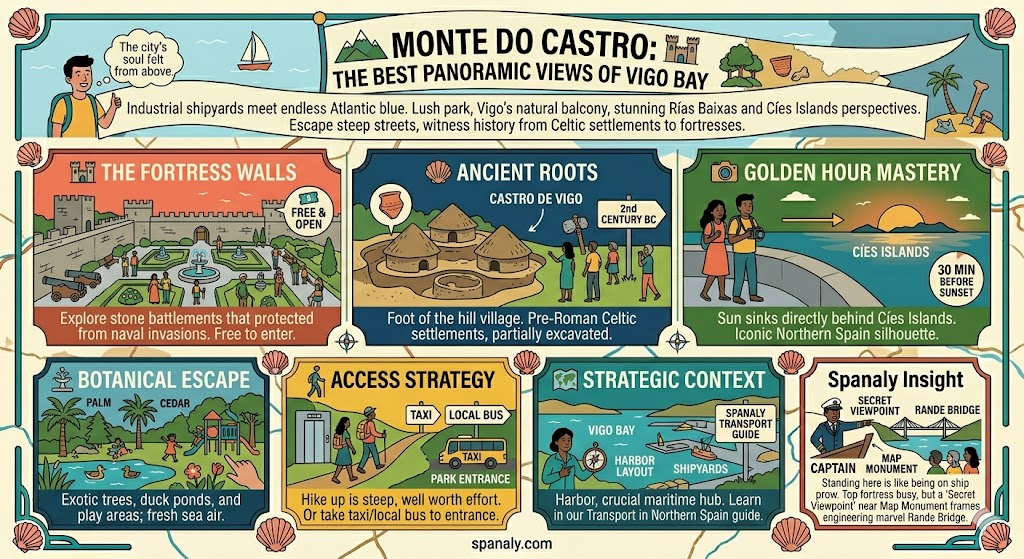
The true soul of the city is best felt from above, where the industrial power of the shipyards meets the endless blue of the Atlantic. Monte do Castro is a lush, hilltop park that serves as Vigo’s natural balcony, offering a stunning perspective on the Rías Baixas and the distant Cíes Islands. It is the perfect place to escape the steep city streets and witness the historical layers of the region, from Celtic settlements to defensive fortresses.
🏰 The Fortress Walls: Explore the 17th-century stone battlements that once protected the city from naval invasions; the gardens inside the walls are meticulously maintained and free to enter.
🐚 Ancient Roots: At the foot of the hill, you can visit the partially excavated Castro de Vigo, a pre-Roman Celtic village that dates back to the 2nd century BC.
📸 Golden Hour Mastery: Timing is everything. Arrive at the viewpoint at least 30 minutes before the sun dips below the horizon. Watch the spectacle: the sun sinks directly behind the Cíes Islands, creating a silhouette that defines the Northern Spain experience.
⛲ Botanical Escape: The park is filled with exotic trees, duck ponds, and children’s play areas, making it a favorite spot for local families to enjoy the fresh sea air.
🚶 Access Strategy: While the hike up is steep, it is well worth the effort; however, if you are saving your energy for the islands, you can take a taxi or a local bus to the park entrance.
🗺️ Strategic Context: From this height, you can clearly see the layout of the harbor, a crucial maritime hub you can learn more about in our Transport in Northern Spain guide.
🐚 Coastal Villages: Baiona, Sanxenxo, and Combarro Day Trips
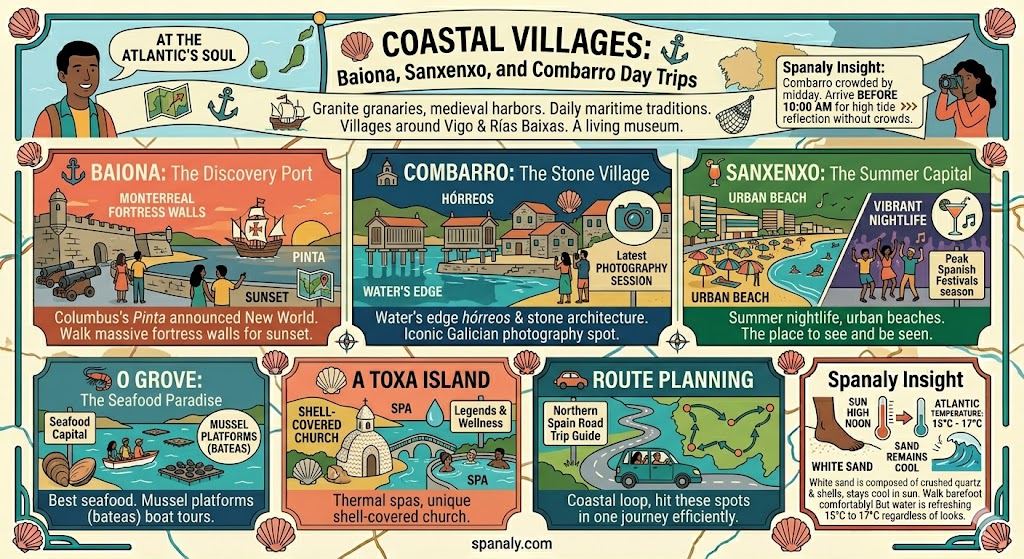
The true soul of the Atlantic isn’t confined to the city limits; it breathes through the granite granaries and medieval harbors of the surrounding coast. Exploring the villages around Vigo and the Rías Baixas is like stepping into a living museum where ancient maritime traditions still dictate the daily pace of life.
⚓ Baiona: The Discovery Port: Visit the spot where Columbus’s Pinta first announced the discovery of the New World. Walk the massive fortress walls of Monterreal for a sunset that rivals any in Northern Spain.
⛪ Combarro: Tradition meets the tide. This village is famous for “hórreos” (stone granaries) built directly at the water’s edge. Focus your lens: as the most iconic example of Galician architecture, it offers the perfect backdrop for professional-grade photography.
🍹 Sanxenxo: The Summer Capital: Known for its vibrant nightlife and urban beaches, it is the place to see and be seen during the peak Spanish Festivals season.
🦐 O Grove: The Seafood Paradise: Often called the “Seafood Capital,” it’s the best place to hop on a boat tour to see the mussel platforms (bateas) up close.
🧖 A Toxa Island: Connected by a bridge, this island is legendary for its thermal spas and its unique church completely covered in seashells.
🚗 Route Planning: To hit these spots in one journey, check our Northern Spain Road Trip guide for the most efficient coastal loops.
📅 Best Time to Visit: Weather, Festivals, and High Season Tips
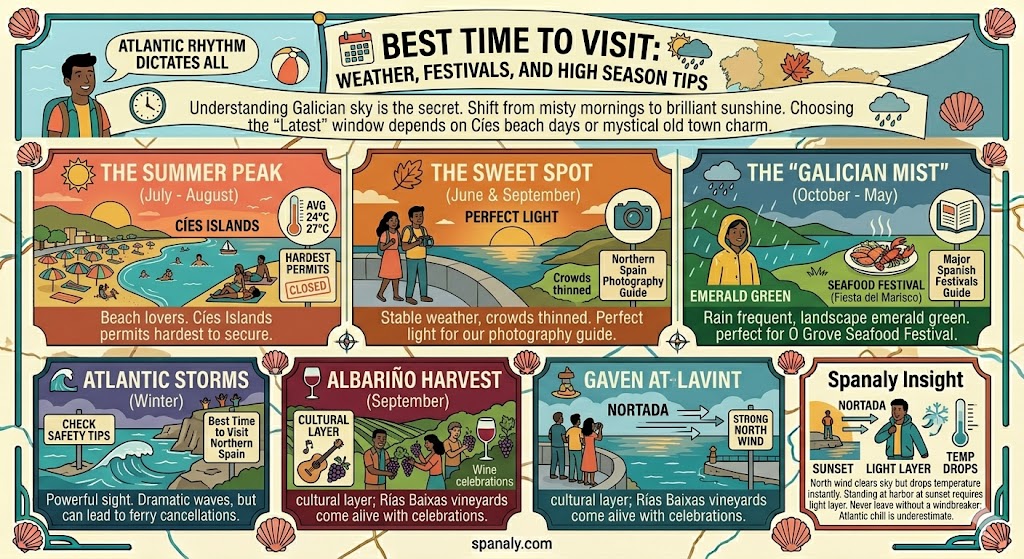
The Atlantic rhythm dictates everything here, and understanding the Galician sky is the secret to a successful trip. Unlike the predictable heat of the south, Vigo and the Rías Baixas offer a microclimate that can shift from misty mornings to brilliant sunshine in hours. Choosing the Essential window for your visit depends on whether you seek beach days on the Cíes Islands or the mystical, rain-slicked charm of the old town.
☀️ The Summer Peak (July – August): This is the prime time for beach lovers, with temperatures averaging 24°C to 27°C; however, this is also when the Cíes Islands permits are hardest to secure.
🍂 The Sweet Spot (June & September): Often the best months for travelers; the weather is stable, the crowds have thinned, and the light is perfect for our Best Photography Spots Spain guide.
🌧️ The “Galician Mist” (October – May): While rain is frequent, the landscape becomes an emerald green. It is the perfect time for the Seafood Festival (Fiesta del Marisco) in O Grove, a highlight of Major Spanish Festivals.
🌊 Atlantic Storms: Winter brings dramatic waves crashing against the cliffs; it’s a powerful sight but can lead to ferry cancellations—always check our Best Time to Visit Northern Spain for seasonal safety tips.
🍷 Albariño Harvest (September): Visiting during the grape harvest adds a cultural layer to your trip, as the vineyards of the Rías Baixas come alive with traditional celebrations.
Spanaly Insight: The “Nortada” wind is deceptive. This refreshing north wind clears skies but drops temperatures instantly. Layer up for sunset: even in peak summer, the harbor’s edge requires a windbreaker to combat the Atlantic chill.
🏨 Where to Stay in Vigo: Best Neighborhoods and Hotels

Location defines your experience. Choosing a base depends on your priority: historical charm or seamless transport links. Vigo offers diverse options, from stone-walled boutique hotels in the old town to modern suites with bay views. Pick your spot wisely: the right location is key to navigating the city’s steep hills without exhaustion.
🏰 Casco Vello (The Historic Heart): Perfect for those who want to be steps away from the “Oyster Street” and the ferry terminal; expect charming, renovated buildings but be prepared for some nightlife noise.
🏙️ Ensanche (The Modern Center): This is the high-end district near the García Barbón theater; it offers wide avenues, luxury shopping, and some of the best high-end Accommodation in Spain options.
🚉 Urzaiz & Vía Norte: Ideal for travelers arriving by high-speed train; this area is home to the modern “Vialia” complex, offering great connectivity and easy access to our Transport in Northern Spain routes.
🏖️ Samil Beach (Coastal Escape): Best for families and summer visitors who prefer a resort feel over the urban bustle; it’s a 15-minute taxi ride from the center but offers the best Atlantic sunsets.
📍 O Castro Hill: A quieter, more residential choice with cooler air and panoramic views, though it requires using the city’s public elevators to reach the port.
💰 Budget Strategy: Value meets convenience. For affordable stays, look for local guesthouses (pensiones) near the Principe Street shopping area. Stay central for less: these spots offer excellent value and keep you within walking distance of the city’s main attractions.
⏱️ Vigo in One Day: The Strategic Atlantic Itinerary
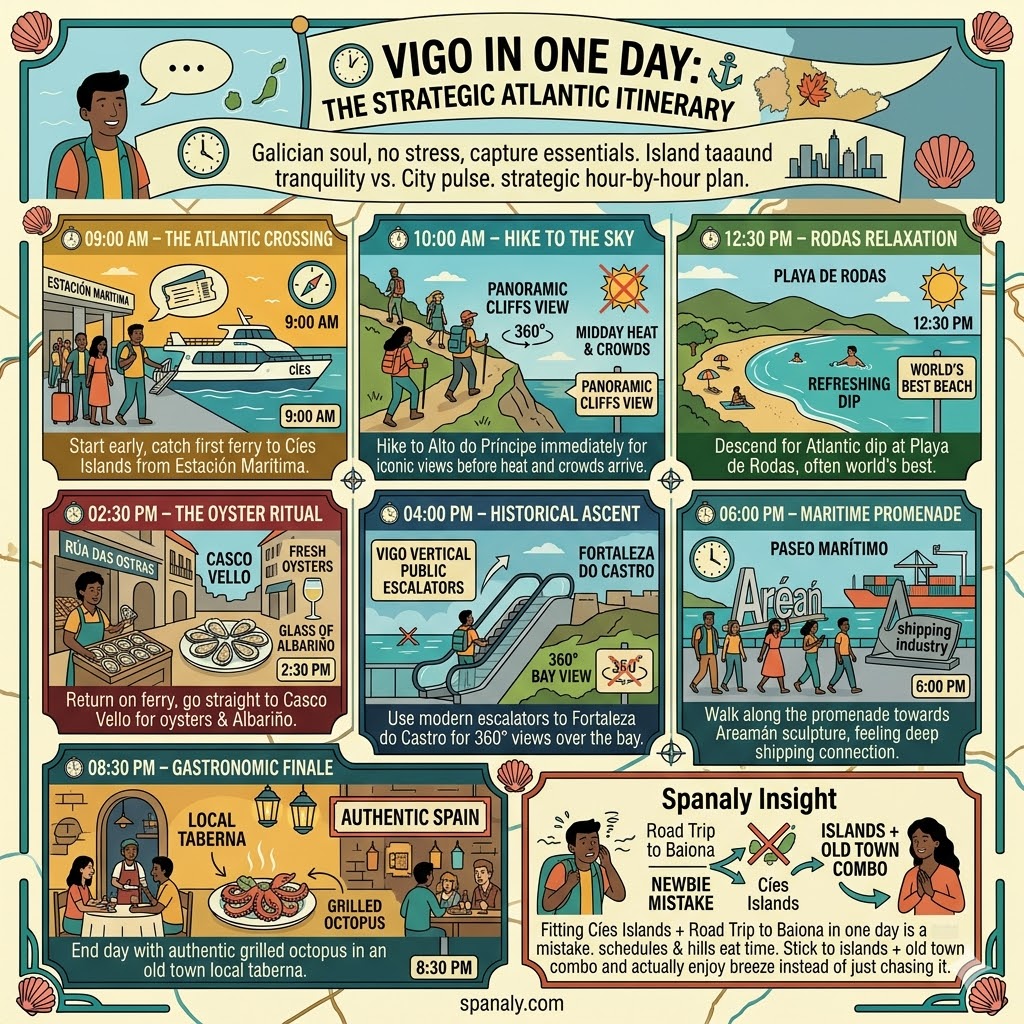
The reality of a short stay is that you must choose between the islands’ tranquility and the city’s vibrant pulse. If you only have 24 hours in Vigo and the Rías Baixas, this hour-by-hour plan ensures you capture the essential “Galician soul” without the stress of missing the last boat.
09:00 AM – The Atlantic Crossing: Start early at the Estación Marítima to catch the first ferry to the Cíes Islands.
10:00 AM – Hike to the Sky: Immediately hike up to Alto do Príncipe for the iconic panoramic view of the cliffs before the midday heat and crowds arrive.
12:30 PM – Rodas Relaxation: Descend for a quick, refreshing “Atlantic dip” at Playa de Rodas, the beach often cited as the world’s best.
02:30 PM – The Oyster Ritual: Take the ferry back and head straight to Rúa das Ostras in the Casco Vello for fresh oysters and a glass of Albariño.
04:00 PM – Historical Ascent: Use the Vigo Vertical public escalators to reach the Fortaleza do Castro for a 360-degree view of the bay you just crossed.
06:00 PM – Maritime Promenade: Walk along the Paseo Marítimo toward the “Areamán” sculpture, feeling the city’s deep connection to the shipping industry.
08:30 PM – Gastronomic Finale: End your day with authentic Spanish Cuisine in the old town, specifically targeting a local “Taberna” for grilled octopus.
Spanaly Insight: Avoid the “one-day overload” mistake. Pairing the Cíes Islands with a Baiona road trip is physically impossible due to ferry schedules. Focus your energy: stick to the islands and Vigo’s old town to truly enjoy the Atlantic breeze.
📸 Spanaly Elite Tips: The "Reddit" Secret Guide to Rías Baixas

The Atlantic hides its best secrets. Beyond the brochures lie the “Latest” hacks we’ve distilled from local Galician forums. These micro-details ensure an elite expert experience in Vigo and the Rías Baixas.
🕵️ The “Invisible” Permit Hack: Sold out for Cíes Islands? Check Ons Island schedules instead. It offers a similar vibe with 40% fewer crowds and better last-minute availability.
🔌 The Ferry Power Trap: Most island ferries have broken USB ports. Start at 100% battery. Salt air and constant photos will drain your phone faster than on the mainland.
🧥 The “15-Minute” Weather Rule: It might be 30°C in Vigo, but the islands feel 10 degrees colder. The “Nortada” wind is constant. Pack a light windbreaker in your daypack—no exceptions.
📵 Signal Black Holes: Expect a mobile “dead zone” between the two main Cíes islands. Download your QR codes and Northern Spain Road Trip maps for offline use before boarding.
🥤 Free Water Secret: Bottled water is expensive on the islands. Look for the natural spring near the Campsite (Camping). It is free, cold, and safe for refilling reusable bottles.
🦪 Oyster Timing: Never eat on “Rúa das Ostras” after 3:00 PM. The freshest batches arrive with the morning boats. Late afternoon often means “tourist leftovers.”
🛒 Port-Side Savings: Vigo center has “Froiz” or “Gadisa” supermarkets. Buy snacks here. Terminal kiosk prices are nearly double the local rate.
Spanaly Insight: Skip the escalator lines. During rush hour, the main Porta do Sol escalator is packed. The Elite move: walk one block to the Rúa de Carral stairs. You’ll beat the cruise crowds to the Casco Vello every time.
🛡️ Visitor FAQs – Vigo & Rías Baixas Guide
🛡️ Is it safe to leave my car in the Vigo port area overnight?
Yes, but we recommend using official underground parking garages (like those at A Laxe or Vigo-Guixar) rather than street parking. These facilities are well-lit, monitored by 24/7 security, and provide direct access to the ferry terminal, making them a secure choice for those staying on the Cíes Islands for a night.
🎫 Do I need to print my Cíes Islands permit and ferry ticket?
No, digital versions are fully accepted. However, because mobile signal is inconsistent on the boat and near the island pier, we strongly advise saving your QR code as a screenshot or in your digital wallet before you leave the mainland to avoid boarding delays.
💊 Can I find English-speaking pharmacies for Atlantic sea sickness?
Absolutely. The pharmacies in Vigo's Ensanche and near the port (marked with the green cross) are accustomed to international travelers. Ask for "biodramina" if you are sensitive to boat movements. For emergencies, the Vigo central clinics offer fast service, though the 112 emergency line is the standard for any critical medical needs.
🧺 Can I take my own food and drinks to the Cíes Islands?
Yes, and it is highly recommended. While there are a couple of restaurants on the island, they can be expensive and very busy during peak hours. Bring your own supplies in a reusable cooler bag, but remember you must carry all waste and plastic back to Vigo, as there are no bins on the islands.
♿ Is Vigo accessible for visitors using wheelchairs?
Vigo has pioneered the "Vigo Vertical" project, installing numerous public elevators and outdoor escalators to bypass its steep slopes. While the historic Casco Vello still has some uneven cobblestones, the modern center and the ferry terminal are highly accessible. For the Cíes Islands, only the main paths near the pier are paved enough for standard wheelchairs.
Vigo & Rías Baixas Guide by Spanaly.com
The mist may fade, but the impression left by the Rías Baixas remains etched in your memory long after you leave. Vigo and the Rías Baixas are more than just a destination; they are a sensory masterclass in Atlantic life, where every wave tells a story of discovery and every meal is a tribute to the sea.
🏝️ Final Horizon: From the silent cliffs of the Cíes Islands to the bustling “Oyster Street,” you’ve touched the raw heart of Galicia.
🐚 Cultural Echoes: The granite hórreos and Celtic ruins prove that in this corner of Spain, the past and present flow together like the tides.
🍷 Tasting the Coast: Whether it’s the crisp Albariño or the fresh octopus, the flavors of the Rías Baixas are the true souvenirs you’ll carry home.
⛵ Northern Expansion: If the maritime history of Vigo has sparked your curiosity, continue your Atlantic quest by visiting the legendary Tower of Hercules Guide, the world’s oldest working lighthouse.
Standing at the harbor’s edge one last time, you realize that the “Galician Caribbean” is just the beginning of your northern adventure. Pack your spirit of exploration, follow the Atlantic light, and let the rugged beauty of Spain’s coast guide your next chapter.