Table of Contents
Toggle🏛️ Tower of Hercules
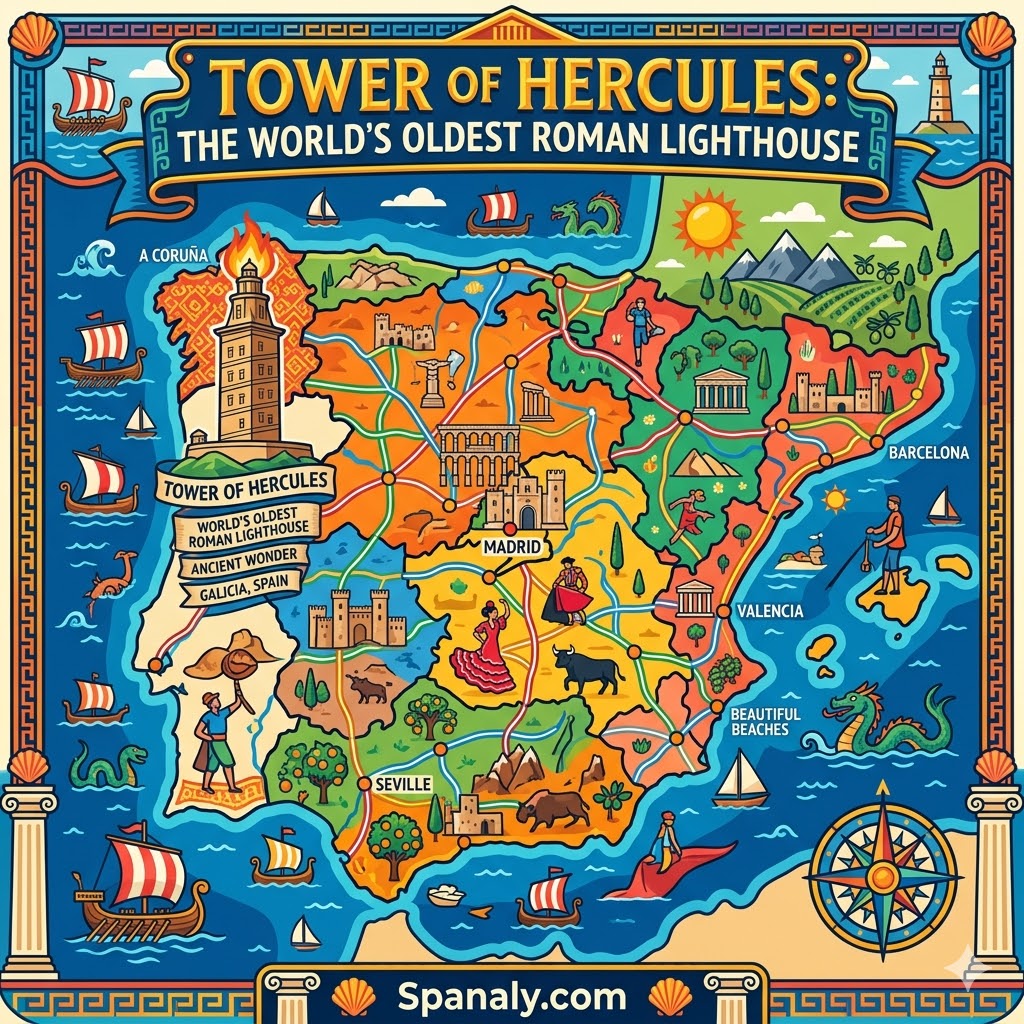
Standing at the edge of the ancient world, you quickly realize that the Tower of Hercules is much more than a maritime beacon. It is the only Roman lighthouse still fulfilling its original function after nearly two millennia, defying the fierce Atlantic storms of the Galician coast. Whether you are a history enthusiast or searching for the perfect sunset, this guide offers everything needed to explore this UNESCO World Heritage site.
⚓ Ancient Legacy: Explore the internal Roman core of the world’s oldest working lighthouse.
⚔️ Mythic Roots: Uncover the legendary battle between Hercules and the giant Geryon that defines this historic site.
🌅 Panoramic Views: Climb the 234 steps for an unforgettable 360-degree view of A Coruña’s rugged coastline.
🌍 Regional Context: To see how this monument fits into your broader journey, consult our Ultimate Northern Spain Travel Guide for expert regional insights.
Stepping toward the tower means walking through layers of history, from original Roman masonry to neoclassical restorations. Let the Atlantic breeze lead you to a place where ancient engineering still guides the modern world.
📅 Tower of Hercules: Essential Visitor Snapshot
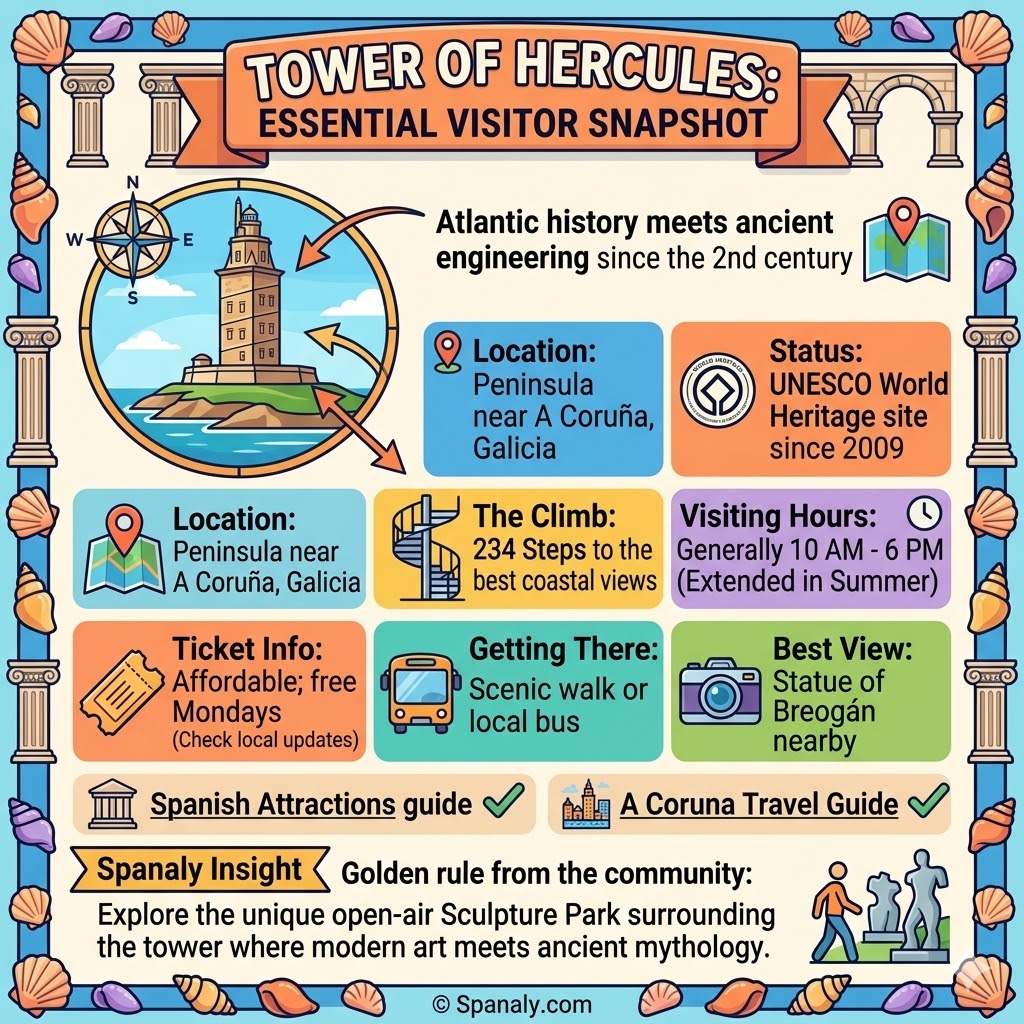
Few places in Europe preserve the raw maritime power of the Roman Empire as effectively as this peninsula. Approaching the base of the Tower of Hercules, you aren’t just visiting a monument; you are entering a living piece of history that still guides ships into A Coruña’s harbor.
⏱️ Visit Duration: Plan for 60 to 90 minutes if you intend to climb the tower and explore the immediate grounds.
🪜 Physical Demand: The 234 steps are steep and narrow; it is generally not recommended for seniors with mobility issues or very young children without supervision.
👪 Family Friendly: While the climb is tough, the surrounding Sculpture Park is perfect for kids to run around safely.
☀️ Summer Wait Times: During July and August, wait times for the climb can exceed 45 minutes due to capacity limits in the Roman chambers.
☕ Amenities: A small café and clean public restrooms are located within the Visitor Center near the parking lot—none are available inside the tower itself.
🎟️ Ticket Strategy: Remember that tickets are sold only at the Visitor Center. Admission is often free on Mondays, but expect significantly larger crowds.
🏙️ Local Guide: To maximize your time in the city, consult our A Coruna Travel Guide for the best post-visit tapas spots.
Spanaly Insight: Travelers quickly notice that the Atlantic wind here is unforgiving. Even on a warm day, the temperature at the top of the tower feels 5-8°C colder than in the city center. Carry a light windbreaker in your bag to stay comfortable during the climb.
🏛️ Ancient vs. Modern: How the Tower of Hercules Compares
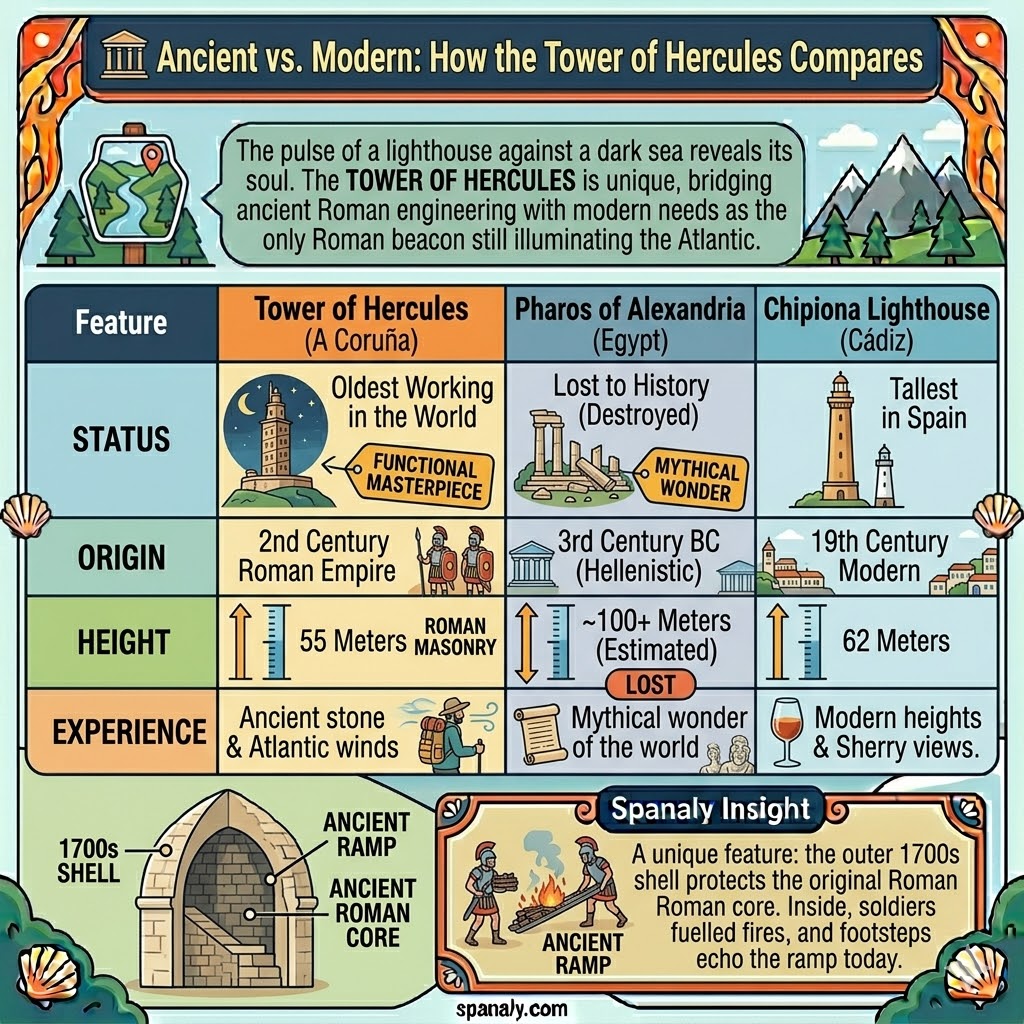
The true soul of a lighthouse is felt in the rhythmic pulse of its light against a dark, crashing sea. While many structures guide ships today, Tower of Hercules stands in a league of its own as the only Roman beacon still illuminating the Atlantic. The beauty of this comparison lies in how it bridges the gap between ancient engineering and modern maritime needs.
| Feature | Tower of Hercules (A Coruña) | Pharos of Alexandria (Egypt) | Chipiona Lighthouse (Cádiz) |
| Status | Oldest Working in the World | Lost to History (Destroyed) | Tallest in Spain |
| Origin | 2nd Century Roman Empire | 3rd Century BC (Hellenistic) | 19th Century Modern |
| Height | 55 Meters | ~100+ Meters (Estimated) | 62 Meters |
| Experience | Ancient stone & Atlantic winds | Mythical wonder of the world | Modern heights & Sherry views |
🔱 The Roman Legacy: Unlike the Pharos of Alexandria, which only exists in history books, you can still touch the original Roman masonry of the Hercules tower.
🗼 Spanish Heights: While the Chipiona Lighthouse in Cádiz is taller, it lacks the ancient soul and UNESCO heritage of its Galician older brother.
🌊 Coastal Vibes: To explore more legendary shores and beacons, dive into our Ultimate Spain Beach Guide for the best coastal experiences.
📜 History and Origin: The Eternal Roman Sentinel

Long before modern navigation, this rocky outcrop served as the Roman Empire’s ultimate frontier against the “unknown” Atlantic. Tower of Hercules was commissioned in the 2nd century, not merely as a lighthouse, but as a bold statement of Roman engineering dominating the treacherous Galician waves.
🧱 The Architect’s Mark: The original structure was designed by Gaius Sevius Lupus, who dedicated his masterpiece to Mars, the Roman god of war.
⚒️ 1,800-Year-Old Masonry: While the neoclassical exterior dates to 1788, the internal chambers still consist of the original Roman core.
🔥 The Ancient Hearth: For centuries, specialized crews maintained massive wood fires at the summit to guide Roman galleys through the “Coast of Death”.
🗺️ Historical Scope: To see how this beacon influenced other ancient sites, explore our guide to the Best Places to Visit In Northern Spain.
⏳ Preservation Note: The tower has survived centuries of Atlantic salt corrosion, requiring specialized conservation efforts every few decades to protect the porous stone.
📜 Unique Status: It remains the only fully preserved Roman lighthouse in the world that has never ceased its maritime function.
Spanaly Insight: Standing here feels like stepping into a time capsule. Once inside, the air temperature drops significantly as you touch the massive, rough-hewn Roman stones—a physical connection to the past that modern steel and glass structures simply cannot replicate.
🔱 The Legend: Hercules and the Giant Geryon
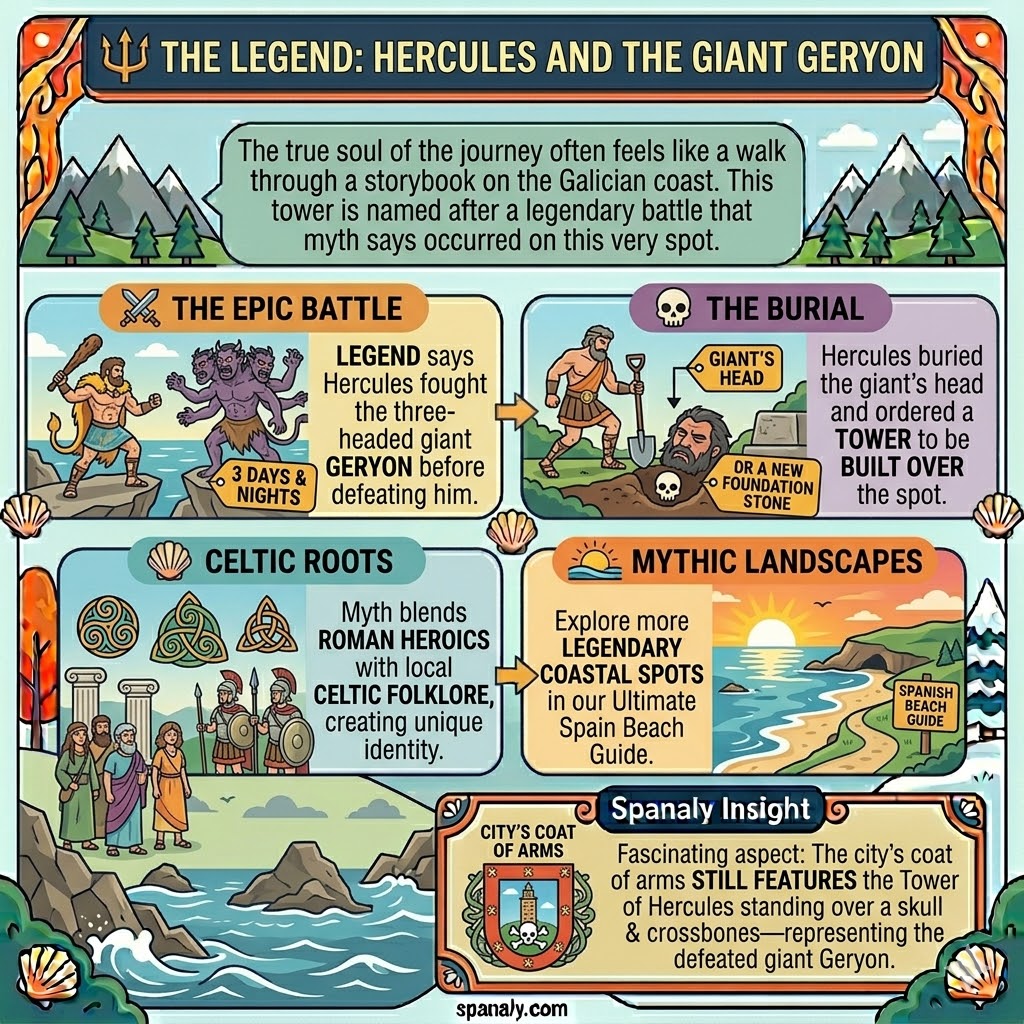
At sunset, the monument becomes more than just stone and mortar; it transforms into the stage of an ancient clash between gods and giants. This legendary heritage is so deeply rooted that it defines the very identity of A Coruña.
⚔️ The Epic Battle: Mythology tells of Hercules fighting the three-headed giant Geryon for three grueling days and nights.
💀 The Burial: Following his victory, Hercules reportedly buried the giant’s head on this cliff and commanded a tower to be built above the site.
🐚 Celtic Fusion: This narrative cleverly weaves Roman heroic traditions with local Galician Celtic folklore.
🌅 Mythic Landscapes: For more shores where history and myth collide, explore our Ultimate Spain Beach Guide for hidden gems.
🛡️ Heraldic Proof: You can see the legacy of this battle today in the city’s official coat of arms.
🎨 Artistic Clues: The surrounding Sculpture Park features several works that visually interpret these ancient myths for modern visitors.
Spanaly Insight: Travelers quickly notice the skull and crossbones beneath the tower on local insignias. While it might look like a pirate symbol, it actually represents the defeated giant Geryon, marking the exact spot where myth and masonry meet.
🏗️ Architecture and Design: A Roman Engineering Marvel
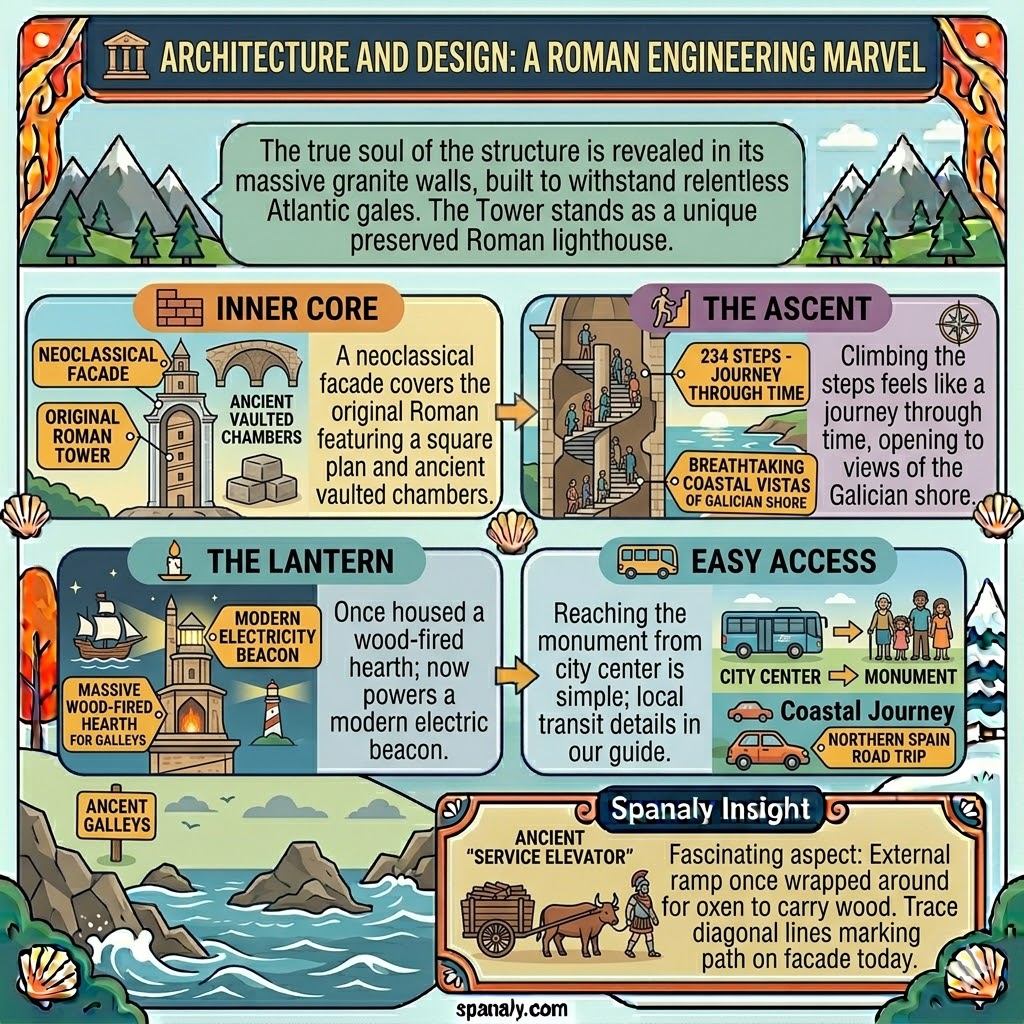
Unlike most Roman sites that have surrendered to time, the massive granite walls of this structure reveal a defiant engineering marvel built to withstand the relentless Atlantic gales. Tower of Hercules stands as a unique global example of a Roman lighthouse that has preserved its internal structural integrity through nearly two millennia.
🧱 Inner Core: Behind the neoclassical facade lies the original Roman tower, featuring a square plan and ancient vaulted chambers.
🪜 The Ascent: Climbing the 234 steps feels like a journey through time, opening into breathtaking coastal vistas of the Galician shore.
🕯️ The Lantern: While modern electricity now powers the beacon, the top once housed a massive wood-fired hearth to guide ancient galleys.
🚗 Coastal Journey: Many travelers visit this architectural wonder as part of a broader Northern Spain Road Trip to explore the rugged Atlantic coast.
🚌 Easy Access: Reaching this monument from the city center is simple; you can find details on local transit in our Transport in Northern Spain guide.
🎟️ Visitor Information: Plan Your Visit to the Tower
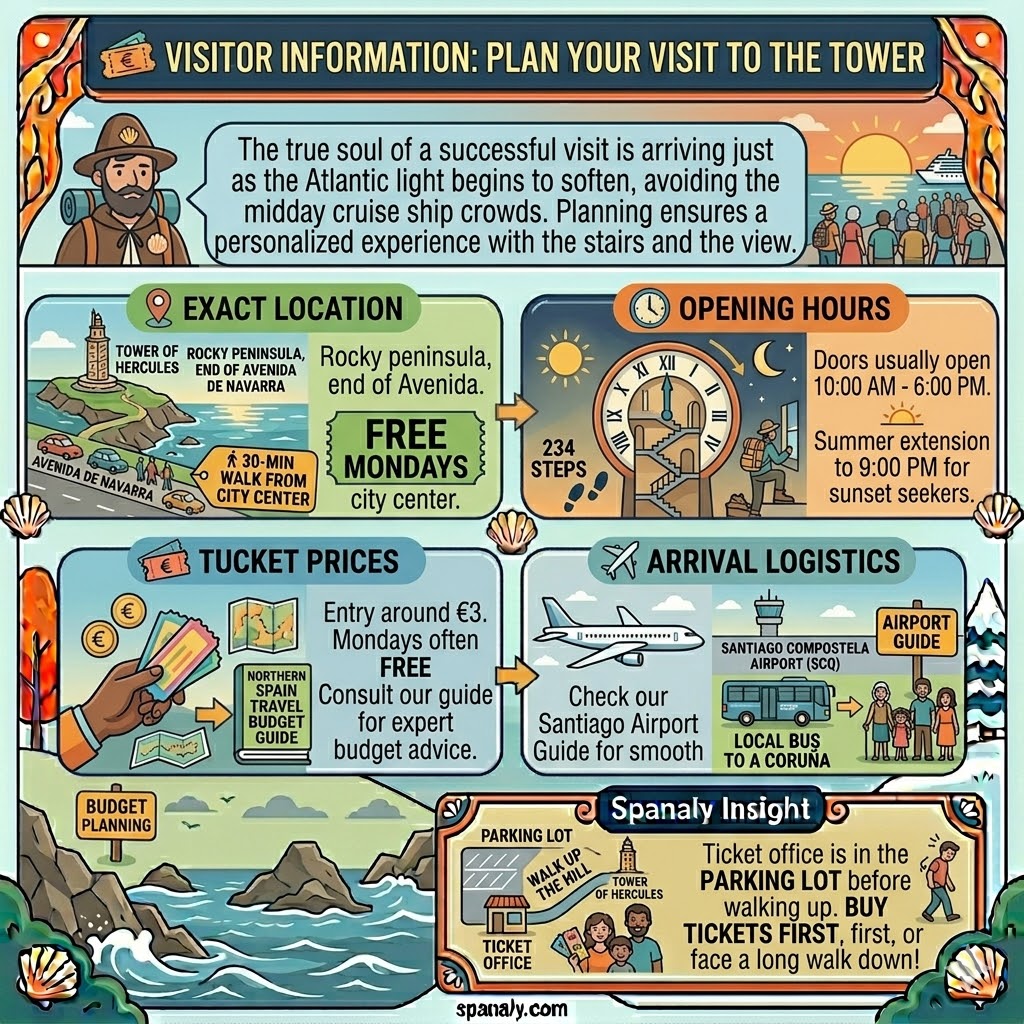
At sunset, the monument becomes a magnet for those seeking the perfect Atlantic glow, so arriving just as the light begins to soften is the best way to avoid the midday cruise ship crowds. Tower of Hercules is a popular site, so a little planning goes a long way in ensuring you have the stairs and the panoramic view to yourself.
📍 Exact Location: The tower sits on a rocky peninsula at the end of Avenida de Navarra, about a 30-minute walk from the city center.
🕒 Opening Hours: Doors typically open at 10:00 AM and close at 6:00 PM, though summer hours often extend until 9:00 PM for sunset seekers.
🎟️ Ticket Prices: Entry is very affordable (around €3), and Mondays are often free, making it a perfect day for budget-conscious travelers.
🪜 Climbing Tips: The ascent involves 234 steps; it is best to wear sturdy shoes and take small breaks to admire the changing views through the slit windows.
💰 Budget Planning: To see how these costs fit into your overall trip, consult our guide on Northern Spain Travel Cost & Budget for expert advice.
✈️ Arrival Logistics: If you are flying into the region to see this marvel, check our Santiago Compostela Airport Guide for the smoothest connection to A Coruña.
Spanaly Insight: A remarkable feature of the ticket office is its location it is situated in the parking lot before you walk up the hill to the tower. Make sure to buy your tickets there first, or you’ll face a long, frustrating walk back down!
🎨 The Sculpture Park: Art on the Atlantic Edge
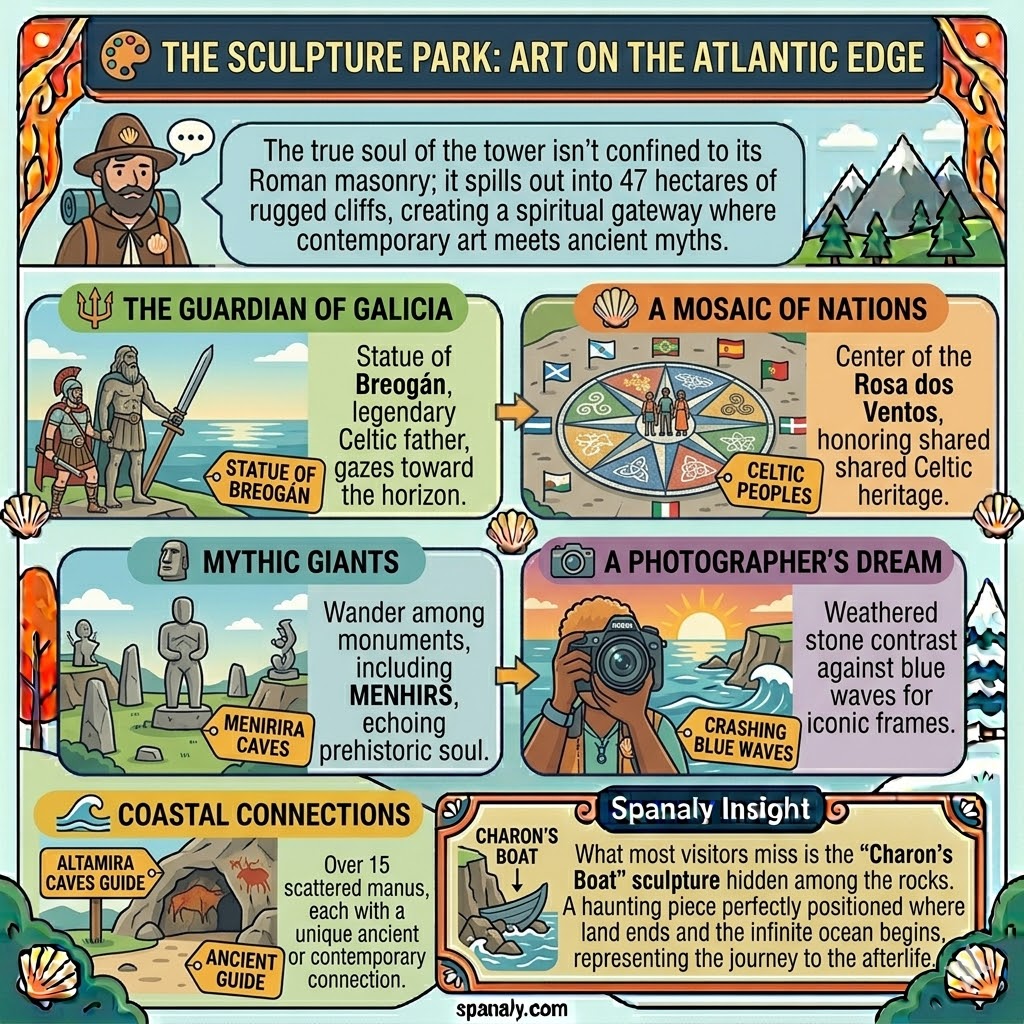
Unlike most Roman sites that are confined to their ancient masonry, this landmark spills out into 47 hectares of rugged, art-filled cliffs. The Sculpture Park functions as a breathtaking open-air museum where contemporary art meets ancient Atlantic myths, creating a spiritual gateway to the lighthouse.
🔱 The Guardian of Galicia: Your journey begins at the Statue of Breogán, the legendary Celtic father of the nation who gazes toward the horizon.
🐚 A Mosaic of Nations: Stand at the center of the Rosa dos Ventos, a giant compass rose at the tower’s feet that honors the shared heritage of Celtic peoples.
🗿 Mythic Giants: Wander among over 15 scattered monuments, including the “Menhirs” that echo the prehistoric soul of the Galician coastline.
📸 A Photographer’s Dream: The contrast between the weathered stone sculptures and the crashing blue waves offers the most iconic frames in Northern Spain.
🌊 Coastal Connections: If these seaside landscapes inspire you, explore the prehistoric magic of the Altamira Caves Guide to see how ancient art still defines this region.
Spanaly Insight: What most visitors miss is the “Charon’s Boat” sculpture hidden among the rocks. It’s a haunting piece that represents the journey to the afterlife, perfectly positioned where the land literally ends and the infinite ocean begins.
🛡️ UNESCO Heritage: A Legacy of Universal Value

The reality of time is that most Roman engineering has crumbled into dust, yet this sentinel remains standing against the Atlantic storms. Tower of Hercules earned its place as a UNESCO World Heritage site not just for its age, but for being the only lighthouse of antiquity that still functions today.
🏛️ Architectural Integrity: It is recognized as a unique example of a Roman lighthouse that has preserved its structural core for nearly two millennia.
🔱 Continuous Service: Since the 2nd century, it has never ceased to be a vital maritime signal for ships navigating the rugged Galician coast.
🌍 Global Landmark: Its UNESCO status highlights it as a masterpiece of Roman maritime technology and a symbol of human perseverance.
📜 Cultural Context: To see how this ancient beacon compares to other historic wonders, explore our guide to the most iconic Spanish Attractions.
📍 Best Things to Do Near the Tower of Hercules
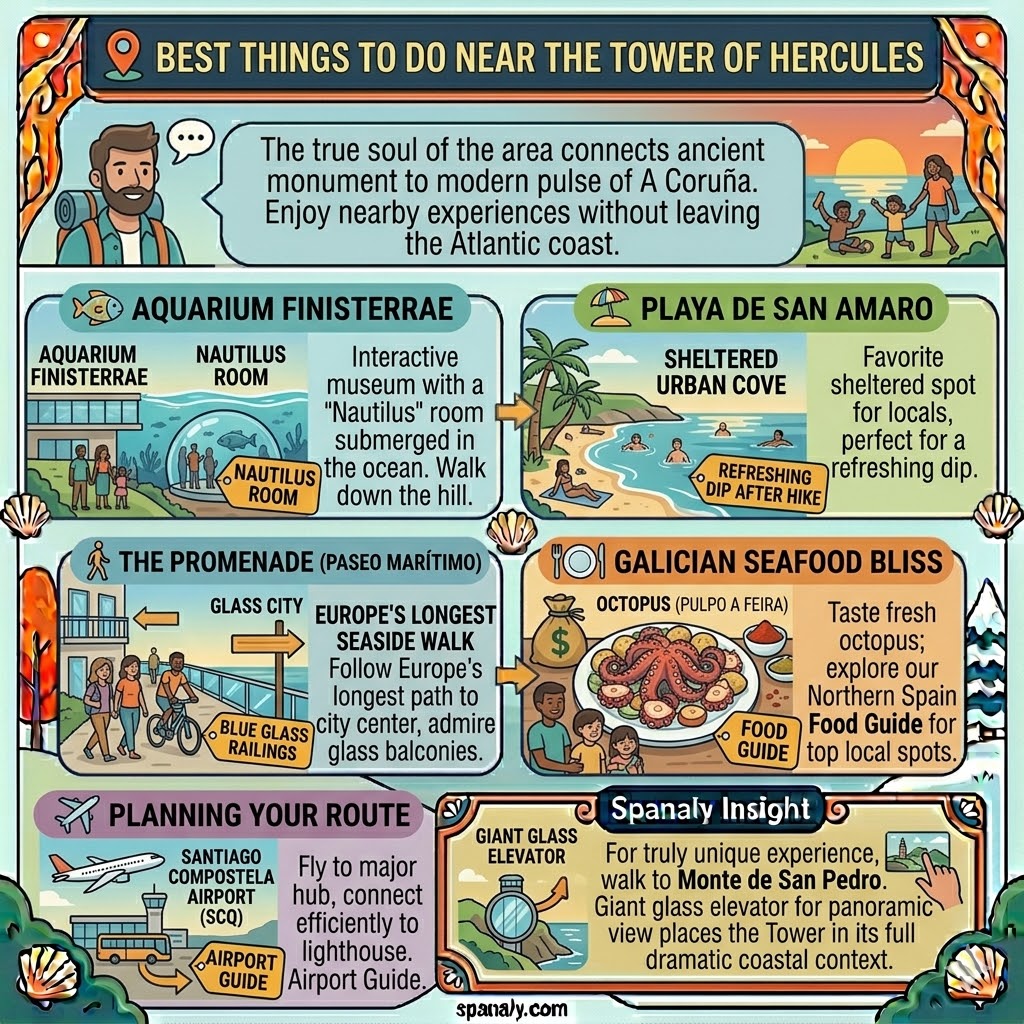
From the cliff edge, you can see exactly how the ancient monument connects to the modern pulse of A Coruña. After climbing the Roman stairs, these nearby experiences offer the perfect way to spend your afternoon without leaving the Atlantic coast.
🐠 Aquarium Finisterrae: Located just a short walk down the hill, this interactive museum features a “Nautilus” room submerged in the ocean—offering a fish-eye view of Atlantic marine life.
🏖️ Playa de San Amaro: This sheltered urban cove is a favorite for locals; it’s the best spot for a refreshing dip after your hike through the sculpture park.
🚶 The Promenade (Paseo Marítimo): Follow the blue glass railings of Europe’s longest seaside walk to reach the city center, enjoying the “Glass City” balconies along the way.
🍽️ Galician Seafood Bliss: No visit to A Coruña is complete without tasting fresh octopus (Pulpo a Feira); explore our Northern Spain Food Guide for the best local spots to eat.
✈️ Planning Your Route: If this is your first stop in the region, check our Santiago Compostela Airport Guide for the most efficient ways to reach the lighthouse from the nearest major hub.
Spanaly Insight: For a truly unique experience, walk to the “Monte de San Pedro” nearby. You can take a giant glass elevator to the top for a panoramic view that places the Tower of Hercules in its full, dramatic coastal context.
🚌 How to Reach the Tower from A Coruña City Center
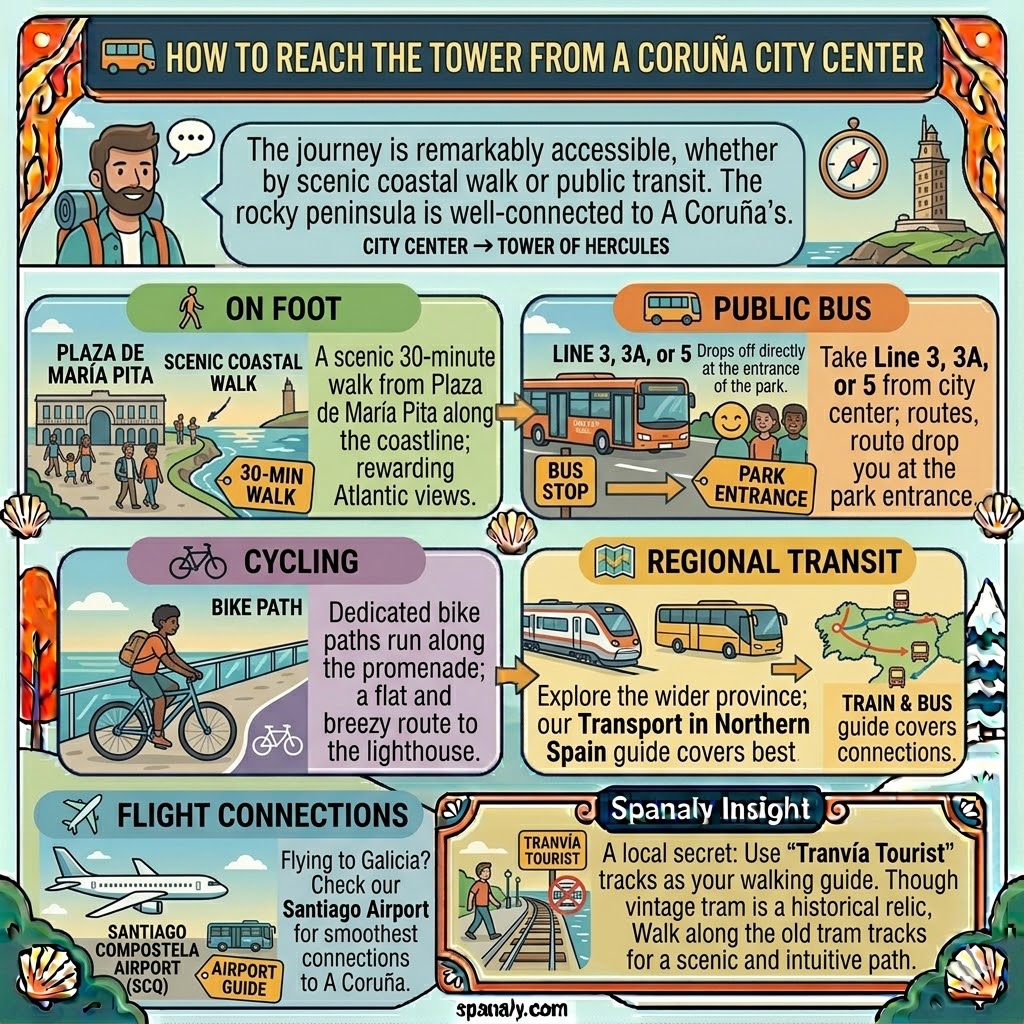
The reality of the journey is that the tower is remarkably accessible, whether you prefer a scenic coastal walk or the speed of public transport. Tower of Hercules sits on a rocky peninsula that is well-connected to the heart of A Coruña.
🚶 On Foot: A scenic 30-minute walk from Plaza de María Pita along the coastline offers the most rewarding views of the Atlantic.
🚌 Public Bus: Take Line 3, 3A, or 5 from the city center; these routes drop you off directly at the entrance of the park.
🚗 By Car: Ample parking is available at the base, but it fills up quickly during the peak summer months.
🚲 Cycling: The city’s dedicated bike paths run along the promenade, providing a flat and breezy route to the lighthouse.
🗺️ Regional Transit: If you are exploring the wider province, our guide on Transport in Northern Spain covers the best train and bus connections.
✈️ Flight Connections: For those traveling from outside Galicia, check our Santiago Compostela Airport Guide for the easiest way to reach A Coruña.
Spanaly Insight: A local secret is to use the “Tranvía Tourist” tracks as your walking guide. While the vintage tram itself is currently a historical relic, following its path along the sea is the most intuitive and scenic way to find the tower.
📸 Spanaly Elite Tips: The "Reddit" Secret Guide

Travelers quickly notice that the best experiences happen away from the main crowds, and knowing what the guidebooks don’t tell you is the key to an expert trip. Based on the latest traveler “hacks” and local insights, here is how to experience the Tower of Hercules like a pro:
🌬️ The Windward Strategy: Never trust a sunny day in A Coruña; the Atlantic wind at the tower’s base is 10°C colder than in the city center—always bring a windbreaker even in summer.
🕒 The “Monday” Mystery: While Monday is free, the line starts forming 45 minutes before opening; if you value your time over €3, go on a Tuesday morning for a nearly empty tower.
🦶 The Footwear Truth: Avoid the “Glass Railing” path if it’s raining; the smooth stones become a skating rink—stick to the internal gravel paths for grip.
🔋 Signal Dead Zones: Mobile data often drops near the “Rosa dos Ventos” due to the thick granite and coastal interference; download your offline maps before leaving the city center.
🦅 The Bird’s Eye Hack: For a free “drone-style” photo without a drone, hike up to the abandoned military battery at Monte de San Pedro for the ultimate telephoto shot of the tower.
🗺️ Regional Depth: If you enjoy these “insider” hacks, check out our Spanaly Tips for more survival secrets across the country.
🎒 Pack Like a Pro: This coastal wind requires specific gear; see our What to Pack for Spain guide to stay comfortable during your Galician adventure.
The ultimate Reddit hack: Don’t just look at the tower. Walk 5 minutes north to the “Cariño” cliffs. Most tourists stop at the lighthouse, but this spot offers a view of the tower framed by wild Atlantic foam that looks like a scene from Game of Thrones.
🛡️ Visitor FAQs – Tower of Hercules Guide
🛡️ Is it safe to visit the tower during Atlantic storms?
The tower is built to withstand extreme weather, but for safety, the top lantern level is closed when winds exceed certain speeds. The surrounding park remains open, offering a dramatic view of the waves crashing against the cliffs—just ensure you stay on the marked gravel paths to avoid slippery rocks.
🎫 Can I buy tickets inside the tower building?
No. This is a common visitor mistake. Tickets must be purchased at the Visitor Center located near the parking lot, before you walk up the hill. If you reach the tower entrance without a ticket, you will have to walk back down the hill to get one, as there is no ticket booth at the tower door.
🧗 Is the climb suitable for people with claustrophobia?
The internal staircase is stone and historic, but it is surprisingly spacious compared to other ancient towers. There are high ceilings and "resting chambers" at various levels where you can pause. However, the final few steps to the very top lantern are narrower and may feel slightly confined.
📸 Are drones allowed to film the lighthouse?
Strict regulations apply as the tower is a UNESCO site and close to urban areas. Recreational drone flying is generally prohibited without a specific permit from the A Coruña city council and aviation authorities. For the best "aerial-style" shots, we recommend using a telephoto lens from the Monte de San Pedro viewpoint.
🎒 Is there a luggage storage area at the visitor center?
The visitor center has very limited space and does not offer formal luggage lockers. Large backpacks are not allowed inside the tower for safety reasons. It is best to leave your luggage at your accommodation or use the storage lockers at the A Coruña train or bus stations before heading to the site.
Tower of Hercules Guide by Spanaly.com
Standing at the edge of the world, you can feel how the steady, golden beam of the Tower of Hercules captures the eternal spirit of the Atlantic. This Roman sentinel is far more than a monument; it is a bridge between ancient legends and modern wanderlust.
🏛️ A Living History: Experience the rare privilege of touching 2,000-year-old stones that still guide modern ships.
🔱 Beyond the Tower: Take your time to wander the sculpture park and feel the Celtic spirit of Galicia.
🌅 Sunset Mastery: Make sure to stay for the golden hour, as there is no sight quite like the tower glowing against the deep blue ocean.
👣 Continue the Journey: For many, the lighthouse marks the end of a long spiritual trek; if you are ready for your own adventure, explore our Camino de Santiago Beginner Guide to start your path.
Stepping away from the tower, you don’t just leave with photos; you carry a piece of the eternal Roman legacy with you. The Atlantic winds may be cold, but the history here provides a warmth that stays long after you’ve returned home.