🎭 Experience the Soul of Spain
Ready to dive into the real heartbeat of Spain?
🇪🇸 Festivals here are not side events — they are Spain.
From the explosive fire of Las Fallas to the electric passion of Feria de Abril, these celebrations transform entire cities into living stages of history, rhythm, and raw emotion.
🎯 Why You Should Prioritize Spanish Festivals
- Live the country like a true local, not a spectator
- Touch traditions that have survived for centuries
- Collect memories no guidebook or photo can replace
Whether your mission is running with the bulls in Pamplona, joining the tomato war in Buñol, or dancing till dawn in Seville — this guide gives you the exact plan you need.
For the full monthly calendar and in-depth tactical briefings, head to our Ultimate Spain Festivals Guide.
💡 Spanaly Insight: Festival dates in Spain can shift slightly each year based on the lunar calendar. Specifically, we recommend checking the official city hall (Ayuntamiento) website before booking your trip. This ensures you arrive in time for the grand opening ceremony! 🛡️✨
🗓️ Spanaly Quick-Look: Major Spanish Festivals at a Glance
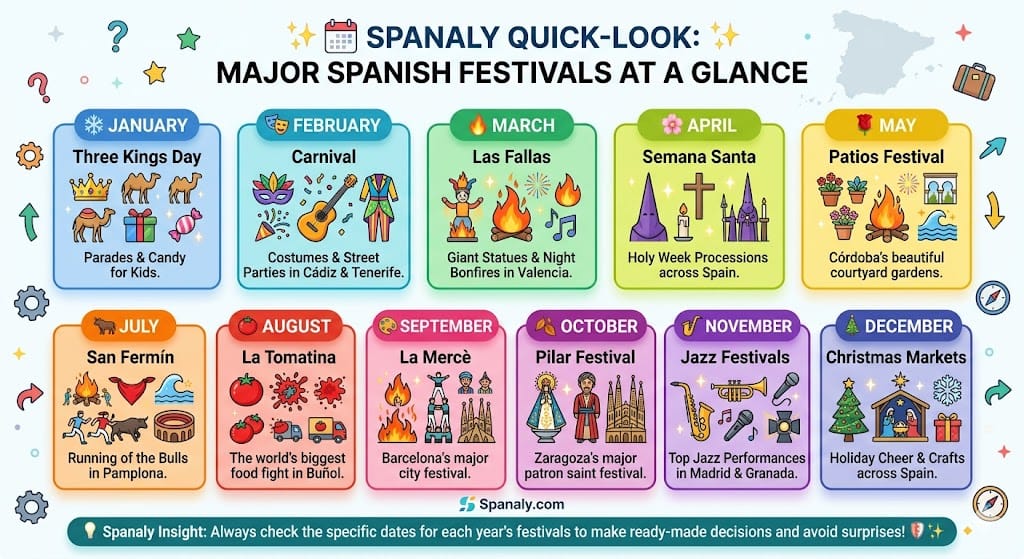
To help you plan your journey, we have compiled this essential monthly calendar. Specifically, these are the top cultural events that define the Spanish spirit throughout the year.
| Month | Festival Name | Top City / Region | Highlights |
| January | Three Kings Day | Madrid / All Spain | Grand Parades & Candy |
| February | Carnival | Cádiz / Tenerife | Costumes & Music |
| March | Las Fallas | Valencia | Giant Statues & Fire |
| April | Semana Santa | Seville / Málaga | Solemn Parades & Art |
| May | Patios Festival | Córdoba | Flower-filled Courtyards |
| June | San Juan | Costa Blanca / Beaches | Bonfires & Fireworks |
| July | San Fermín | Pamplona | Running of the Bulls |
| August | La Tomatina | Buñol (Valencia) | World’s Biggest Food Fight |
| September | La Mercè | Barcelona | Giant Parades & Concerts |
| October | Pilar Festival | Zaragoza | Flower Offerings & Music |
| November | Jazz Festivals | Madrid / Granada | World-class Performances |
| December | Christmas Markets | Madrid / Barcelona | Holiday Lights & Crafts |
💡 Spanaly Insight: Many festivals, like Semana Santa and Feria de Abril, change dates based on the lunar calendar. Specifically, we suggest checking the specific dates for your travel year to avoid arriving a week early or late! 🛡️✨
🎭 The Spirit of Spain: Connecting with the Local Soul
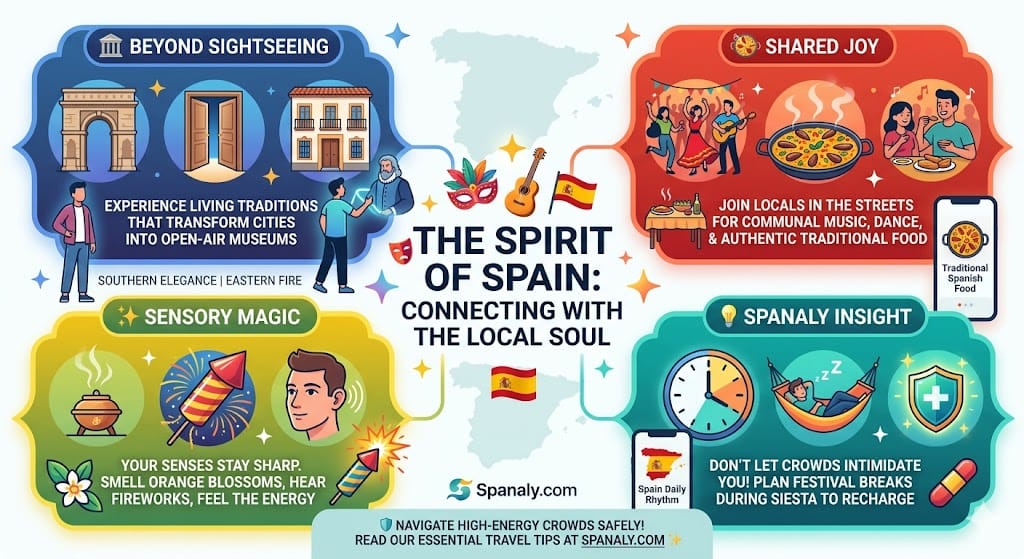
Experiencing the Major Spanish Festivals is the most authentic way to connect with the local soul. Specifically, these are not just events; they are living traditions that transform cities into vibrant open-air museums. Whether you seek southern elegance or eastern fire, you are seeing the real Spain.
🏛️ Beyond Sightseeing: Festivals offer a deeper connection than any standard monument or museum.
🥘 Shared Joy: Specifically, you will join locals in the streets for music and authentic Traditional Spanish Food.
✨ Sensory Magic: From the scent of incense to the roar of fireworks, your senses will stay sharp.
To navigate these high-energy crowds safely, specifically, we recommend checking our Essential Spain Travel Tips for a smoother journey.
💡 Spanaly Insight: Don’t let the crowds intimidate you! Specifically, if you understand the Spain Daily Rhythm, you can plan your festival breaks during siesta. This allows you to recharge before the main nighttime festivities begin! 🛡️✨
❄️ January in Spain: Kings, Drums, and Winter Traditions
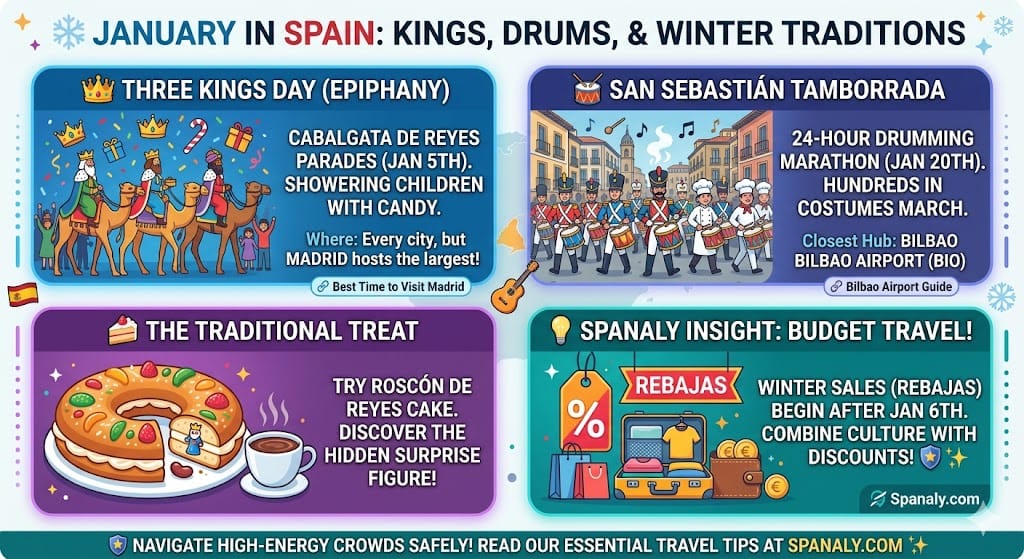
January in Spain is far from quiet. Specifically, after the New Year celebrations, the country prepares for one of its most beloved family traditions. While the air is crisp, the atmosphere is warmed by parades and rhythmic drumming. If you are planning to arrive this month, checking the Best Time to Visit Madrid will help you prepare for the capital’s winter charm.
👑 Three Kings Day (Epiphany)
The Major Spanish Festivals season truly kicks off on the evening of January 5th. Specifically, the Cabalgata de Reyes (Three Kings Parade) sees the biblical Magi arrive in every city to shower children with tons of candy.
Where: Every city, but Madrid hosts the largest and most spectacular parade.
The Treat: You must try Roscón de Reyes, a delicious ring-shaped cake hidden with a surprise figurine.
🥁 San Sebastián Tamborrada
On January 20th, the northern city of San Sebastián erupts in a 24-hour drumming marathon. Specifically, hundreds of participants dressed as cooks and soldiers march through the streets. To reach this rhythmic celebration easily, check our Bilbao Airport Guide for the closest international hub.
💡 Spanaly Insight: January is perfect for budget travelers! Specifically, once the Three Kings Day ends on January 6th, the winter sales (Rebajas) begin. You can combine cultural festivals with some of the best shopping discounts in Europe! 🛡️✨
🎭 February in Spain: The Wild Magic of Carnival
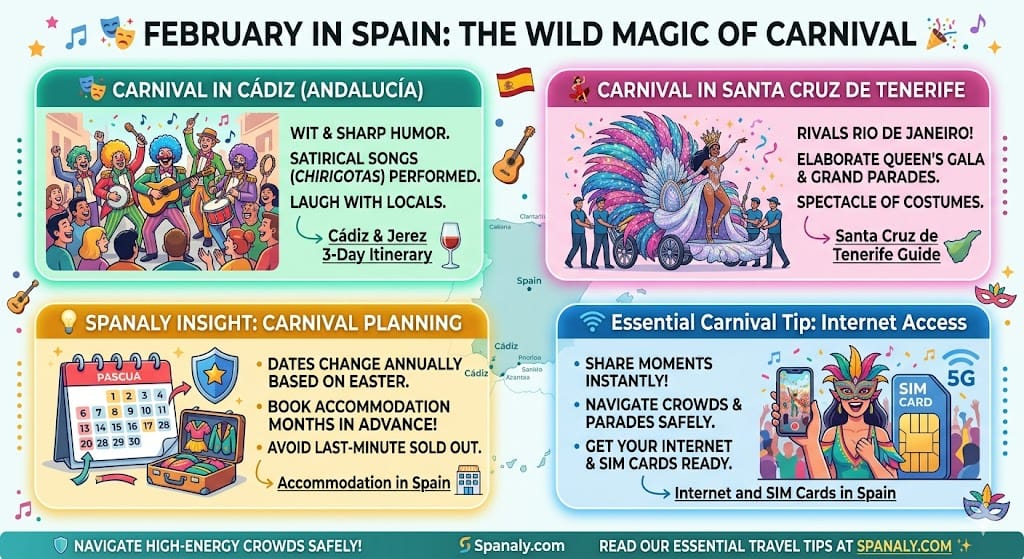
February in Spain is synonymous with Major Spanish Festivals of joy, satire, and elaborate costumes. Specifically, while the rest of Europe might be shivering, Spain’s coastal cities ignite with the energy of Carnival. To ensure you stay connected during these massive street parties, we recommend getting your Internet and SIM Cards in Spain ready before the music starts.
🎭 Carnival in Cádiz
The Carnival of Cádiz is famous for its wit and sharp humor. Specifically, local groups called Chirigotas perform satirical songs about politics and daily life.
The Vibe: It is less about luxury and more about clever costumes and laughing with locals.
Pro Tip: Check our Cádiz & Jerez 3-Day Itinerary to combine the party with the region’s famous sherry wineries.
💃 Carnival in Santa Cruz de Tenerife
If you seek a spectacle rivaling Rio de Janeiro, Tenerife is your destination. Specifically, the Queen’s Gala features costumes so massive they require wheels to move! To experience this island magic, dive into our Santa Cruz de Tenerife Guide for the best local spots.
💡 Spanaly Insight: Carnival dates change every year based on Easter. Specifically, always book your accommodation months in advance! If hotels in the center are full, check our Accommodation in Spain guide for alternative stay-options and transport hacks. 🛡️✨
🔥 March in Spain: Fire, Art, and Valencia’s Fallas
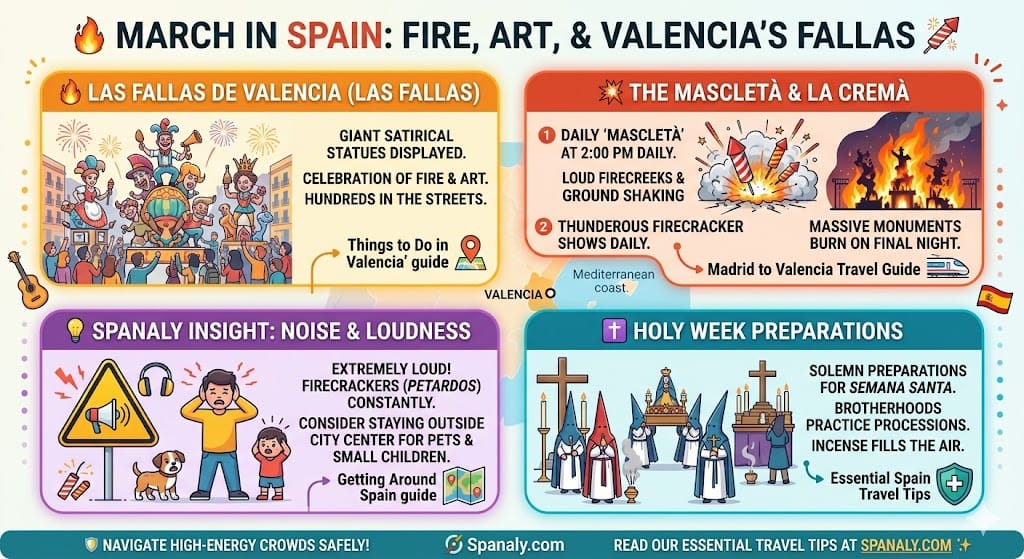
March marks the true arrival of spring and the heat of Major Spanish Festivals. Specifically, this month is dominated by one of the world’s most explosive traditions in Valencia. As crowds gather for the fire festivals, navigating the city becomes a challenge. We recommend checking our Getting Around Spain guide to master the high-speed trains and local transport during this busy season.
🔥 Las Fallas in Valencia
Las Fallas is a spectacular celebration of fire and satire. Specifically, the city displays hundreds of giant, colorful statues (Fallas) made of wood and papier-mâché, only to burn them to the ground on the final night.
The Mascletà: Every day at 2:00 PM, witness a thunderous firecracker show that shakes the ground.
La Cremà: Specifically, on the night of March 19th, the massive monuments are set ablaze in a stunning display.
Local Guide: Dive into our Things to Do in Valencia to find the best spots for viewing the fire without the heavy crowds.
✝️ Holy Week Preparations
While Valencia burns, the rest of Spain begins its solemn preparations for Semana Santa. Specifically, you will see brotherhoods practicing their processions and the scent of incense filling the air. To reach these early celebrations, the Madrid to Valencia high-speed train is your fastest connection.
💡 Spanaly Insight: Las Fallas is extremely loud! Specifically, if you are traveling with pets or small children, be aware that firecrackers (Petardos) go off constantly in the streets. We recommend staying slightly outside the city center to enjoy the festival and still get some rest! 🛡️✨
🌸 April in Spain: The Grand Soul of Seville & Holy Week
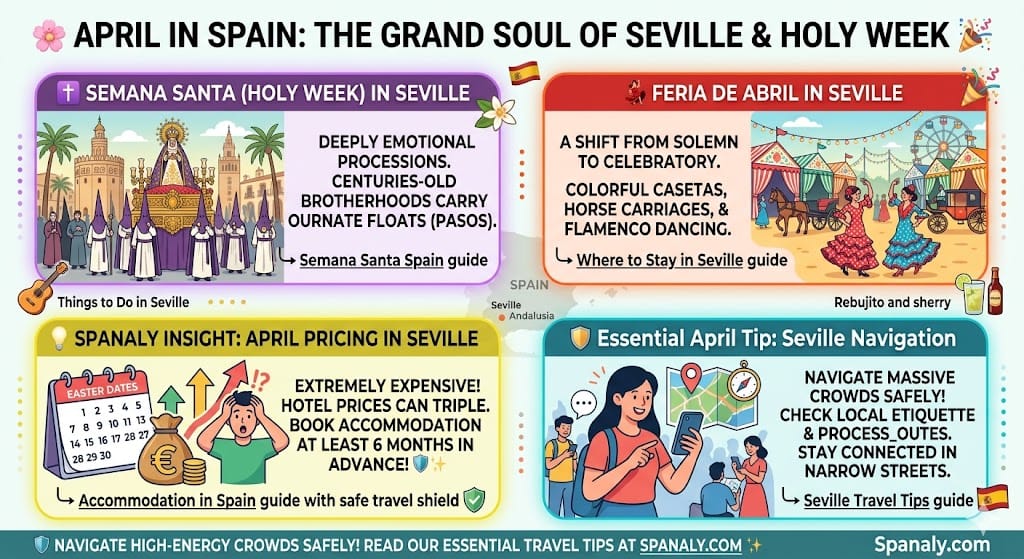
April is arguably the most iconic month for Major Spanish Festivals, specifically in the southern region of Andalusia. The scent of orange blossoms (Azahar) fills the air as cities prepare for two back-to-back world-class events. To navigate these massive crowds, we recommend checking our Seville Travel Tips for advice on local etiquette and safety.
✝️ Semana Santa (Holy Week)
Semana Santa is a deeply emotional and visual experience. Specifically, centuries-old brotherhoods carry massive, ornate floats (Pasos) through narrow streets, accompanied by haunting trumpet music.
The Highlight: Seville and Málaga offer the most dramatic processions.
Pro Tip: To find the best viewing spots, use our Things to Do in Seville guide to explore the historic Santa Cruz district.
Detailed Guide: For a deep dive into the traditions, visit our dedicated Semana Santa Spain page.
💃 Feria de Abril in Seville
Two weeks after Easter, the mood shifts from solemn to celebratory. Specifically, the Real de la Feria becomes a city of colorful tents (Casetas), horse carriages, and flamenco dancing.
The Dress: Locals wear stunning “Traje de Flamenca” dresses.
The Drink: You must try Rebujito, a refreshing mix of sherry and lime soda.
Stay Central: Check Where to Stay in Seville to find hotels within walking distance of the fairgrounds.
💡 Spanaly Insight: During April, Seville becomes the most expensive city in Spain! Specifically, hotel prices can triple. We recommend booking your Accommodation in Spain at least six months in advance to secure a fair rate and a central location! 🛡️✨
🌹 May in Spain: Patios, Flowers, and Madrid’s Traditions
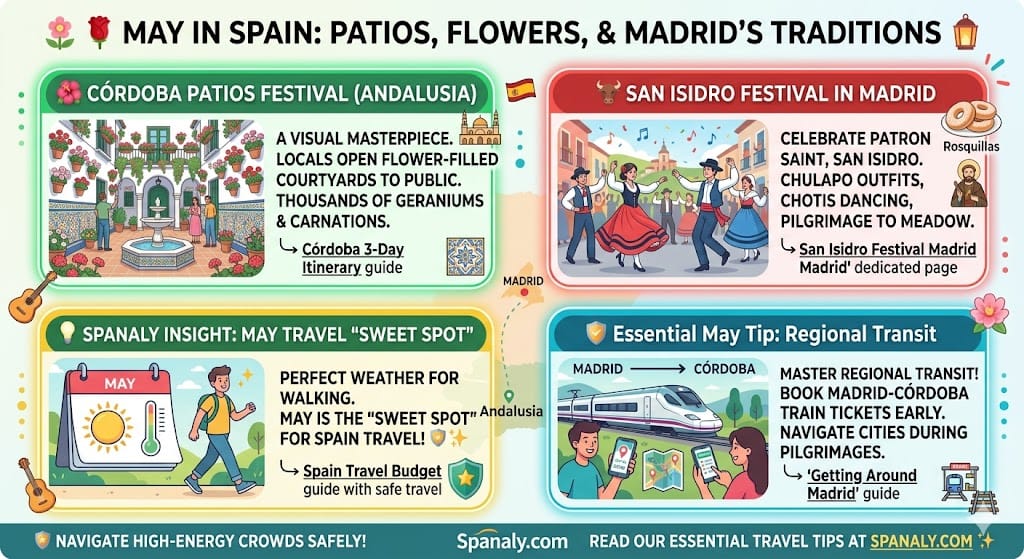
May is the month of blooming beauty and local pride. Specifically, the intense heat of summer hasn’t arrived yet, making it the perfect time for outdoor Major Spanish Festivals. To explore these floral and historic events comfortably, checking our Spain Travel Budget will help you manage your expenses during this popular spring month.
🌺 Córdoba Patios Festival
The Festival of the Patios is a visual masterpiece in Córdoba. Specifically, locals open their private, flower-filled courtyards to the public, competing for the title of the most beautiful patio.
The Sights: Thousands of geraniums and carnations hanging from whitewashed walls.
Pro Tip: Use our Córdoba 3-Day Itinerary to combine the flower tour with a visit to the Mezquita.
Location: Most patios are in the historic San Basilio neighborhood.
🐂 San Isidro Festival in Madrid
In mid-May, Madrid celebrates its patron saint, San Isidro. Specifically, you will see Madrileños dressed in traditional Chulapo outfits, dancing the Chotis in the streets.
Authentic Experience: Visit our dedicated San Isidro Festival Madrid page for the best parade routes.
Local Flavor: Specifically, you must try Rosquillas, the traditional San Isidro donuts sold near the Saint’s meadow.
Transit Tip: Check Getting Around Madrid to navigate the city during the massive pilgrimage to San Isidro Meadow.
💡 Spanaly Insight: May is the “Sweet Spot” for Spanish travel! Specifically, the weather is perfect for walking, and the Things to Do in Córdoba are at their peak beauty. Book your train tickets early, as the high-speed line between Madrid and Córdoba fills up quickly this month! 🛡️✨
🔥 June in Spain: Summer Solstice and Music Festivals
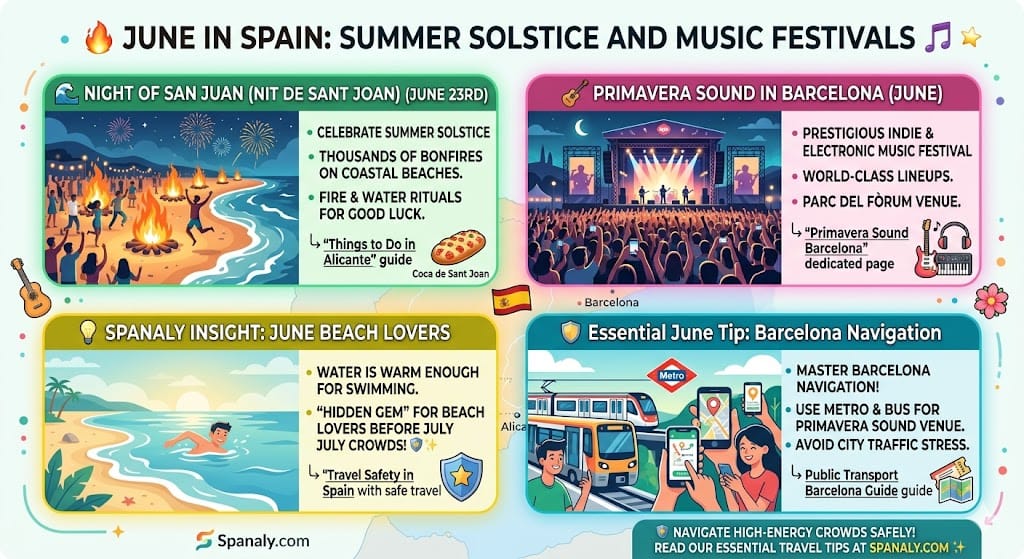
June marks the official start of the Mediterranean summer. Specifically, this month is a blend of ancient fire rituals and modern music scenes. As the days reach their longest point, the Major Spanish Festivals move to the beaches and open-air stages. To enjoy the coastal heat safely, specifically, check our Travel Safety in Spain guide for sun protection and beach etiquette tips.
🌊 Night of San Juan (Nit de Sant Joan)
On the night of June 23rd, Spain celebrates the summer solstice with fire and water. Specifically, beaches from Barcelona to Málaga light up with thousands of bonfires.
The Ritual: Tradition says you must jump over a bonfire or wash your face in the sea at midnight for good luck.
The Best Spot: Alicante and Barcelona offer the most massive celebrations. Specifically, check our Things to Do in Alicante for the best beach locations.
🎸 Primavera Sound in Barcelona
For music lovers, June is the peak season. Specifically, Primavera Sound is one of the world’s most prestigious indie and electronic music festivals.
Direct Guide: Visit our dedicated Primavera Sound Barcelona page for ticket and lineup tips.
Logistics: Use the Barcelona Public Transport Guide to reach the Parc del Fòrum venue without the stress of city traffic.
💡 Spanaly Insight: June is the “Hidden Gem” for beach lovers! Specifically, the water is warm enough for swimming, but the massive July crowds haven’t arrived yet. If you are in Barcelona for San Juan, specifically, grab a Coca de Sant Joan (traditional sweet bread) from a local bakery to eat by the fire! 🛡️✨
🐂 July in Spain: Running of the Bulls and Northern Traditions
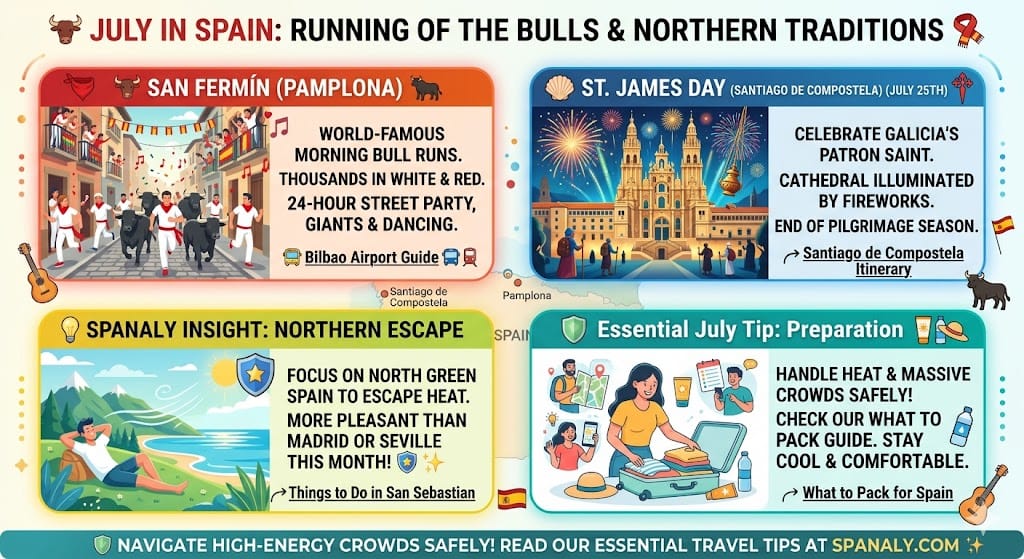
July is the heart of summer, specifically characterized by high energy and intense sun. While the south gets very hot, the Major Spanish Festivals move towards the cooler north. To handle the heat and the large crowds, we recommend checking our What to Pack for Spain guide to stay cool and comfortable.
🐂 San Fermín (Running of the Bulls)
San Fermín in Pamplona is world-famous for its daring morning bull runs. Specifically, thousands of people dressed in white with red scarves run through narrow streets ahead of six bulls.
The Atmosphere: It is a 24-hour party with music, traditional dancing, and massive parades of giants (Gigantes).
Pro Tip: To watch the run safely, specifically, book a balcony spot months in advance to avoid the chaos on the ground.
Travel Hub: Use our Bilbao Airport Guide for the easiest access to Pamplona via a short bus or train ride.
🐚 St. James Day (Santiago de Compostela)
On July 25th, the capital of Galicia celebrates its patron saint. Specifically, the cathedral is illuminated with a spectacular fireworks display, marking the end of the pilgrimage season.
The Experience: Witness the swinging of the massive Botafumeiro (incense burner) inside the cathedral.
Local Guide: Check our Santiago de Compostela Itinerary to plan your visit around the festivities.
💡 Spanaly Insight: July is peak season! Specifically, northern Spain is much more pleasant than Madrid or Seville this month. If you want to escape the heat, focus on the Things to Do in San Sebastian after visiting Pamplona for a perfect coastal breeze! 🛡️✨
🍅 August in Spain: Tomato Battles and Neighborhood Parties
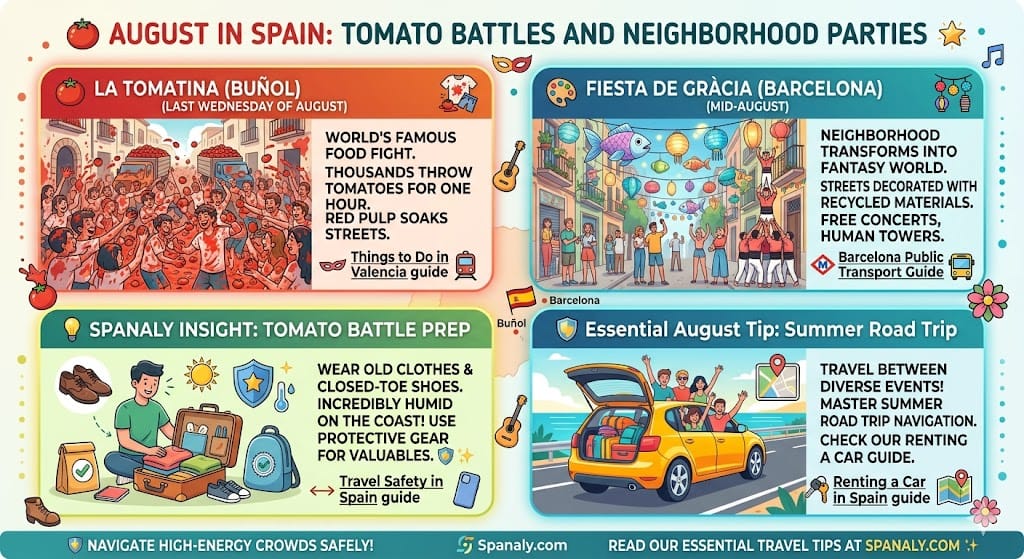
August is the height of the Spanish holiday season. Specifically, while many locals head to the coast, the Major Spanish Festivals reach a peak of creativity and fun. From messy street battles to artistic neighborhood competitions, August offers a unique vibe. To travel between these diverse events, check our Renting a Car in Spain guide for the ultimate summer road trip.
🍅 La Tomatina (Buñol)
La Tomatina is perhaps the world’s most famous food fight. Specifically, on the last Wednesday of August, thousands of people throw over-ripe tomatoes at each other in the small town of Buñol.
The Experience: It lasts exactly one hour, leaving the streets (and you) soaked in red pulp.
Pro Tip: You need an official ticket to enter! Specifically, stay in nearby Valencia and take the train early in the morning.
Prep Guide: Visit our Things to Do in Valencia page to plan your base camp for the battle.
🎨 Fiesta de Gràcia (Barcelona)
In mid-August, the Gràcia neighborhood in Barcelona transforms into a fantasy world. Specifically, residents spend months decorating their streets with recycled materials to win the “Best Decorated Street” prize.
The Atmosphere: Free outdoor concerts, traditional “Castellers” (human towers), and stunning overhead decorations.
Navigation: Use our Barcelona Public Transport Guide to easily reach the Gràcia district during the festivities.
💡 Spanaly Insight: August is incredibly humid on the coast! Specifically, if you are attending La Tomatina, wear old clothes and closed-toe shoes that you don’t mind throwing away. To keep your valuables dry and safe, check our Travel Safety in Spain guide for festival-specific gear tips! 🛡️✨
🍇 September in Spain: Wine Harvests and Human Towers
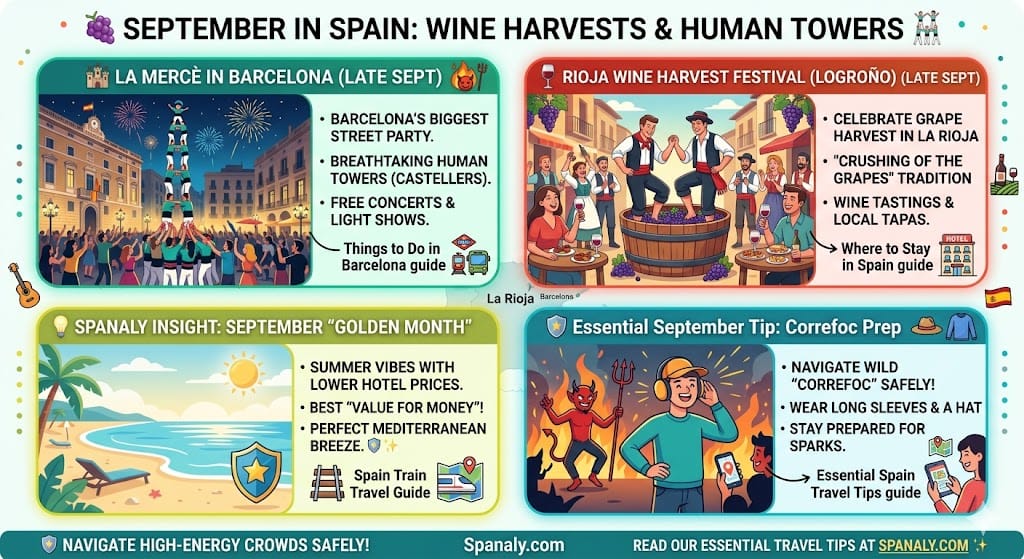
September is the “Golden Month” for travelers. Specifically, the scorching summer heat fades, replaced by a perfect Mediterranean breeze. As the harvest season begins, the Major Spanish Festivals celebrate the land’s bounty and incredible feats of human strength. To move between these regional celebrations, we recommend checking our Spain Train Travel Guide for a scenic and stress-free journey.
🏰 La Mercè in Barcelona
La Mercè is Barcelona’s biggest street party. Specifically, it honors the city’s patron saint with a week of free concerts, fire-runs (Correfocs), and the famous “Castellers.”
The Castellers: Witness breathtaking human towers, sometimes reaching ten stories high, in Plaça de Sant Jaume.
The Correfoc: Watch out for the fire-breathing dragons and devils dancing through the streets.
Navigation: Follow our Things to Do in Barcelona guide to find the best spots for the nightly light shows.
🍷 Rioja Wine Harvest Festival
In late September, the town of Logroño hosts the Fiesta de San Mateo. Specifically, it celebrates the grape harvest in Spain’s most famous wine region, La Rioja.
Traditional Ritual: Witness the “Crushing of the Grapes” by men in traditional costumes inside large wooden vats.
The Flavor: Enjoy endless wine tastings and local tapas in the famous Laurel Street.
Stay & Explore: Check our Where to Stay in Spain guide to find charming boutique hotels in the heart of wine country.
💡 Spanaly Insight: September offers the best “Value for Money”! Specifically, you get summer vibes with lower hotel prices. If you attend the Correfoc in Barcelona, specifically, wear long sleeves and a hat to protect yourself from the sparks—it’s a wild but safe experience if you are prepared! 🛡️✨
🛡️ October in Spain: National Pride and Pilar Festivals
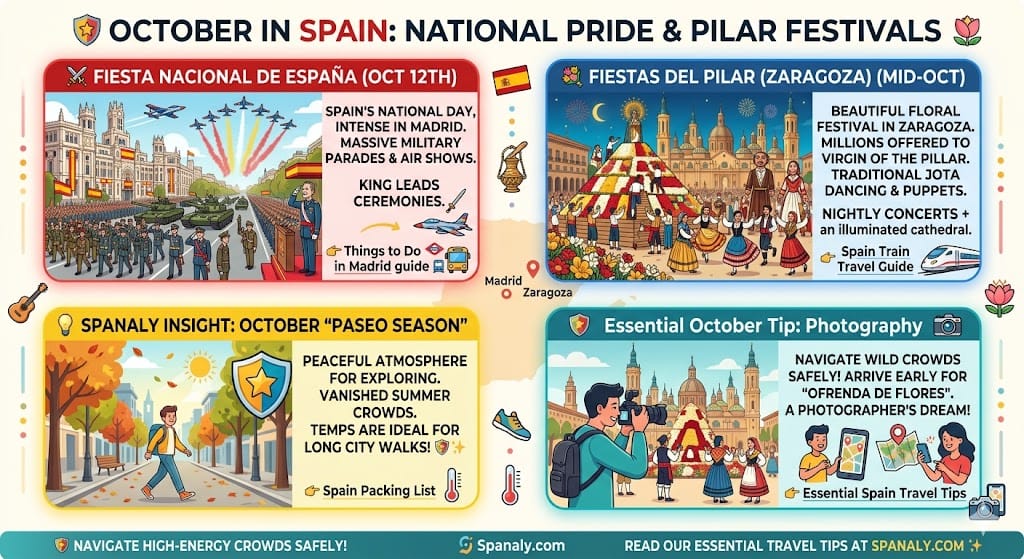
October is the month of transformation in Spain. Specifically, the intense summer crowds have vanished, leaving a peaceful atmosphere for exploring Major Spanish Festivals. To make the most of this mild weather, check our Spain Packing List for essential autumn layers and comfortable walking shoes.
⚔️ Fiesta Nacional de España (October 12th)
Celebrated across the country, but most intensely in Madrid, this day marks Spain’s National Day. Specifically, you will witness massive military parades and air shows featuring the Spanish “Patrulla Águila.”
The Highlight: King Felipe VI leads the ceremonies in central Madrid.
Pro Tip: Use our Things to Do in Madrid guide to find the best viewing spots along Paseo de la Castellana.
Travel Note: Expect many shops and museums to have limited hours on this public holiday.
💐 Fiestas del Pilar (Zaragoza)
Zaragoza hosts one of the most beautiful floral festivals in Spain during mid-October. Specifically, millions of flowers are offered to the Virgin of the Pillar in a massive outdoor ceremony.
The Atmosphere: Traditional Aragonese “Jota” dancing, giant puppet parades, and spectacular nightly concerts.
Logistics: Zaragoza is perfectly located between Madrid and Barcelona. Check our Spain Train Travel Guide to easily add this stop to your itinerary.
💡 Spanaly Insight: October is “Paseo Season”! Specifically, the temperatures are ideal for long city walks without the sweat of July. If you are in Zaragoza for the Ofrenda de Flores, specifically, arrive early at the Plaza del Pilar to witness the massive floral pyramid being built—it’s a photographer’s dream! 🛡️✨
🕯️ November in Spain: Spiritual Traditions and Autumn Flavors
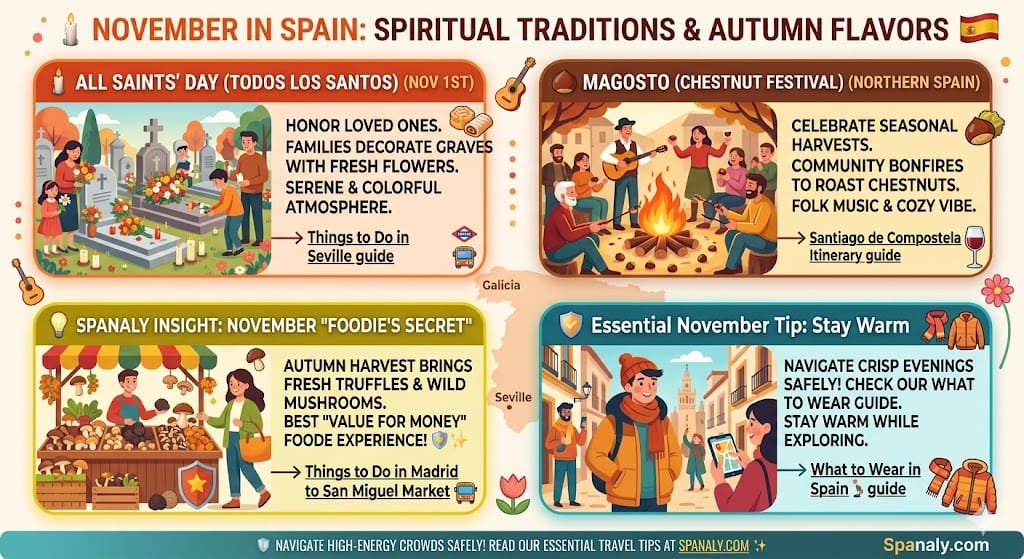
November is a month of reflection and cozy atmosphere. Specifically, as the days get shorter and the air turns crisp, the Major Spanish Festivals focus on family heritage and seasonal harvests. To stay warm while exploring these traditional events, check our What to Wear in Spain guide for stylish autumn layers.
🕯️ All Saints’ Day (Todos los Santos)
On November 1st, Spaniards visit cemeteries to honor their loved ones. Specifically, you will see families cleaning graves and decorating them with fresh flowers, creating a serene and colorful atmosphere.
The Tradition: Visit a local bakery to buy Huesos de Santo (Saint’s Bones) or Buñuelos de Viento.
Local Guide: Explore our Things to Do in Seville to see how the historic city centers embrace this solemn yet beautiful day.
🌰 Magosto (Chestnut Festival)
In Northern Spain, particularly Galicia and Asturias, November is the month of Magosto. Specifically, communities gather around bonfires to roast the first chestnuts of the season.
The Vibe: Red wine, roasted chestnuts, and folk music in the crisp evening air.
Travel Tip: Use our Santiago de Compostela Itinerary to find the best local squares for these authentic gatherings.
💡 Spanaly Insight: November is the “Foodie’s Secret”! Specifically, the autumn harvest brings fresh truffles and wild mushrooms to the markets. If you are in Madrid, specifically, head to San Miguel Market via our Things to Do in Madrid guide to taste these seasonal delicacies! 🛡️✨
🎄 December in Spain: Magical Markets and Midnight Grapes
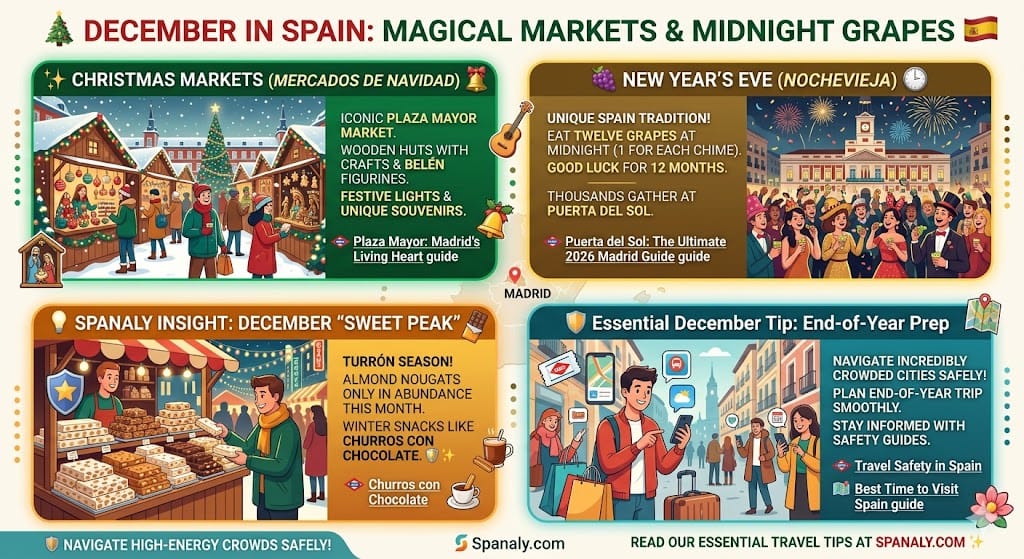
December transforms Spain into a glittering wonderland of lights and ancient traditions. Specifically, as the year ends, the Major Spanish Festivals shift towards family gatherings and festive street markets. To plan your end-of-year trip smoothly, we recommend checking our Best Time to Visit Spain guide for weather and holiday schedules.
✨ Christmas Markets (Mercados de Navidad)
Throughout December, plazas are filled with wooden huts selling handmade crafts and nativity scenes. Specifically, Madrid hosts the most iconic market in Plaza Mayor.
The Highlight: Buy traditional “Belen” figurines to take home as a unique souvenir.
Local Guide: Use our Plaza Mayor: Madrid’s Living Heart guide to navigate the market like a local.
Sweet Treats: Don’t miss out on seasonal sweets; check our Churros con Chocolate guide for the best winter warming snack.
🍇 New Year’s Eve (Nochevieja)
Spain has a unique tradition for welcoming the New Year. Specifically, as the clock strikes midnight, you must eat twelve grapes—one for each chime—to ensure good luck for the next twelve months.
The Centerpiece: Thousands gather at Puerta del Sol in Madrid to eat their grapes together.
Preparation: Read our Puerta del Sol: The Ultimate 2026 Madrid Guide to find the best spots for the countdown.
Safety First: Since the city becomes incredibly crowded, stay informed with our Travel Safety in Spain protocols.
💡 Spanaly Insight: December is the peak of “Turrón” season! Specifically, these almond nougats are only found in abundance this month. If you are staying in the capital, check our Where to Stay in Madrid guide to find a hotel near the festive lights of Gran Vía! 🛡️✨
🌑 Special Highlight: 2026 Total Solar Eclipse Viewing Parties
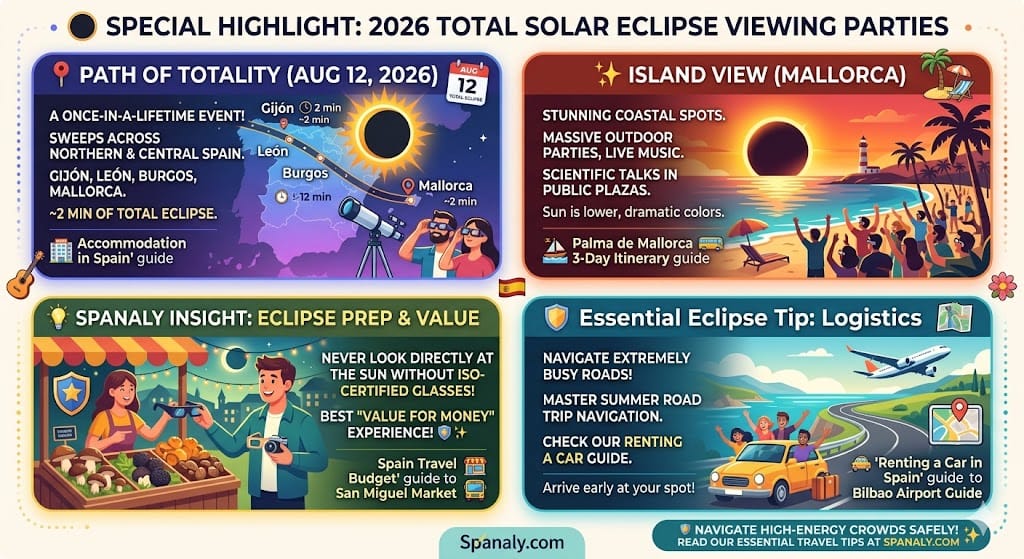
A once-in-a-lifetime event is coming to Spain. Specifically, on August 12, 2026, a Total Solar Eclipse will sweep across northern and central Spain. This rare celestial phenomenon is turning local villages into massive Major Spanish Festivals for one night only. To ensure you have a place to stay during this high-demand event, check our Accommodation in Spain guide immediately.
📍 Where to Watch the Eclipse
The path of totality covers cities like Gijón, León, Burgos, and parts of Mallorca. Specifically, the sun will be completely obscured for nearly two minutes in some areas.
The Atmosphere: Expect massive outdoor viewing parties, live music, and scientific talks in public plazas.
Travel Hub: Use our Bilbao Airport Guide to reach the northern totality zone comfortably.
Island View: If you prefer the Mediterranean, Mallorca will offer a stunning sunset eclipse. Check our Palma de Mallorca 3-Day Itinerary for the best coastal spots.
🛡️ Safety and Preparation
Watching an eclipse requires specific gear. Specifically, never look directly at the sun without ISO-certified eclipse glasses.
Logistics: Roads to the totality path will be extremely busy. We recommend Renting a Car in Spain (Driving in Spain) to find remote, uncrowded viewing spots.
Budgeting: Prices for hotels in the path are rising fast. Review our Spain Travel Budget to manage costs during this peak period.
💡 Spanaly Insight: This is the first total solar eclipse in continental Europe since 1999! Specifically, the “Golden Hour” will be literal this time. If you plan to photograph the event, specifically, arrive at your spot 4 hours early. To navigate the expected traffic jams, keep our Essential Spain Travel Tips bookmarked! 🛡️✨
🏆 The "Big Five": Top 10 Must-See Festivals You Can't Miss
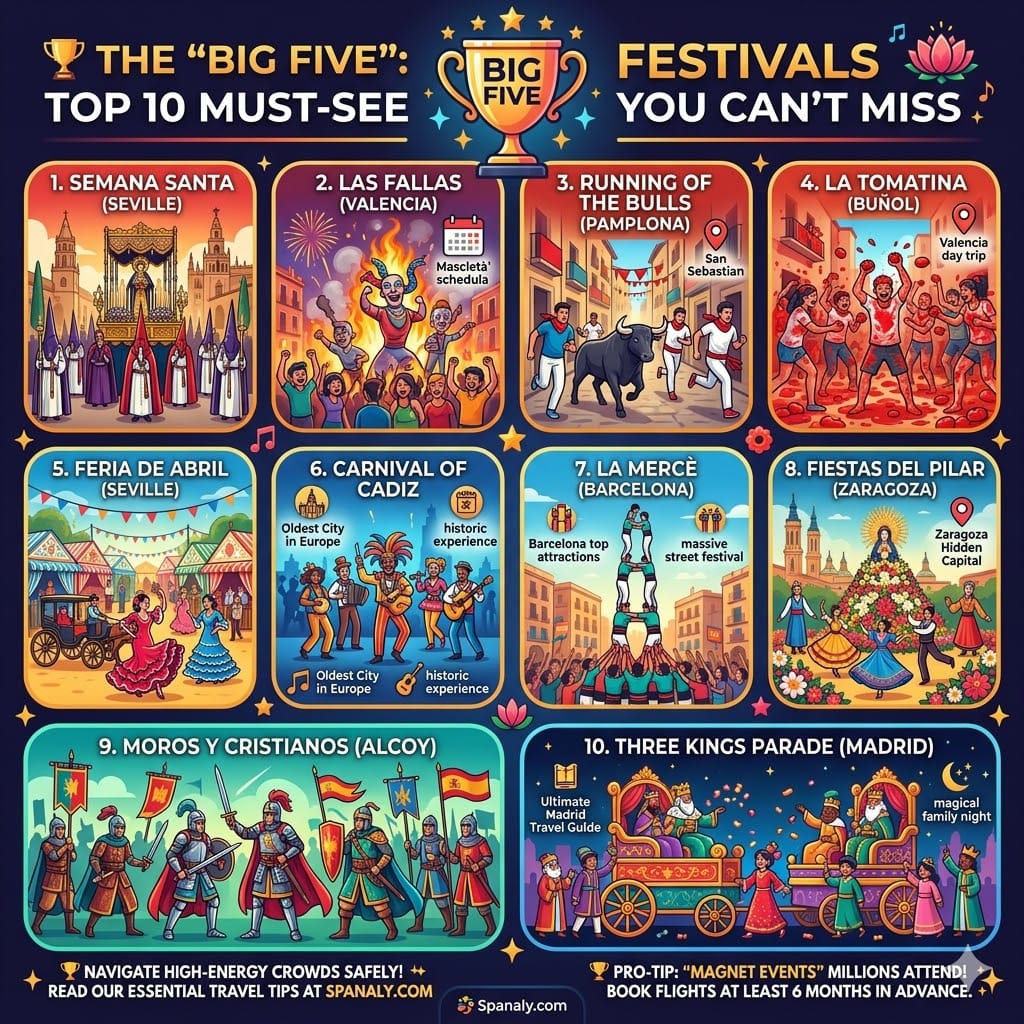
While Spain hosts thousands of celebrations, these are the heavyweights. Specifically, if you only have time for a few, these Major Spanish Festivals define the country’s cultural soul. To navigate between these iconic cities, we recommend checking our Getting Around Spain guide for the fastest transport options.
🥇 The Absolute Icons
Semana Santa (Seville): The most intense and artistic religious procession in the world. Specifically, see our Ultimate Seville Travel Guide for the best viewing balconies.
Las Fallas (Valencia): A week of fire, gunpowder, and massive satirical statues. Specifically, visit our Valencia Spain Travel page for the “Mascletà” schedule.
The Running of the Bulls (Pamplona): The world’s most daring street run. Specifically, learn about northern traditions in our San Sebastian Travel Guide nearby.
La Tomatina (Buñol): The messiest hour of your life in a sea of tomatoes. Specifically, check our Things to Do in Valencia to plan your day trip.
Feria de Abril (Seville): A city of colorful tents, flamenco dresses, and horse carriages.
🥈 The Cultural Gems
Carnival of Cadiz: Known for its sharp wit and musical groups. Specifically, see our Cadiz: Oldest City in Europe guide for a historic carnival experience.
La Mercè (Barcelona): A massive street festival featuring human towers. Specifically, explore our Barcelona Top Attractions during the party.
Fiestas del Pilar (Zaragoza): A floral masterpiece in the heart of Aragon. Specifically, use our Zaragoza: Hidden Capital of Aragon guide to explore more.
Moros y Cristianos (Alcoy): Epic historical battles re-enacted in the streets.
Three Kings Parade (Madrid): The most magical night for families. Specifically, read our Ultimate Madrid Travel Guide to find the parade route.
💡 Spanaly Insight: These festivals are “Magnet Events”! Specifically, they attract millions. If you want to experience the soul of Spain without the stress, specifically, book your flights at least 6 months in advance using our Best Flights to Spain Guide. 🛡️✨
📍 Spain Festival Map: Where to Go and When
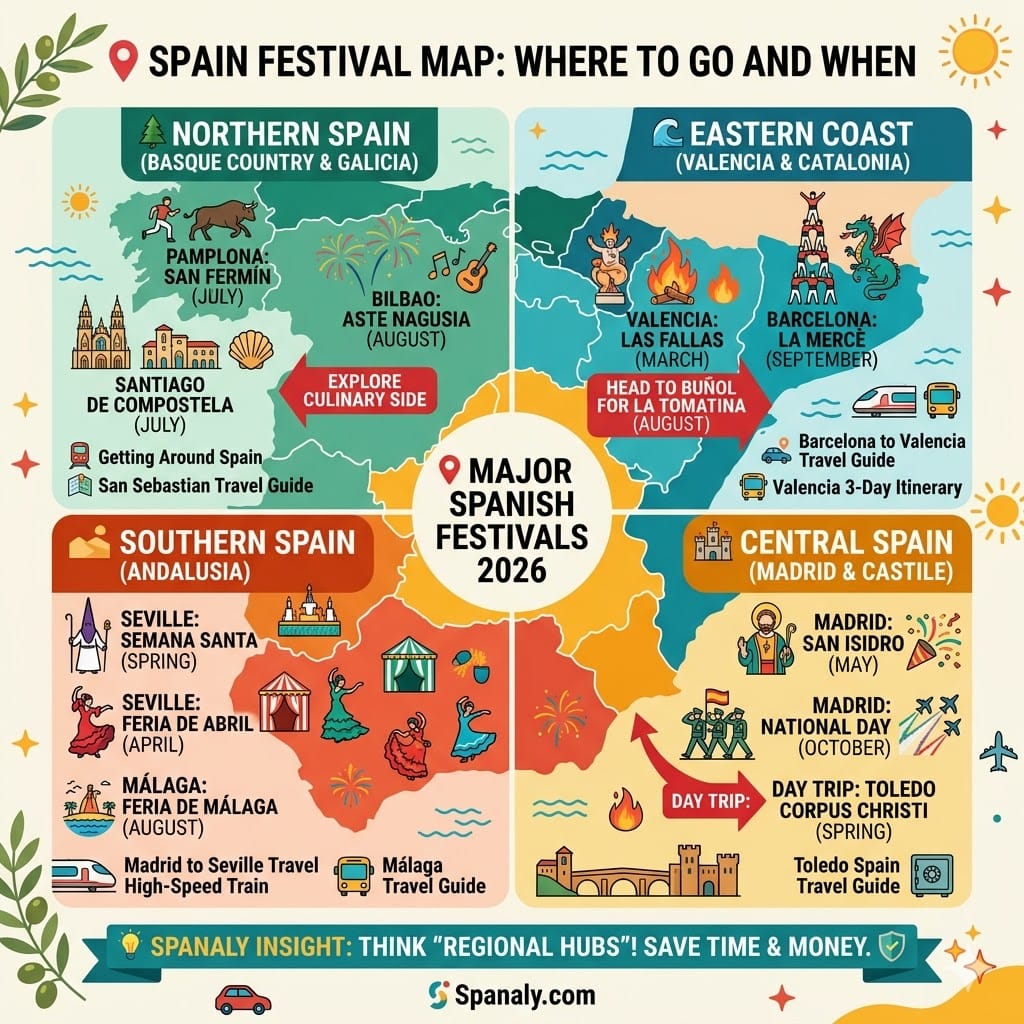
Spain is a mosaic of cultures, and every region has its own signature celebration. Specifically, while the south is famous for its passion, the north offers ancient folklore and high-energy music. To plan your route across these regions, check our Getting Around Spain guide for the most efficient travel tips.
🏜️ Southern Spain (Andalusia)
The heart of tradition. Specifically, this region dominates the spring and summer calendar with flamenco and religious fervor.
Key Stops: Seville for Semana Santa and Feria de Abril.
Insight: Don’t miss the coastal vibes; check our Málaga Travel Guide for the famous August Feria de Málaga.
Transport: Use the high-speed train; read our Madrid to Seville Travel guide for a seamless connection.
🌊 Eastern Coast (Valencia & Catalonia)
The land of fire and creativity. Specifically, the Mediterranean coast is where you will find the most visually spectacular modern festivals.
Key Stops: Valencia for Las Fallas and Barcelona for La Mercè.
Hidden Gem: Head to Buñol for La Tomatina; plan your stay using our Valencia 3-Day Itinerary.
Logistics: Easily travel between these hubs with our Barcelona to Valencia Travel Guide.
🌲 Northern Spain (Basque Country & Galicia)
A mix of ancient Celtic roots and modern rock. Specifically, the north offers a cooler climate and unique cultural identity.
Key Stops: Pamplona for San Fermín and Bilbao for Aste Nagusia.
Local Flavor: Explore the culinary side in our San Sebastian Travel Guide.
Adventure: If you love road trips, follow our Bilbao-San Sebastian 3-Day Itinerary for a perfect northern loop.
🏰 Central Spain (Madrid & Castile)
The royal stage for national pride. Specifically, the capital hosts grand parades and massive music festivals.
Key Stops: Madrid for San Isidro and the National Day parade.
Day Trips: Use the capital as a base to visit the Corpus Christi in Toledo via our Toledo Spain Travel Guide.
💡 Spanaly Insight: Think “Regional Hubs”! Specifically, stay in major cities like Madrid or Seville and take short trips to nearby festivals. This saves time and money. Check our Spain Travel Budget to see how much you can save by staying in one hub! 🛡️✨
💡 Pro-Tips for 2026 Travelers
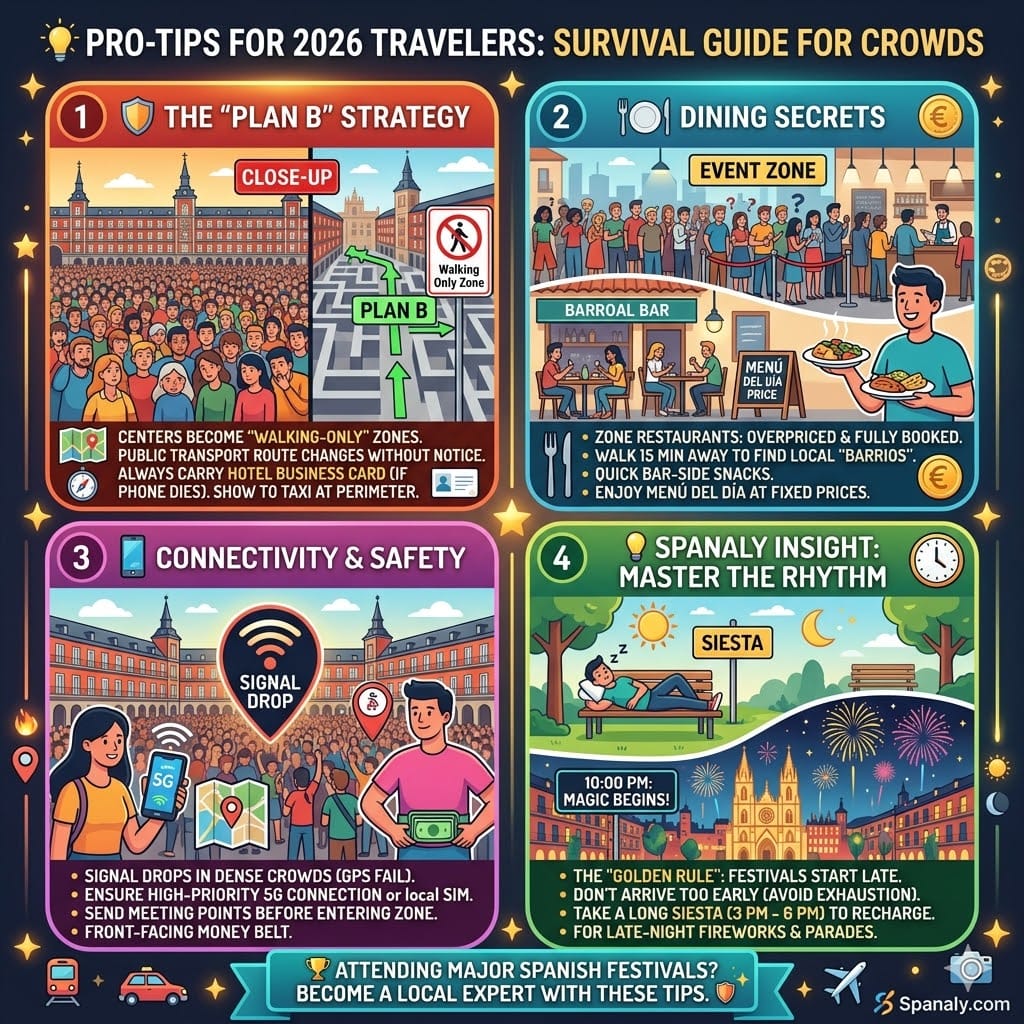
Attending Major Spanish Festivals is an exhilarating experience, but it requires strategic planning to avoid exhaustion and hidden costs. Specifically, navigating millions of people during events like Las Fallas or Semana Santa can be tricky. To ensure a smooth journey, specifically, you must adopt a “local mindset” to handle the logistical challenges of these massive celebrations.
🛡️ The “Plan B” Strategy
During massive festivals, the city center usually becomes a “walking-only” zone. Specifically, public transport routes and bus stops often change without any prior notice.
The Solution: Download reliable travel apps to get real-time transit updates and keep offline maps ready.
Pro-Tip: Always carry a physical business card of your hotel. Specifically, if your phone battery dies in the crowd, you can simply show it to a taxi driver at the city perimeter.
🍽️ Dining Secrets During Festivals
Restaurants located in the “Event Zone” will likely be overpriced and fully booked. Specifically, you might wait hours for a simple tapa or a table.
The Hack: Walk 15 minutes away from the main plaza to find authentic “Barrios” where locals eat. Specifically, these hidden gems offer better quality and much faster service.
Budget Tip: Look for “Menú del Día” options in residential areas. Specifically, these three-course meals often stay at fixed prices even during high-demand holidays.
📱 Connectivity and Safety
Crowded festivals are prime spots for cellular signal drops. Specifically, when thousands of people try to upload videos at once, your GPS and messaging apps might fail.
Stay Connected: Ensure you have a high-priority 5G connection or a local SIM. Specifically, send your meeting points to your group before entering the festival zone.
Security: Keep your valuables in a front-facing money belt. Specifically, follow strict safety protocols to avoid professional pickpockets who thrive in dense, distracted crowds.
💡 Spanaly Insight: The “Golden Rule” of Spanish festivals is mastering the daily rhythm! Specifically, the real magic doesn’t truly start until 10:00 PM. If you arrive too early, you will be exhausted before the main events begin. Specifically, take a long Siesta between 3:00 PM and 6:00 PM to recharge for the late-night fireworks and parades! 🛡️✨
🛡️ Visitor FAQs – Major Spanish Festivals 2026 Guide
🎭 Do I need to buy tickets for street festivals like Las Fallas or La Mercè?
Most Major Spanish Festivals are celebrated in public plazas and are 100% free to attend. However, in 2026, certain exclusive viewing balconies for Semana Santa or reserved seating for the Three Kings Parade require advance booking through official city portals to avoid the massive ground-level crowds.
🧥 What is the "Festival Dress Code" for international visitors?
While locals might wear traditional costumes (like Trajes de Flamenca in Seville), visitors should focus on comfort and respect. Specifically, for religious processions like Semana Santa, avoid very casual beachwear. In 2026, the trend is "Festive Casual"—comfortable sneakers are mandatory due to the miles of walking on cobblestones.
🔋 How can I find my friends if I lose them in a massive crowd?
Don't rely solely on your phone, as network congestion is common during fireworks or parades. Always agree on a "Fixed Landmark Meeting Point" before entering the festival zone. In 2026, many Spanish cities have Purple Points (Puntos Violetas) which are safe, well-lit areas with staff trained to assist lost or distressed tourists.
🛒 Are shops and supermarkets open during major holidays?
Specifically on "Red Days" (National Holidays), most large supermarkets and local shops will close. In 2026, restaurants and bars usually remain open to serve the festival crowds, but we recommend stocking up on essentials at least 24 hours before the main event days to avoid long queues at 24-hour convenience stores.
📸 Is it safe to use professional camera gear in high-density crowds?
Yes, but you must be vigilant. In 2026, Spanaly recommends using a secure neck strap and keeping your equipment bag in front of your body at all times. Specifically, avoid changing lenses in the middle of a crowd to prevent theft or accidental damage. For festivals like La Tomatina, a waterproof and shockproof housing is absolutely essential.
Major Spanish Festivals Guide by Spanaly.com
Spain is not just a destination; it is a celebration of life itself. Specifically, throughout 2026, every corner of this beautiful country will be alive with the energy of Major Spanish Festivals. Whether you seek the solemnity of Semana Santa or the fire of Las Fallas, your perfect adventure awaits.
🎭 Pick Your Vibe: Choose between historic traditions or modern street parties.
📅 Plan Ahead: Remember that 2026 is a high-demand year for festivals.
🛡️ Travel Smart: Stay safe, follow the local rhythm, and embrace the Siesta.
📍 Explore Further: If you want a break from the crowds, discover the magic of the white villages with our 3-Day Ronda Itinerary.
💡 Spanaly Insight: Don’t just watch the festival—become part of it! Specifically, talk to the locals, try the street food, and let the Spanish spirit guide you. Your 2026 memories are waiting to be made! 🇪🇸✨