Table of Contents
Toggle🌊 Green Spain Itinerary
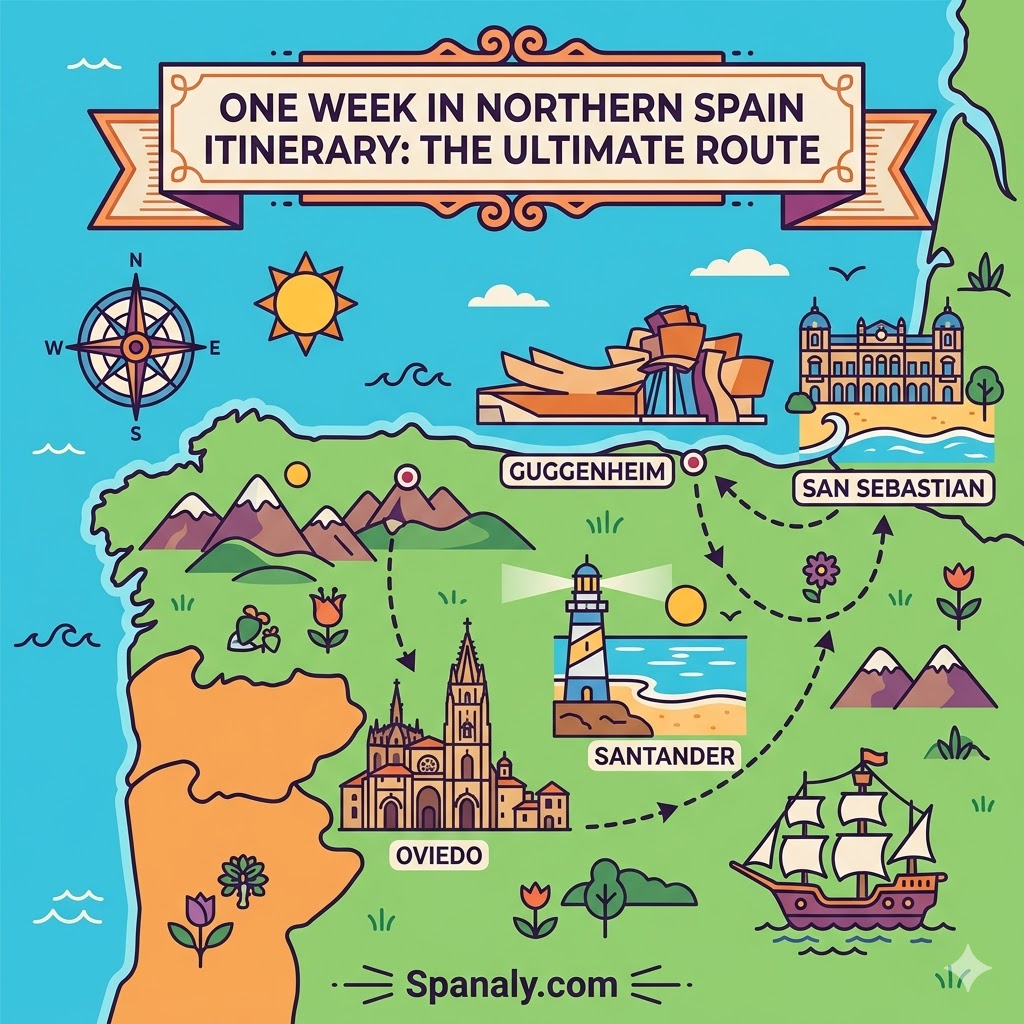
The rhythmic Atlantic waves crash against jagged cliffs while the scent of salt and wood-fired pintxos fills the air. Mastering a One Week in Northern Spain Itinerary requires a balance between coastal elegance and rugged mountain escapes. This guide transforms your 7 days in Northern Spain into a seamless professional Northern Spain road trip across the lush landscapes of España Verde.
The Route: Start in the titanium heart of Bilbao and conclude at the historic gates of Santiago.
The Experience: Balance Michelin-star gastronomy with the raw, misty beauty of the Picos de Europa peaks.
The Logistics: Navigate the Spain Atlantic coast between Cantabria and Asturias using an optimized planning strategy.
The Goal: Avoid common tourist traps by leveraging our elite local insights and real-time budget data.
Spanaly Insight: Do not rush the Cantabrian highway. The “hidden” coastal detours near Llanes offer the best Atlantic views. These small turns save you from peak-hour traffic while providing cinematic photo stops for your Northern Spain by car adventure.
📸 Snapshot: Essential One Week Northern Spain Facts
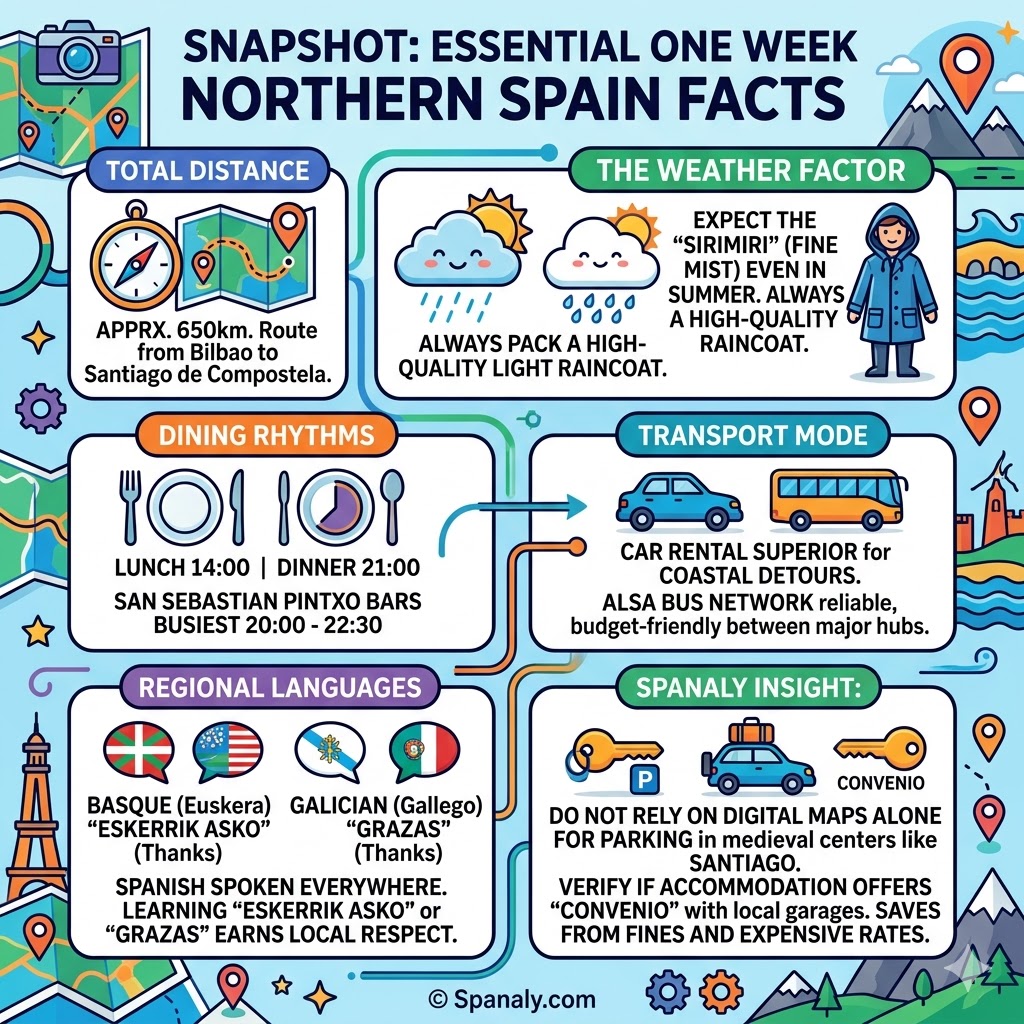
Mastering your 7 days in Northern Spain requires a deep understanding of the Atlantic coast’s unique logistics. These quick facts ensure you navigate your Northern Spain road trip with professional precision while discovering the culinary secrets in our Northern Spain food guide.
Total Distance: Approximately 650km from Bilbao to Santiago de Compostela to complete your Green Spain itinerary.
The Weather Factor: Expect the “Sirimiri” (fine mist); always pack a light raincoat for the Spain Atlantic coast.
Dining Rhythms: Lunch starts at 14:00 and dinner at 21:00, especially during your Basque Country itinerary.
Transport Mode: Northern Spain by car is superior for coastal detours, though ALSA buses link major hubs effectively.
Regional Languages: You will encounter Basque (Euskera) and Galician (Gallego), though Spanish is spoken everywhere.
Spanaly Insight: Do not rely on digital maps alone for parking in medieval centers like Santiago. Verify if your accommodation offers a “Convenio” with local garages. This technical step saves you from steep fines and expensive daily rates during your Asturias road trip.
⚖️ 7-Day vs. 3-Day Route: Which Itinerary Fits You?
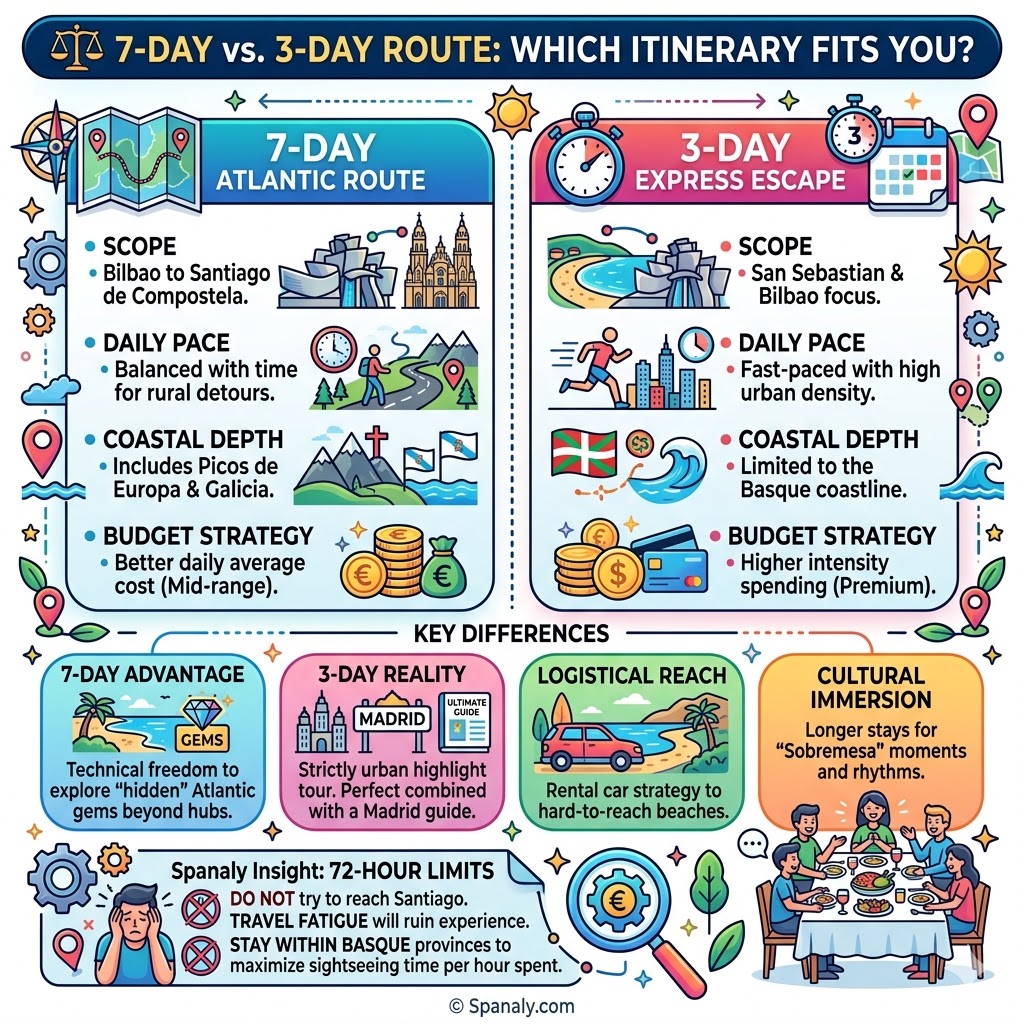
Choosing the duration of this Green Spain adventure depends on your travel goals and logistical pace. While this northern journey offers a deep immersion that a weekend escape cannot match, keep in mind that trying to reach Santiago in just 72 hours will technically lead to travel fatigue. Therefore, we recommend staying within the Basque provinces to maximize your actual sightseeing time per hour spent.
| Feature | 7-Day Atlantic Route | 3-Day Express Escape |
| Scope | Bilbao to Santiago de Compostela. | San Sebastian & Bilbao focus. |
| Daily Pace | Balanced with time for rural detours. | Fast-paced with high urban density. |
| Coastal Depth | Includes Picos de Europa & Galicia. | Limited to the Basque coastline. |
| Budget Strategy | Better daily average cost (Mid-range). | Higher intensity spending (Premium). |
The 7-Day Advantage: You gain the freedom to explore “hidden” Atlantic gems beyond the major hubs.
The 3-Day Reality: This is strictly an urban highlight tour. It is perfect for those combining the north with an ultimate Madrid travel guide experience.
Logistical Reach: An full week allows for a rental car strategy to visit hard-to-reach beaches.
Cultural Immersion: Longer stays provide the “Sobremesa” moments needed to understand regional rhythms.
💰 Northern Spain Travel Cost: 7-Day Budget Breakdown
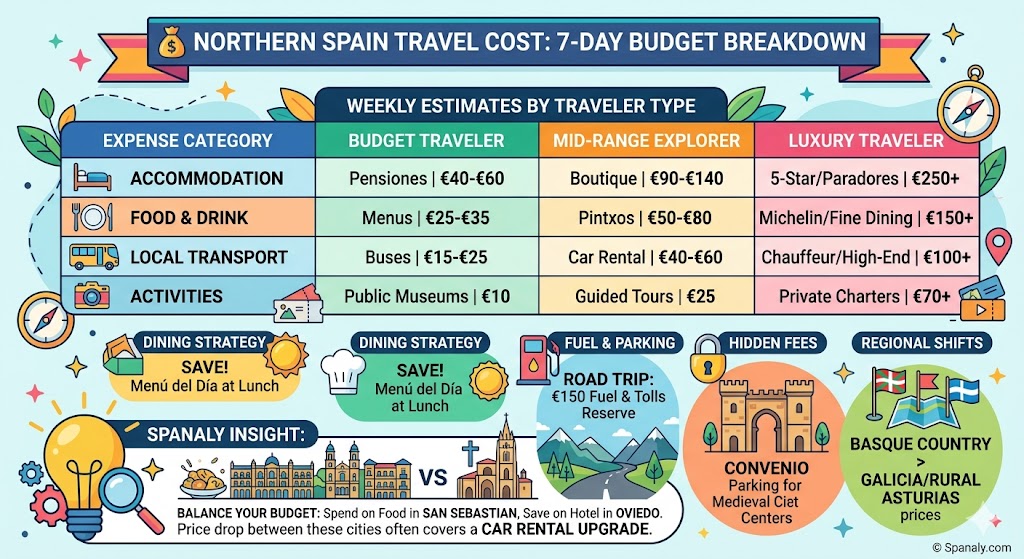
Estimating your expenses for a One Week in Northern Spain Itinerary is essential for a stress-free Atlantic adventure. The northern provinces offer a wide range of price points, from the premium bars of San Sebastian to the affordable cider houses in Oviedo. Navigating these differences effectively depends on how you manage your Northern Spain travel cost throughout the trip.
| Expense Category | Budget Traveler | Mid-Range Explorer | Luxury Traveler |
| Accommodation | €40 – €60 (Pensiones) | €90 – €140 (Boutique) | €250+ (5-Star/Paradores) |
| Food & Drink | €25 – €35 (Menus) | €50 – €80 (Pintxos) | €150+ (Michelin/Fine) |
| Local Transport | €15 – €25 (Buses) | €40 – €60 (Car Rental) | €100+ (Chauffeur/High-End) |
| Activities | €10 (Public Museums) | €25 (Guided Tours) | €70+ (Private Charters) |
Dining Strategy: You can save significantly by choosing the Menú del Día during lunch hours.
Fuel and Parking: Budget approximately €150 for fuel and tolls if you follow our recommended road trip route.
Hidden Fees: Always set aside a reserve for “Convenio” parking fees in medieval city centers.
Regional Shifts: Prices in the Basque Country are generally higher than the rates found in Galicia or rural Asturias.
Spanaly Insight: Do not let San Sebastian’s prices intimidate you. You can balance your total budget by spending on world-class food there and saving on accommodation in Oviedo. The price drop between these two cities often covers a car rental upgrade.
⛅ Best Time to Visit Northern Spain for a Road Trip

Choosing the right season for this road trip impacts everything from road visibility to local festival access. The Atlantic climate is unpredictable, making it essential to understand the best time to visit before finalizing your dates. To find the best balance between stable weather and affordable boutique hotel rates, do not avoid “shoulder seasons” like late May or early September.
Late Spring (May – June): This period offers lush green landscapes and comfortable temperatures for hiking.
Summer (July – August): Expect sunny coastal days and vibrant local festivals in every major city.
Early Autumn (September – October): You gain fewer crowds and clear skies, perfect for driving through the Picos de Europa.
The Rain Factor: Prepare for “Sirimiri” mist at any time of year due to the region’s unique geography.
🎨 Day 1: Bilbao – Guggenheim Museum and Casco Viejo
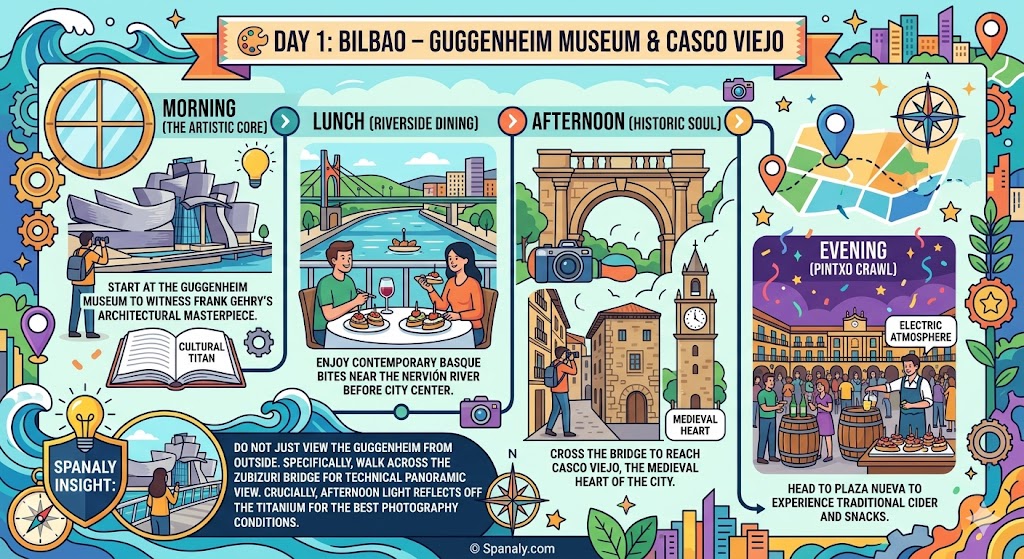
Your One Week in Northern Spain Itinerary begins in the titanium heart of the Basque Country. Bilbao has transformed from an industrial hub into a global cultural titan. Your first 24 hours here should balance the Guggenheim’s modern energy with the medieval soul of Casco Viejo.
Morning (The Artistic Core): Start at the Guggenheim Museum to witness Frank Gehry’s architectural masterpiece.
Lunch (Riverside Dining): Enjoy contemporary Basque bites near the Nervión River before heading toward the city center.
Afternoon (Historic Soul): Cross the bridge to reach Casco Viejo, the medieval heart of the city.
Evening (Pintxo Crawl): Head to Plaza Nueva to experience the electric atmosphere of traditional cider and snacks.
Spanaly Insight: Do not just view the Guggenheim from the outside. Walk across the Zubizuri Bridge for a panoramic view of the museum’s scales. The afternoon light reflects off the titanium in a way that provides the best photography conditions for your trip.
🌊 Day 2: San Sebastian – La Concha Beach and Pintxo Tours
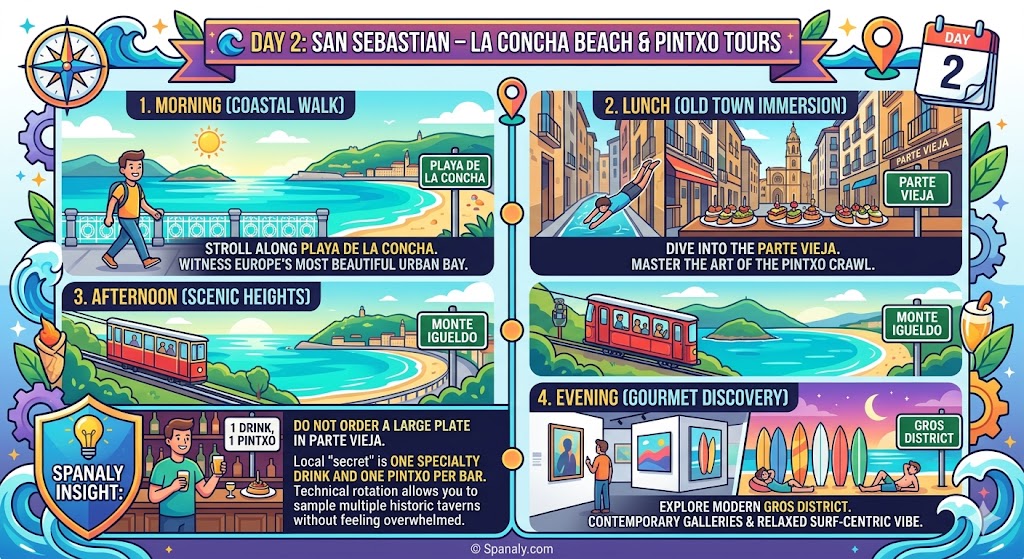
Leaving Bilbao behind, your One Week in Northern Spain Itinerary moves to the world’s culinary capital. San Sebastian balances aristocratic elegance with a rugged Atlantic soul. Your experience here centers on the salt spray of the coast and the sizzle of Michelin-star street food.
Morning (Coastal Walk): Stroll along Playa de la Concha to witness one of Europe’s most beautiful urban bays.
Lunch (Old Town Immersion): Dive into the Parte Vieja to master the art of the pintxo crawl.
Afternoon (Scenic Heights): Take the historic funicular up Monte Igueldo for a panoramic view of the coastline.
Evening (Gourmet Discovery): Explore the modern Gros District for contemporary galleries and a relaxed surf-centric vibe.
Spanaly Insight: Do not order a large plate in the Parte Vieja. The local “secret” is to have one specialty drink and one pintxo per bar. This rotation allows you to sample multiple historic taverns without feeling overwhelmed by the social crowds.
⚓ Day 3: Santander – El Sardinero Beach and Royal Heritage
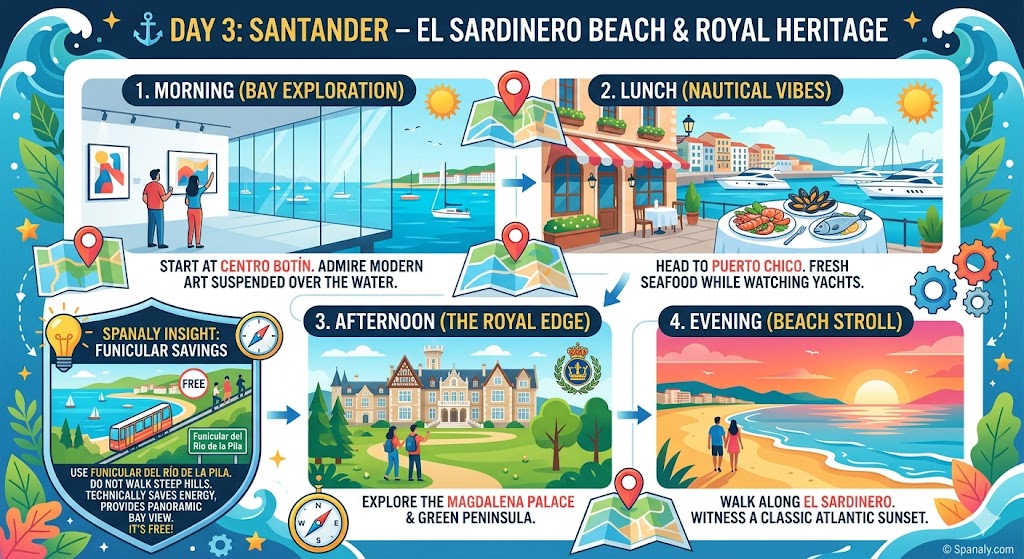
As you continue this Atlantic route, the landscape shifts toward the aristocratic elegance of your Cantabria itinerary. Santander exudes a royal atmosphere, having served as a prestigious retreat on the Spain Atlantic coast. To save your energy for sightseeing, avoid walking up the steep hills from the ferry terminal and instead use the Funicular del Río de la Pila in the city center for a panoramic bay view.
Morning (Bay Exploration): Start at the Centro Botín to admire modern art suspended over the water.
Lunch (Nautical Vibes): Head to Puerto Chico for fresh seafood while watching yachts bob in the harbor.
Afternoon (The Royal Edge): Explore the Magdalena Palace and its surrounding green peninsula.
Evening (Beach Stroll): Walk along the golden sands of El Sardinero to witness a classic Atlantic sunset.
⛰️ Day 4: Picos de Europa – Mountain Scenery and Hiking Trails
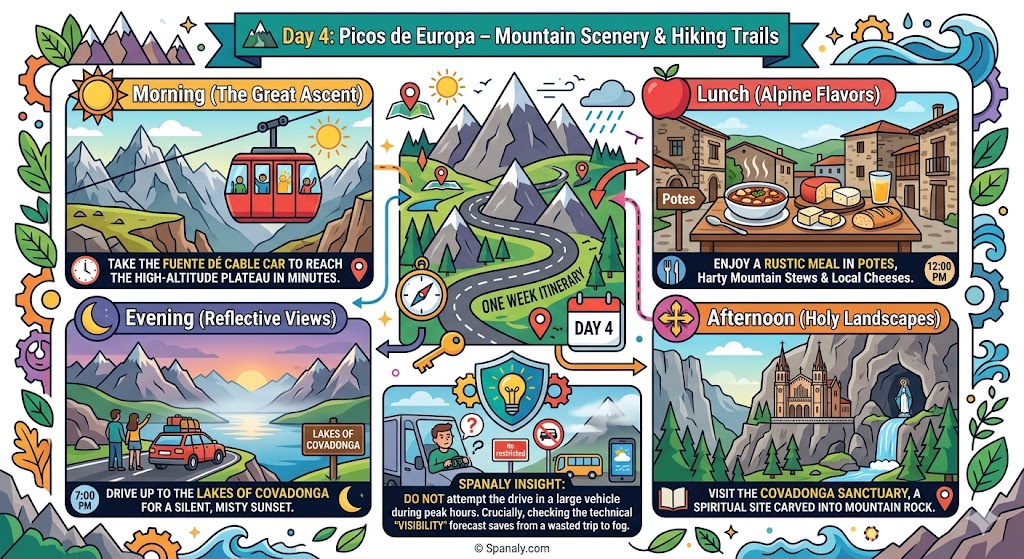
Your One Week in Northern Spain Itinerary now trades the salty coast for the jagged limestone peaks of the Picos de Europa. This natural fortress offers a dramatic sensory shift with its misty valleys and high-altitude cider culture. Success here depends on timing your ascent to avoid the heavy mountain fog.
Morning (The Great Ascent): Take the Fuente Dé cable car to reach the high-altitude plateau in minutes.
Lunch (Alpine Flavors): Enjoy a rustic meal in Potes, focusing on hearty mountain stews and local cheeses.
Afternoon (Holy Landscapes): Visit the Covadonga Sanctuary, a spiritual site carved directly into the mountain rock.
Evening (Reflective Views): Drive up to the Lakes of Covadonga for a silent, misty sunset over the glacial waters.
Spanaly Insight: Do not attempt the drive to the Lakes in a large vehicle during peak hours. Access is often restricted to official shuttle buses during busy seasons. Checking the “visibility” forecast at the base saves you from a wasted trip to a fog-covered peak.
🏰 Day 5: Oviedo – Pre-Romanesque Art and Asturian Cider
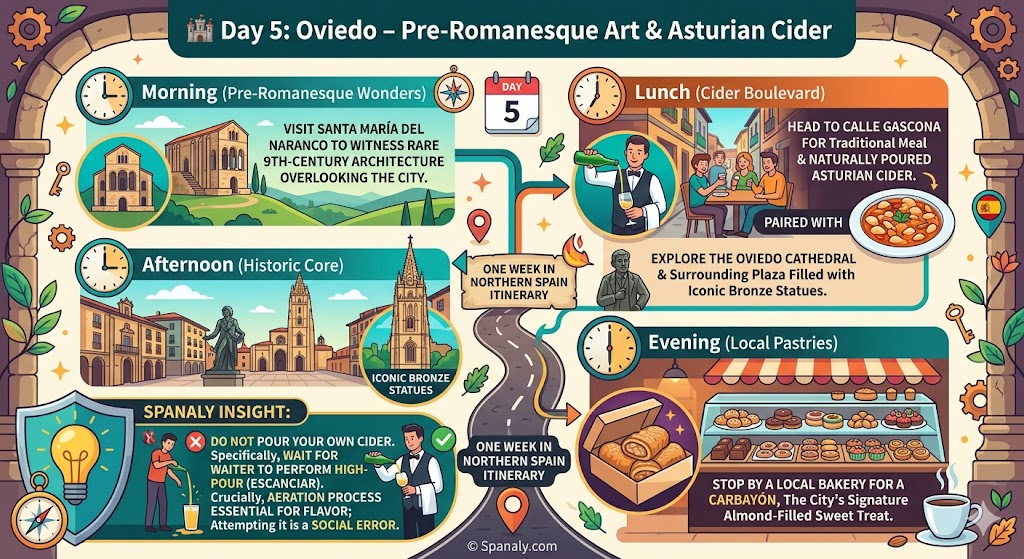
Descending from the peaks, your One Week in Northern Spain Itinerary enters the polished stone streets of Oviedo. This Asturian capital is a triumph of pedestrian design and a key highlight of your Asturias road trip. Your experience here centers on fresh cider and unique Spanish attractions that define the Spain Atlantic coast.
Morning (Pre-Romanesque Wonders): Visit Santa María del Naranco to witness rare 9th-century architecture overlooking the city.
Lunch (Cider Boulevard): Head to Calle Gascona for a traditional meal paired with naturally poured Asturian cider.
Afternoon (Historic Core): Explore the Oviedo Cathedral and the surrounding plaza filled with iconic bronze statues.
Evening (Local Pastries): Stop by a local bakery for a Carbayón, the city’s signature almond-filled sweet treat.
Spanaly Insight: Do not pour your own cider in a traditional Sidrería. Wait for the waiter to perform the high-pour (Escanciar). This aeration process is essential for the flavor, and attempting it yourself is a social error that marks you as a tourist instantly.
⚓ Day 6: Gijon – Roman Sites and Atlantic Coastal Views
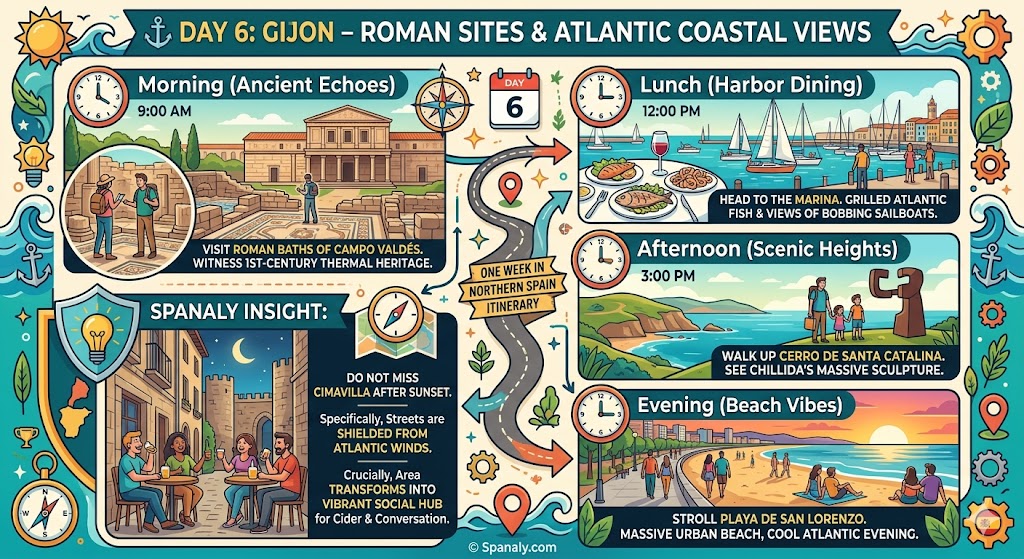
This Green Spain adventure returns to the coast to explore Gijon, a city where maritime history meets urban energy. Mastering your stay here depends on exploring the things to do in Gijon while walking the historic Cimavilla district after sunset. Its narrow streets are technically shielded from Atlantic winds, transforming the area into a vibrant social hub for pre-dinner cider.
Morning (Ancient Echoes): Visit the Roman Baths of Campo Valdés to witness the city’s 1st-century thermal heritage.
Lunch (Harbor Dining): Head to the Marina for grilled Atlantic fish while enjoying the view of bobbing sailboats.
Afternoon (Scenic Heights): Walk up to Cerro de Santa Catalina to see Chillida’s massive “Eulogy to the Horizon” sculpture.
Evening (Beach Vibes): Stroll along Playa de San Lorenzo, a massive urban beach perfect for a cool Atlantic evening.
⛪ Day 7: Santiago de Compostela – The Cathedral and Old Town
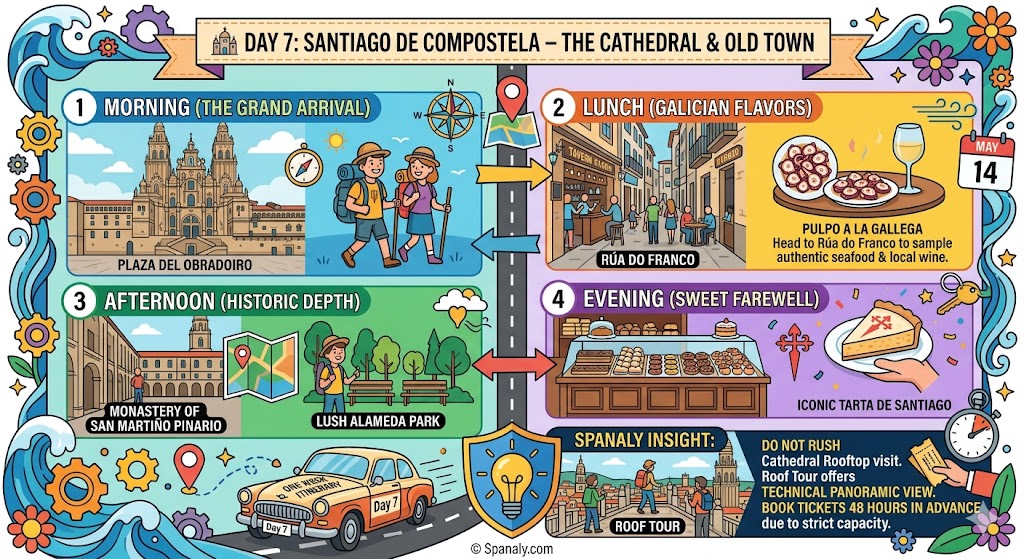
Your One Week in Northern Spain Itinerary reaches its spiritual and historic climax in Galicia. Santiago de Compostela is globally famous as the final stop for thousands of pilgrims. Your final 24 hours should center on the Cathedral of Santiago de Compostela and the granite-paved streets of the surrounding Casco Antiguo.
Morning (The Grand Arrival): Enter Plaza del Obradoiro to witness the breathtaking facade of the Cathedral.
Lunch (Galician Flavors): Head to Rúa do Franco to sample authentic Pulpo a la Gallega and local Albariño wine.
Afternoon (Historic Depth): Explore the Monastery of San Martiño Pinario or wander through the lush Alameda Park.
Evening (Sweet Farewell): Visit a traditional bakery to try the iconic Tarta de Santiago, a flourless almond cake.
Spanaly Insight: Do not rush your visit to the Cathedral rooftop. The “Roof Tour” offers a panoramic view of the medieval city’s layout that you cannot get from street level. Book your tickets 48 hours in advance as daily capacity is strictly limited to preserve the historic structure.
🚆 Transport Options: Car Rental vs. Bus and Train

Effective transit management is key to a seamless 7 days in Northern Spain. Exploring Northern Spain by car offers the most flexibility for coastal detours, while buses provide superior speed between major cities. Avoid relying on regional FEVE trains for tight schedules; specifically, they are beautiful but slow, making the direct bus a better logistical choice for routes like Bilbao to San Sebastian.
| Route | Best Choice | Why? |
| Bilbao → San Sebastian | 🚌 Bus | Twice as fast as any rail alternative. |
| Oviedo → Picos | 🚗 Car | Essential for reaching mountain “hidden” gems. |
| Santiago Old Town | 🚶 Walking | Strictly pedestrianized granite streets. |
Car Rental: Best for reaching remote spots like the Lakes of Covadonga.
ALSA Bus Network: Reliable, frequent service linking Bilbao, Santander, and Oviedo.
Official Booking: Use the Renfe Official Website for real-time high-speed schedules.
🎒 Essential Northern Spain Packing List: What to Bring
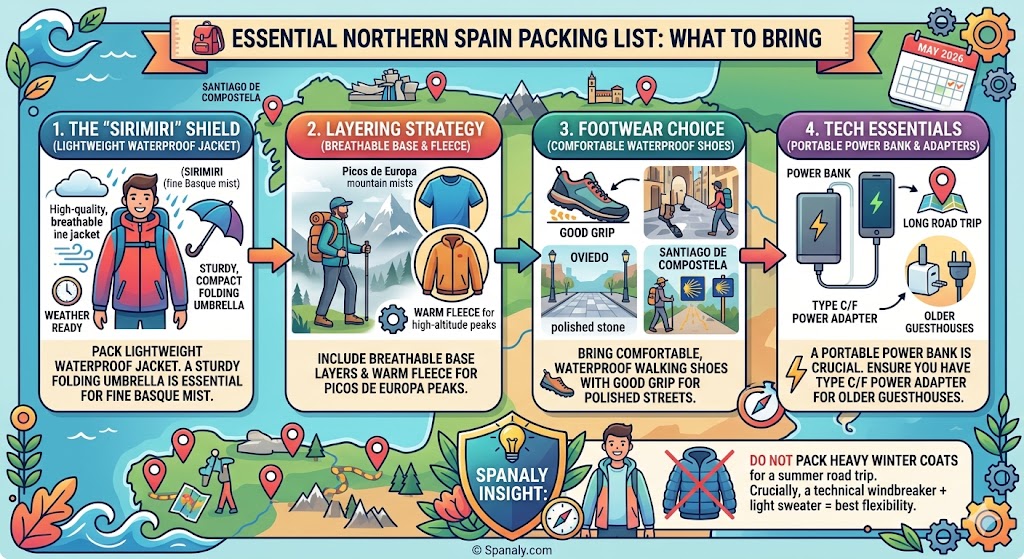
Packing for this northern journey requires preparing for four seasons in a single day. Notably, the Atlantic climate demands a technical layering strategy to handle both coastal humidity and mountain mists. For maximum flexibility, avoid heavy winter coats during a summer road trip and instead use a windbreaker combined with a light sweater to adapt to changing weather patterns.
The “Sirimiri” Shield: Pack a high-quality, lightweight waterproof jacket. A sturdy folding umbrella is essential for the fine Basque mist.
Layering Strategy: Include breathable base layers and a warm fleece for the high-altitude peaks of Picos de Europa.
Footwear Choice: Bring comfortable, waterproof walking shoes with good grip for the polished stone streets of Oviedo and Santiago.
Tech Essentials: A portable power bank is crucial for long road trips. Ensure you have a Type C/F power adapter for older guesthouses.
⚠️ Common Mistakes to Avoid During Your One-Week Itinerary
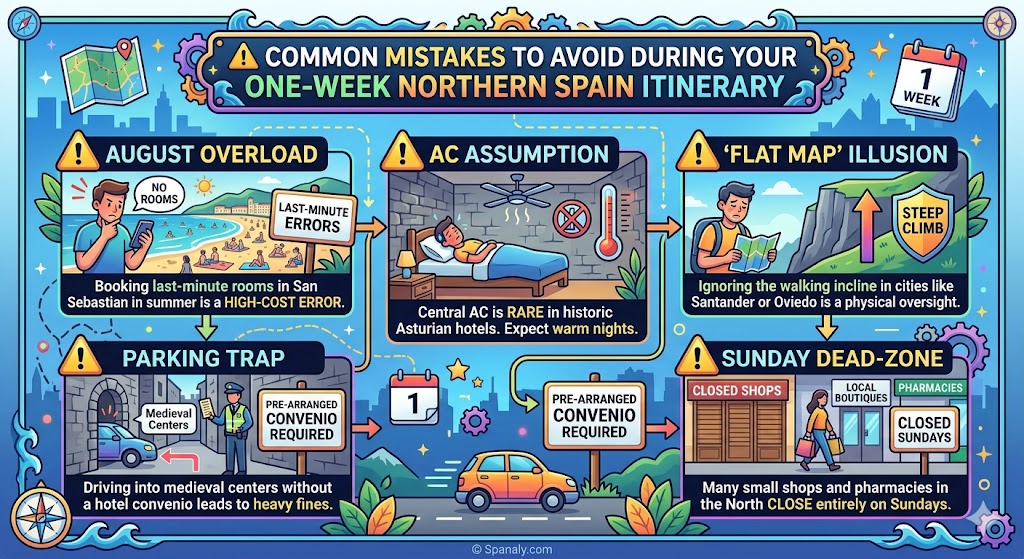
Avoiding logistical pitfalls is the secret to a seamless journey through the Atlantic provinces. Notably, many travelers apply “Mediterranean rules” to the North, which often leads to avoidable friction during their adventure. To maintain a professional pace, do not judge your daily progress by distance alone, as short map intervals often hide steep, exhausting climbs; always check for local lifts like the Funicular del Río de la Pila to save your energy for sightseeing.
The August Overload: Booking last-minute rooms in San Sebastian during peak summer is a high-cost error.
The AC Assumption: Relying on central air conditioning in historic Asturian boutique hotels can lead to sleepless nights.
The “Flat Map” Illusion: Ignoring the “walking incline” in cities like Santander or Oviedo is a common physical oversight.
The Parking Trap: Driving into medieval centers without a pre-arranged hotel “Convenio” leads to heavy fines.
The Sunday Dead-Zone: Forgetting that many local boutiques and pharmacies in the North close entirely on Sundays.
Spanaly Insight: Do not judge your daily pace by the total distance. A short distance on a map can mean a steep, exhausting climb in reality. Always check for local lifts like the Funicular del Río de la Pila to save your energy for sightseeing.
💎 Elite Insider Tips: The Spanaly Secret Playbook

Beyond standard guides, mastering this road trip requires knowing the unwritten rules of the Atlantic coast. These insights, drawn from local social circles, provide a professional edge for your adventure. For the most accurate mountain microclimate data, avoid international weather apps and instead use MeteoAsturias to plan your Picos de Europa ascent.
The “Shadow” Beach Strategy: Use satellite maps to find “Pedreros” (rocky inlets) for snorkeling away from tourist crowds.
The Midweek Museum Hack: Visit the Guggenheim on Tuesday mornings for the quietest photography atmosphere.
Cider House Socializing: Stand near the bar in Asturian Sidrerías for more frequent “high-pours” and authentic social energy.
The Bakery “Hidden” Menu: Ask for “Empanada de Xoubas” in Galician bakeries before 11:00 AM before they sell out to locals.
The Elevation Advantage: Always park facing downhill in steep Cantabrian villages to prevent clutch wear and ensure a smooth exit.
🛡️ Visitor FAQs – Northern Spain Route Guide
🚗 Is it difficult to drive between Bilbao and Santiago for beginners?
The main highways (Autovías) are modern and very safe. However, the coastal detours involve narrow, winding roads with mist. Specifically, the "Sirimiri" fog can reduce visibility suddenly. We recommend a compact car to handle the parking spots in historic Galician villages.
🥘 How do I handle the unique dining hours in the North?
Northern Spain follows a strict regional rhythm. Lunch usually peaks at 14:30 and dinner rarely starts before 21:00. Notably, San Sebastian’s pintxo bars are an exception, staying active from midday. Crucially, always check if a restaurant requires a "Reserva" for Sunday lunch, as it is a sacred family time for locals.
💳 Is cash still necessary for small coastal villages?
While card payments are standard, carrying small Euro notes is safer for rural Asturian cider houses or remote parking meters. Specifically, some family-run bakeries in Galicia might have a minimum spend for card use. Always keep a few coins for public transport in smaller towns.
⛰️ Can I visit Picos de Europa without a 4x4 vehicle?
Yes, the primary access roads to Potes and the Fuente Dé cable car are fully paved and well-maintained. A standard rental car is sufficient for the main route. However, strictly follow local signs regarding shuttle bus requirements for the Covadonga Lakes during peak Atlantic travel seasons.
🌍 Do people speak English along the Northern route?
English is widely spoken in Bilbao and San Sebastian's tourist hubs. Notably, as you move into rural Asturias or the Galician coast, Spanish and local dialects dominate. Crucially, learning basic phrases like "La cuenta, por favor" or "Grazas" improves your social interactions with local artisans.
Northern Spain Guide by Spanaly.com
The best part of a One Week in Northern Spain Itinerary isn’t just the titanium curves of the Guggenheim or the mist over the Picos peaks. It is that final moment at the table when the plates are empty and the conversation flows—the Sobremesa. Northern Spain is a slow-burn experience that rewards those who stop to breathe.
Final Wisdom: Do not treat this route as a checklist to conquer.
True Luxury: Spend an extra hour watching the fog lift from a Galician valley.
Stay Smart: Choosing the best neighborhoods to stay in Northern Spain is the foundation of your comfort.
Local Secret: The most vivid memories often happen in the unplanned stops between the major hubs.
The Atlantic coast will change your rhythm if you let it. Pack your raincoat, bring an open heart, and prepare for a journey that feels more like a homecoming than a holiday.
Safe travels, and we will see you at the next cider pour! 🌊🥂