Table of Contents
Toggle🏔️ Lakes of Covadonga
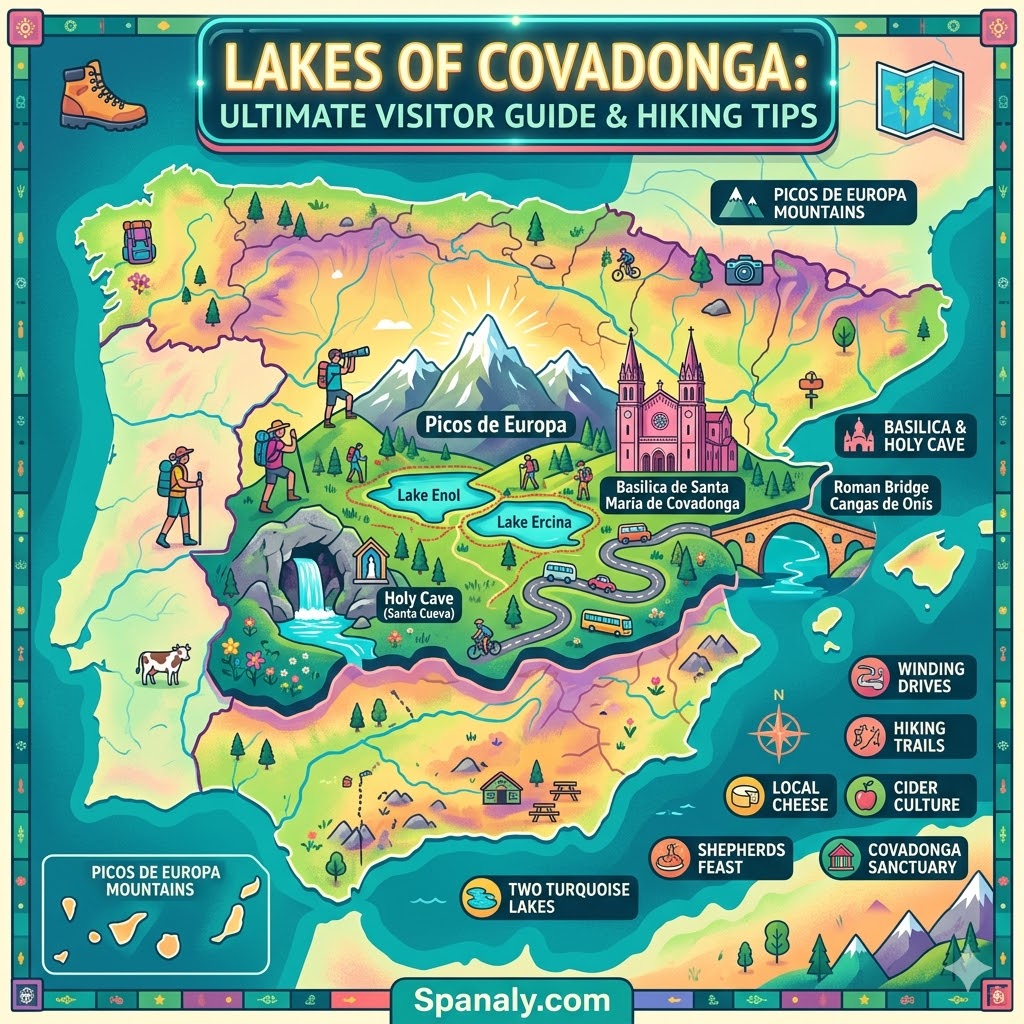
The Lakes of Covadonga are high-altitude glacial basins located in the heart of the Picos de Europa National Park. Unlike the typical coastal images of Spain, this area offers a rugged alpine environment characterized by unpredictable weather and deep-rooted pastoral traditions. Whether you are planning to hike the main circular route or need to navigate the seasonal transport restrictions, this guide provides the essential logistics for your visit.
🚌 Practical Transit: Learn the specific rules of the shuttle bus system to avoid access issues and fines.
🥾 Main Trails: Follow the established circular path to explore the geography of Lake Enol and Lake Ercina.
📸 Strategic Views: Identify the best vantage points to view the glacial basin without the midday crowds.
🌍 Regional Logistics: For a complete trip overview, consult our Ultimate Northern Spain Travel Guide to integrate this stop into your itinerary.
Before we dive into the logistics, take a second to imagine the air here crisp, thin, and smelling of damp limestone.
🏔️ Lakes of Covadonga Snapshot: Quick Essential Guide
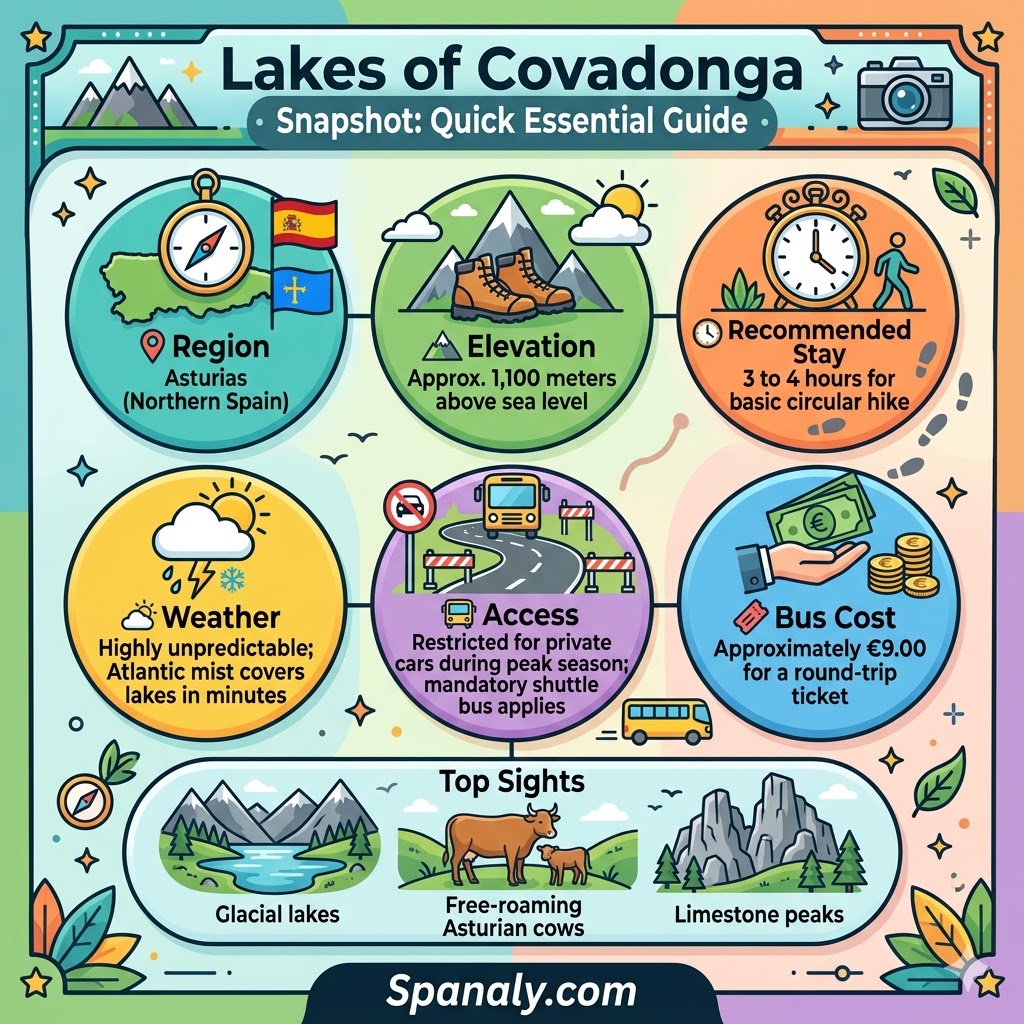
Before lace up your boots, here is the high-level data you need to plan your ascent to these fabled glacial waters.
📍 Region: Asturias (Northern Spain).
⛰️ Elevation: Approximately 1,100 meters above sea level.
⏱️ Recommended Stay: 3 to 4 hours for the basic circular hike.
🌦️ Weather: Highly unpredictable; Atlantic mist can cover the lakes in minutes.
🚍 Access: Restricted for private cars during peak season; mandatory shuttle bus applies.
🎟️ Bus Cost: Approximately €9.00 for a round-trip ticket.
🐄 Top Sights: Glacial lakes, free-roaming Asturian cows, and limestone peaks.
🌍 Part of the Picos de Europa Adventure The Lakes are a primary highlight of the region’s heritage. To see how this mountain escape fits into your broader itinerary, explore our guide to Spanish Attractions to discover more iconic landmarks across the country.
🏔️ Lakes of Covadonga vs. Lauterbrunnen (Switzerland)
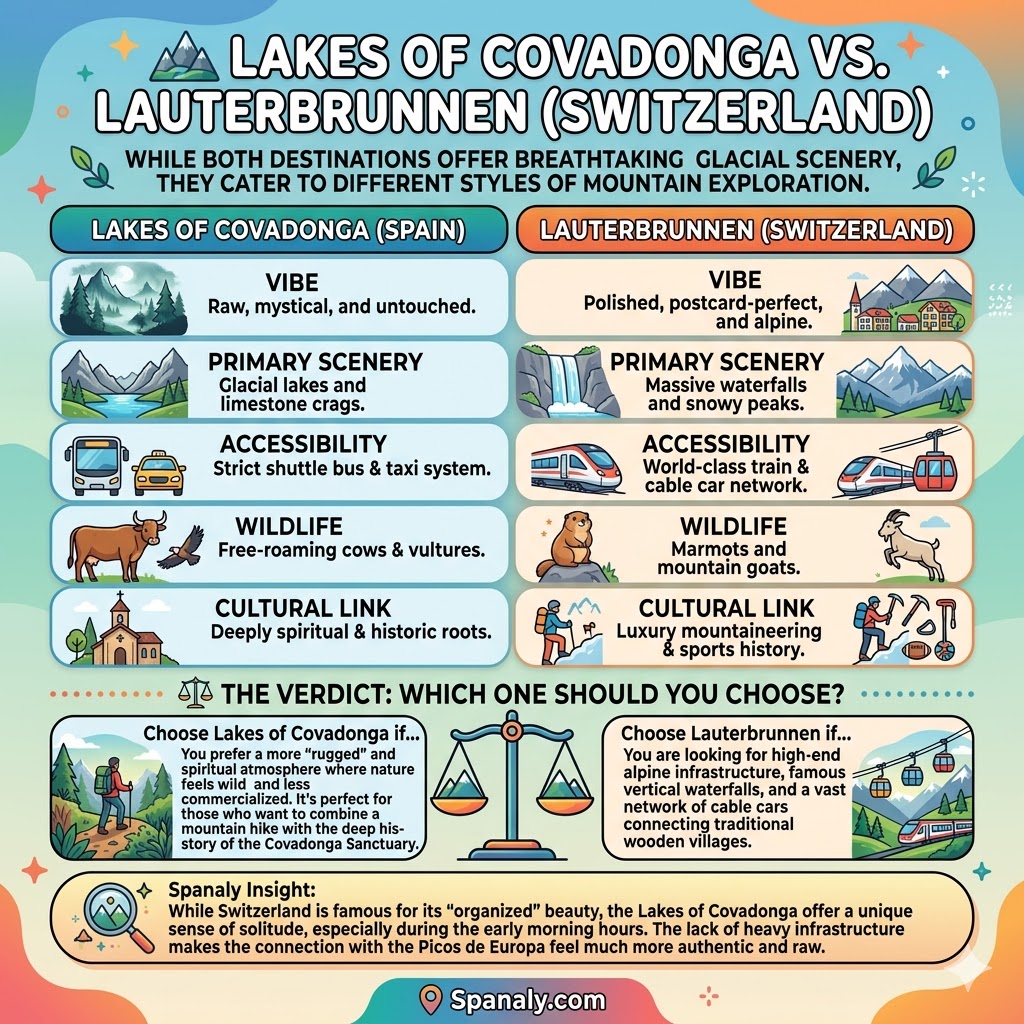
While both destinations offer breathtaking glacial scenery, they cater to different styles of mountain exploration.
| Feature | Lakes of Covadonga (Spain) | Lauterbrunnen (Switzerland) |
| Vibe | Raw, mystical, and untouched. | Polished, postcard-perfect, and alpine. |
| Primary Scenery | Glacial lakes and limestone crags. | Massive waterfalls and snowy peaks. |
| Accessibility | Strict shuttle bus & taxi system. | World-class train & cable car network. |
| Wildlife | Free-roaming cows & vultures. | Marmots and mountain goats. |
| Cultural Link | Deeply spiritual & historic roots. | Luxury mountaineering & sports history. |
⚖️ The Verdict: Which One Should You Choose?
Choose Lakes of Covadonga if… You prefer a more “rugged” and spiritual atmosphere where nature feels wild and less commercialized. It’s perfect for those who want to combine a mountain hike with the deep history of the Covadonga Sanctuary.
Choose Lauterbrunnen if… You are looking for high-end alpine infrastructure, famous vertical waterfalls, and a vast network of cable cars connecting traditional wooden villages.
Spanaly Insight: While Switzerland is famous for its “organized” beauty, the Lakes of Covadonga offer a unique sense of solitude, especially during the early morning hours. The lack of heavy infrastructure makes the connection with the Picos de Europa feel much more authentic and raw.
🌊 Lake Enol Vs Lake Ercina Covadonga Legends
🌊 Lake Enol: Geography and Traditions
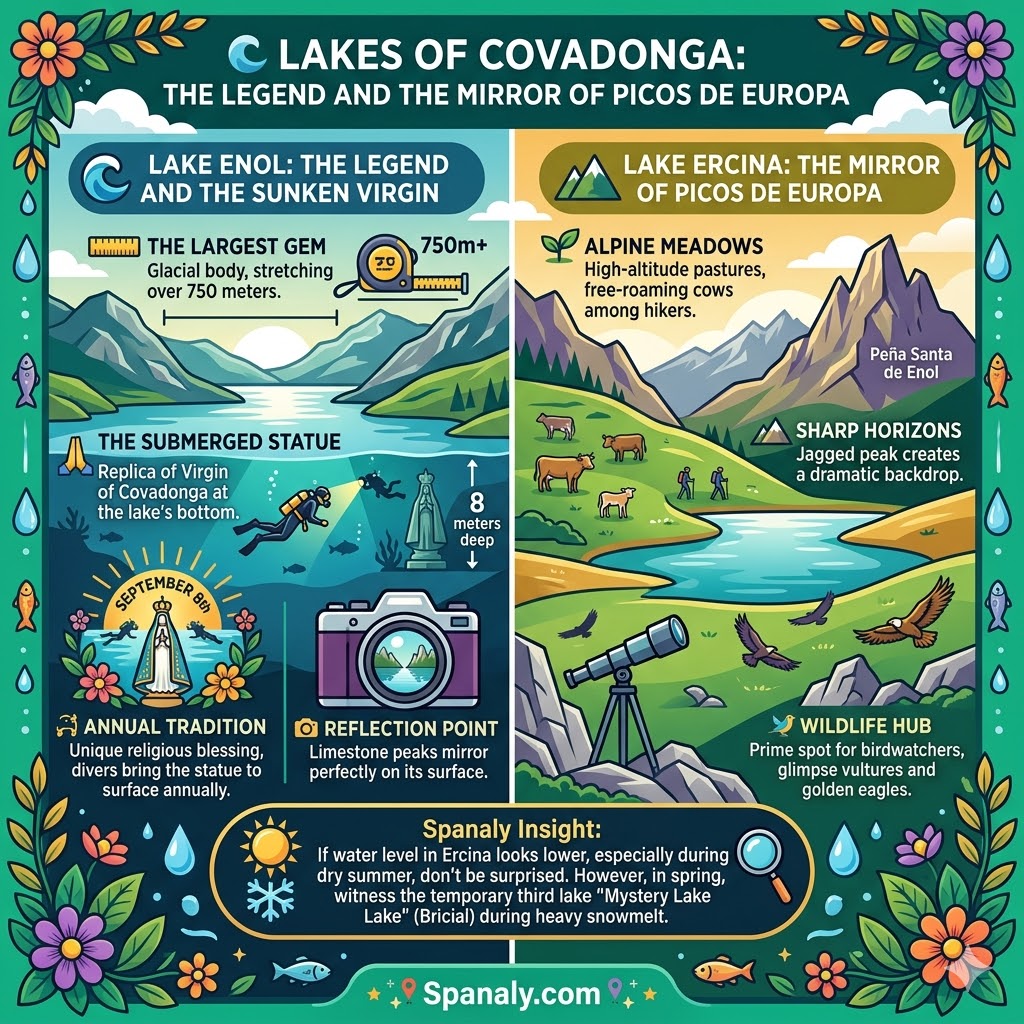
Lake Enol is the largest glacial body in the area and the first major landmark you encounter upon reaching the peaks. Beyond its geological significance, the lake serves as a central point for local traditions and seasonal religious events.
📏 Scale and Size: Covering over 750 meters in length, it remains the primary water body within the sanctuary basin.
🙏 Submerged Replica: A figure of the Virgin of Covadonga is placed at the bottom of the lake, approximately 8 meters deep.
🤿 September Tradition: Every September 8th, local divers recover the statue for a religious blessing before returning it to the water.
📸 Surface Reflections: The surrounding limestone ridges create a clear mirror effect on the water during calm, early morning hours.
⛰️ Lake Ercina: The Mirror of Picos de Europa
Just a short walk uphill from Enol lies Lake Ercina. This lake feels more intimate and is often surrounded by the rhythmic sounds of mountain life.
🌱 Alpine Meadows: High-altitude pastures encircle the water, where Asturian cows graze freely among the hikers.
🏔️ Sharp Horizons: From its banks, the jagged “Peña Santa de Enol” peak creates a dramatic backdrop that defines the Picos de Europa landscape.
🐦 Wildlife Hub: It is a prime spot for birdwatchers to catch a glimpse of vultures or golden eagles circling the limestone crags.
Spanaly Insight: If you visit during a particularly dry summer, don’t be surprised if the water level in Ercina looks lower than expected. However, in spring, you might witness the “mystery lake” (Bricial), a temporary third lake that only appears during the heavy snowmelt.
This is where the mechanical hum of the shuttle bus fades, and the true silence of the Picos begins.
🥾 Best Hiking Trails at Lakes of Covadonga (Circular Route)
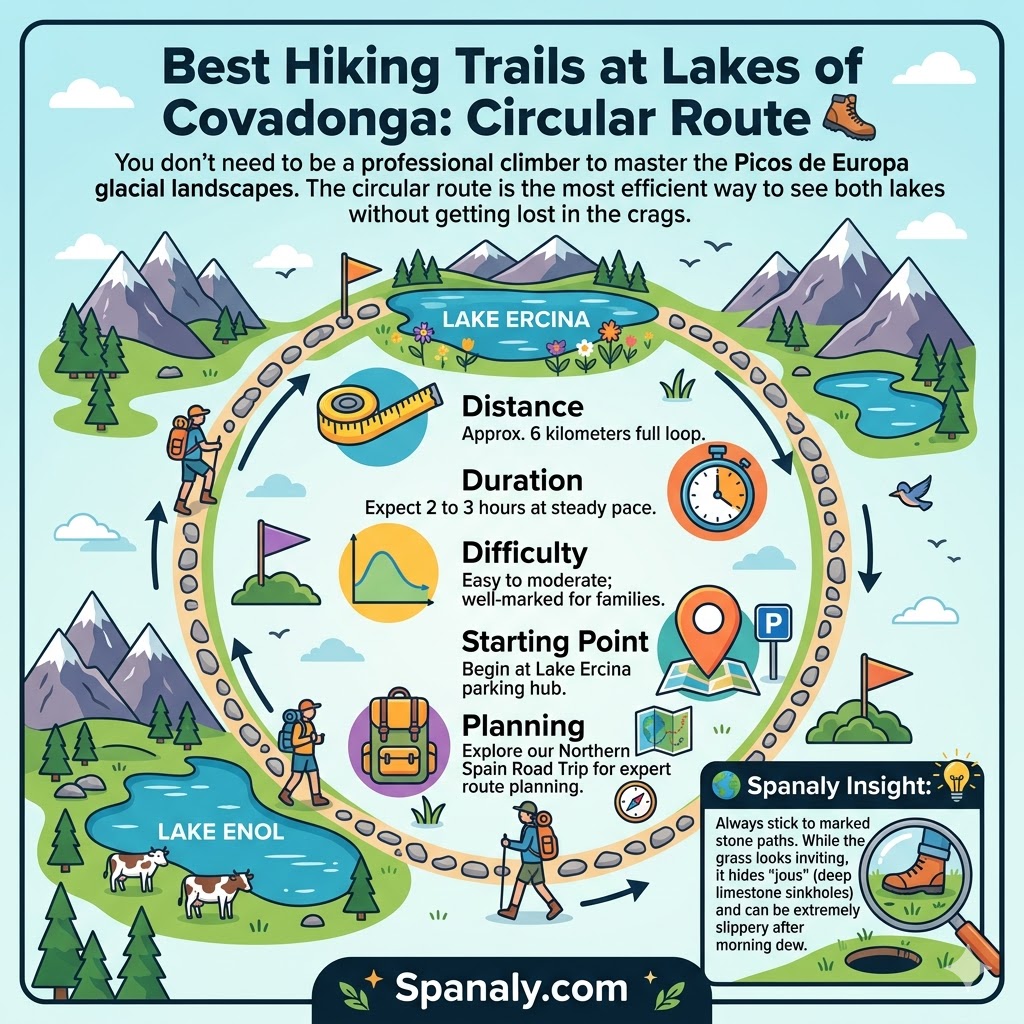
You don’t need to be a professional climber to master the Picos de Europa glacial landscapes. The circular route is the most efficient way to see both lakes without getting lost in the crags.
📏 Distance: Approximately 6 kilometers for the full loop.
⏱️ Duration: Expect to spend about 2 to 3 hours at a steady pace.
📉 Difficulty: Easy to moderate; the paths are well-marked for families.
📍 Starting Point: Begin at the Lake Ercina parking hub for the best flow.
🎒 Planning: To see how this mountain trek fits into a broader adventure, explore our Northern Spain Road Trip for expert route planning.
Spanaly Insight: Always stick to the marked stone paths. While the grass looks inviting, it hides “jous” (deep limestone sinkholes) and can be extremely slippery after the typical Asturian morning dew.
📸 Mirador de Entrelagos: The Best Viewpoint for Photos
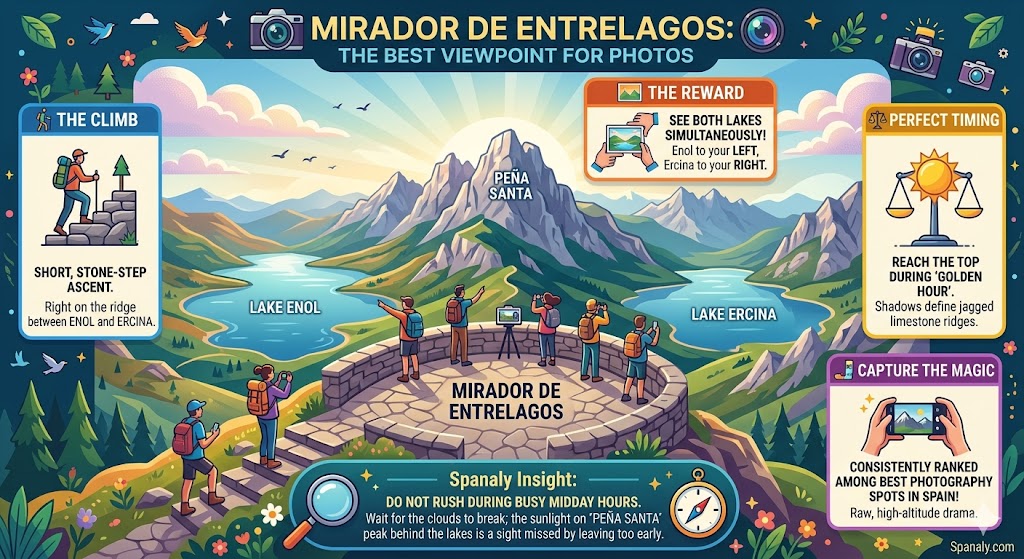
If you have limited time for hiking, this specific ridge offers the most comprehensive view of the entire glacial basin. It serves as a natural balcony positioned strategically between the two main lakes.
🚶 The Ascent: Use the established stone-step path located on the ridge separating Enol and Ercina.
🖼️ Dual Perspective: From this elevation, you can view both Lake Enol and Lake Ercina simultaneously from a single vantage point.
⚖️ Optimal Lighting: Visit during early morning or late afternoon to see the light define the limestone ridges more clearly.
🤳 Photography: This location is widely recognized as a primary spot for high-altitude landscape photography in Northern Spain.
Spanaly Insight: Avoid visiting during the peak midday hours when the light is flat and crowds are highest. If there is cloud cover, wait for a break in the mist; the sunlight hitting the “Peña Santa” peak provides a perspective that most visitors miss by leaving the area too quickly.
🐄 Wildlife and Nature: Cows, Vultures, and Glacial Landscapes
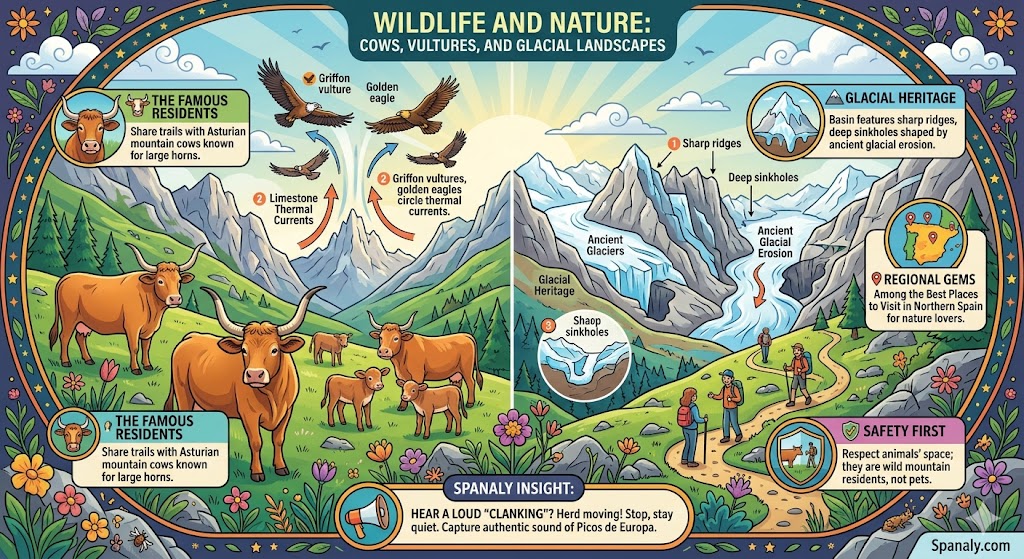
The lakes are a living laboratory of Atlantic biodiversity where animals are part of the landscape. You are walking through high-altitude pastures where nature dictates the daily rhythm.
🐄 The Famous Residents: Share the trails with Asturian mountain cows known for their large horns.
🦅 Kings of the Sky: Spot Griffon vultures and golden eagles circling the limestone thermal currents.
🏔️ Glacial Heritage: The basin features sharp ridges and deep sinkholes shaped by ancient glacial erosion.
📍 Regional Gems: These peaks are among the Best Places to Visit in Northern Spain for nature lovers.
🛡️ Safety First: Respect the animals’ space as they are wild mountain residents, not pets.
Spanaly Insight: If you hear a loud, echoing “clanking” sound, it’s the whole herd moving. Stop and stay quiet to capture the most authentic sound of the Picos de Europa.
Preserving a place this wild requires a bit of discipline and planning.
⚠️ Critical Access Restrictions: The High-Season Rules
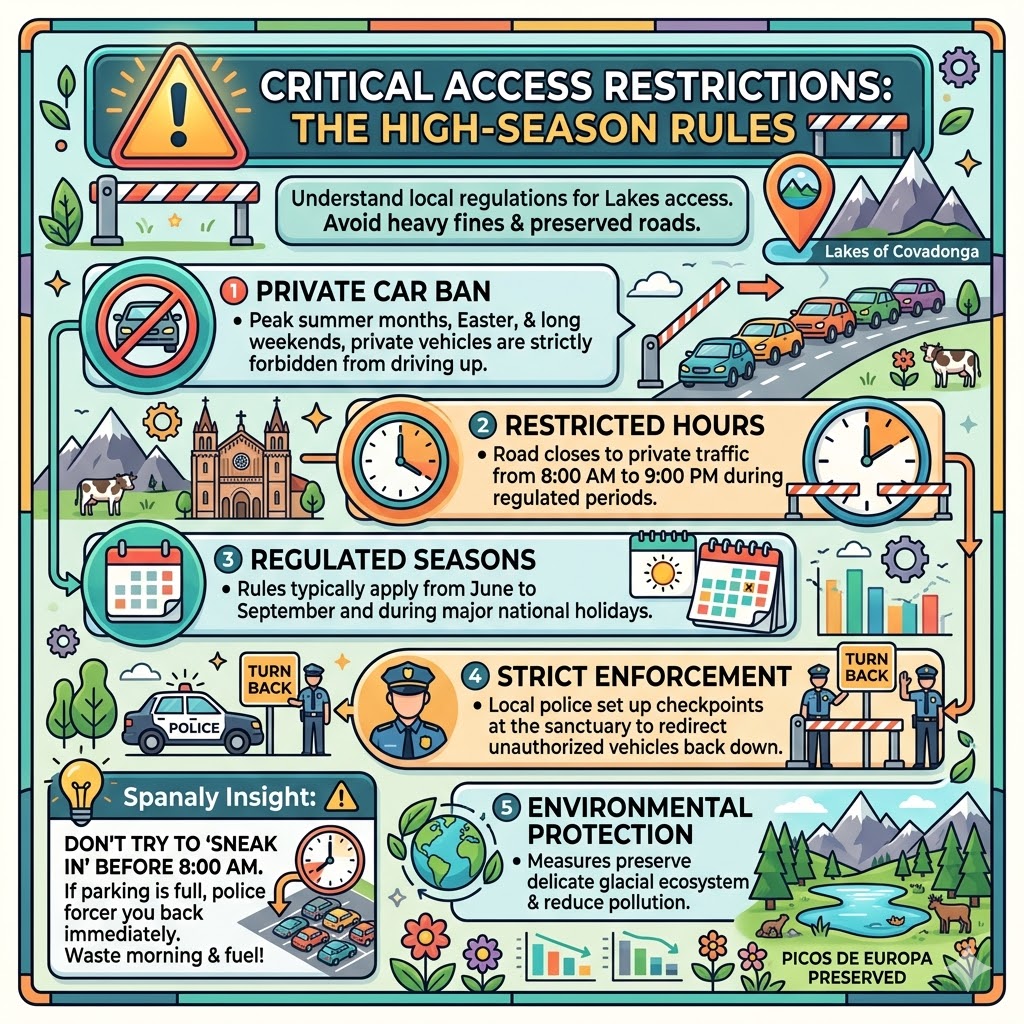
Access to the lakes is not always open to private vehicles due to environmental protection laws. You must understand these local regulations to avoid heavy fines and blocked roads.
🚫 Private Car Ban: During peak summer months, Easter, and long weekends, private cars are strictly prohibited from driving up to the lakes.
🕒 Restricted Hours: The road usually closes to private traffic from 8:00 AM until 9:00 PM during these regulated periods.
📅 Regulated Seasons: These rules typically apply from June to September and during major national holidays.
👮 Strict Enforcement: Local police set up checkpoints at the sanctuary to redirect unauthorized vehicles back to the valley.
🌍 Environmental Protection: These measures ensure the delicate glacial ecosystem of the Picos de Europa remains preserved from pollution.
Spanaly Insight: Don’t try to “sneak in” just before 8:00 AM. If the parking lots at the top are full, the police will force you to drive back down immediately, wasting your morning and fuel.
🧣 What to Pack for the Lakes: Essential Mountain Gear
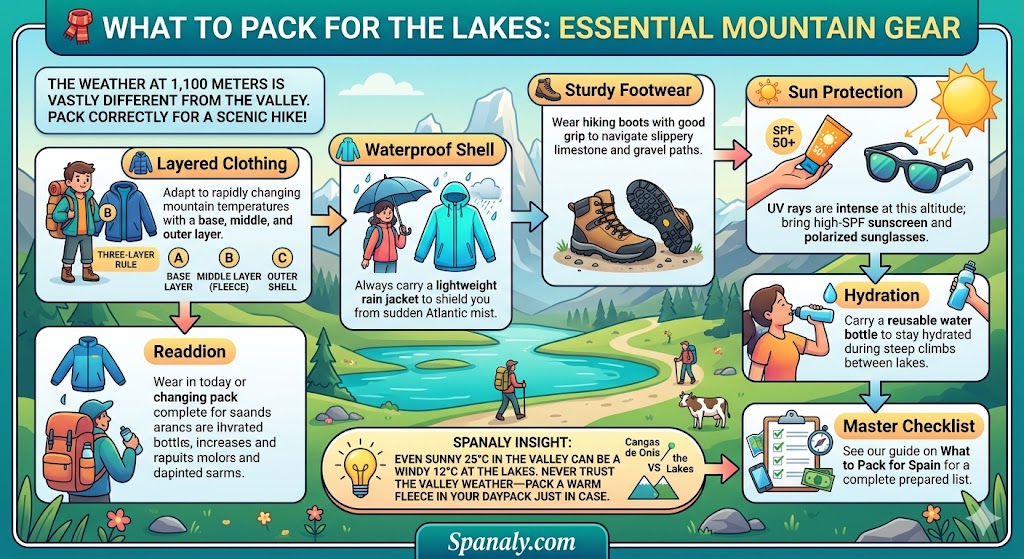
The weather at 1,100 meters is vastly different from the valley. Packing correctly is the difference between a scenic hike and a freezing, damp ordeal.
🧥 Layered Clothing: Use the “three-layer rule” to adapt to the rapidly changing mountain temperatures.
🧥 Waterproof Shell: Always carry a lightweight rain jacket to shield you from the sudden Atlantic mist.
🥾 Sturdy Footwear: Wear hiking boots with good grip to navigate the slippery limestone and gravel paths.
☀️ Sun Protection: The UV rays are intense at this altitude; bring high-SPF sunscreen and polarized sunglasses.
💧 Hydration: Carry a reusable water bottle to stay hydrated during the steep climbs between the lakes.
📋 Master Checklist: For a complete list of everything you need for your trip, see our guide on What to Pack for Spain to stay prepared.
Spanaly Insight: Even if it’s a sunny 25°C in Cangas de Onís, it can be a windy 12°C at the lakes. Never trust the valley weather—pack a warm fleece in your daypack just in case.
🎫 Booking Tickets for the Lagos de Covadonga Shuttle Bus

Securing your seat on the official shuttle is the most critical part of your planning. During regulated periods, these buses are the only reliable way to reach the glacial basin.
💻 Online Booking: Purchase your tickets in advance through the official ALSA website to guarantee your departure time.
💳 Ticket Pricing: A round-trip ticket costs approximately €9.00 for adults, with discounts usually available for children.
📍 Departure Points: Buses depart from Cangas de Onís and designated parking hubs (P1, P2, P3, P4) near the sanctuary.
🕒 Frequency: Shuttles run frequently, typically every 10 to 15 minutes during the busiest parts of the day.
🎫 Smart Planning: To manage all your entry passes effectively, check our Spain Attraction Tickets Guide for professional booking advice.
Spanaly Insight: Do not wait until you arrive at the bus stop to buy your ticket. During July and August, tickets for the morning slots often sell out days in advance, leaving unprepared travelers stranded in the valley.
🚌 How to Get to Lakes of Covadonga: Bus, Taxi, or Car?
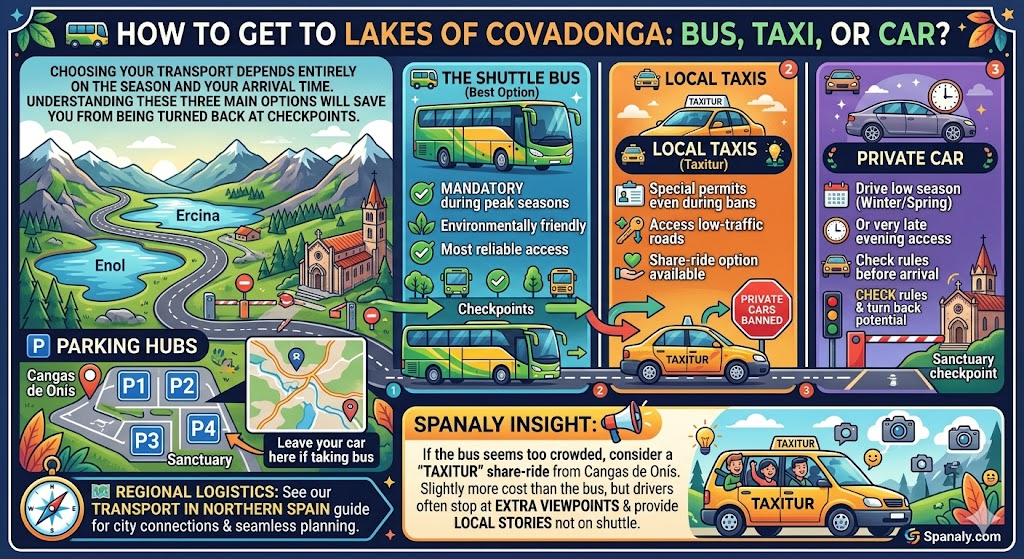
Choosing your transport depends entirely on the season and your arrival time. Understanding these three main options will save you from being turned back at the sanctuary checkpoints.
🚍 The Shuttle Bus (Best Option): This is the mandatory choice during peak seasons and the most environmentally friendly way to reach the lakes.
🚕 Local Taxis (Taxitur): Licensed local taxis have special permits to access the lakes even when private car traffic is banned.
🚗 Private Car: You can only drive your own car during the low season (winter and some spring months) or very late in the evening.
📍 Parking Hubs: If taking the bus, leave your car at the large P1, P2, P3, or P4 parking lots located between Cangas de Onís and the Sanctuary.
🗺️ Regional Logistics: To understand how to reach this area from major cities, explore our Transport in Northern Spain guide for seamless planning.
Spanaly Insight: If the bus seems too crowded, consider a “Taxitur” share-ride from Cangas de Onís. It costs slightly more than the bus, but the drivers often stop at extra viewpoints and provide local stories you won’t get on the shuttle.
🏨 Where to Stay: Hotels in Cangas de Onís and Rural Lodgings
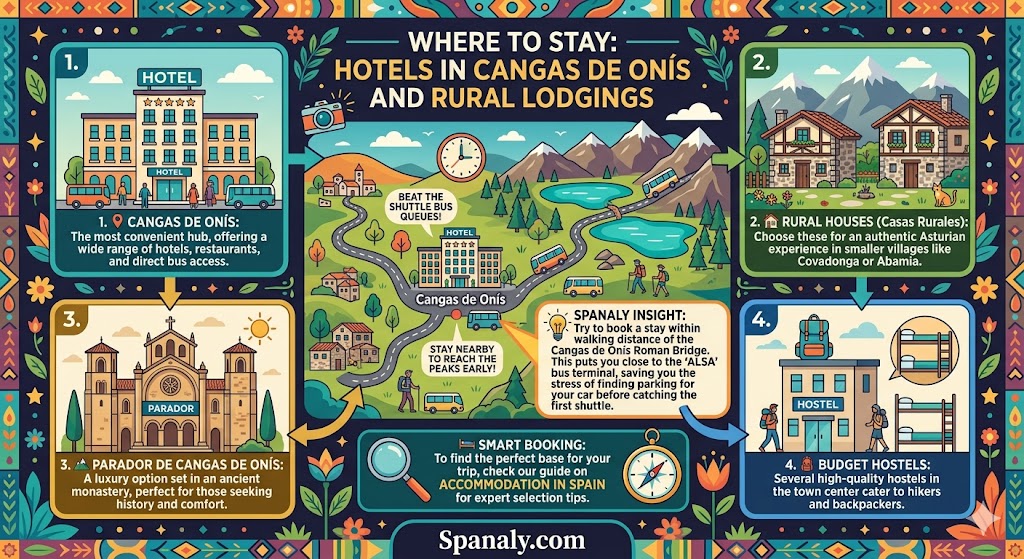
Your choice of accommodation determines how early you can reach the peaks. Staying nearby allows you to beat the morning rush and the shuttle bus queues.
📍 Cangas de Onís: The most convenient hub, offering a wide range of hotels, restaurants, and direct bus access.
🏡 Rural Houses (Casas Rurales): Choose these for an authentic Asturian experience in smaller villages like Covadonga or Abamia.
🏔️ Parador de Cangas de Onís: A luxury option set in an ancient monastery, perfect for those seeking history and comfort.
🎒 Budget Hostels: Several high-quality hostels in the town center cater to hikers and backpackers.
🛌 Smart Booking: To find the perfect base for your trip, check our guide on Accommodation in Spain for expert selection tips.
Spanaly Insight: Try to book a stay within walking distance of the Cangas de Onís Roman Bridge. This puts you close to the “ALSA” bus terminal, saving you the stress of finding parking for your car before catching the first shuttle.
🥘 Where to Eat Near the Lakes: Refugios and Local Food
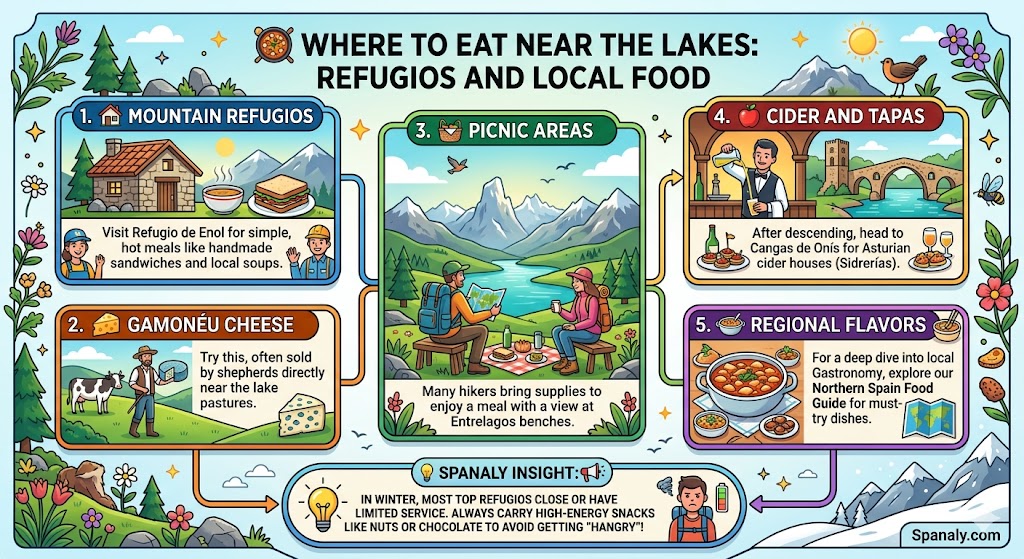
Mountain air builds a massive appetite, and the area around the lakes offers rustic, hearty options. You can choose between a quick bite by the water or a full Asturian feast in the valley.
🏠 Mountain Refugios: Visit Refugio de Enol for simple, hot meals like handmade sandwiches and local soups.
🧀 Gamonéu Cheese: Try this legendary local blue cheese, often sold by shepherds directly near the lake pastures.
🧺 Picnic Areas: Many hikers bring their own supplies to enjoy a meal with a view at the Entrelagos benches.
🍎 Cider and Tapas: After descending, head to Cangas de Onís to experience the famous Asturian cider houses (Sidrerías).
🍲 Regional Flavors: For a deep dive into the local Gastronomy, explore our Northern Spain Food Guide for must-try dishes.
Spanaly Insight: If you are visiting in winter, most refugios at the top close or offer very limited service. Always carry high-energy snacks like nuts or chocolate in your backpack to avoid getting “hangry” on the trails.
🗓️ Best Time to Visit Lakes of Covadonga: Weather and Crowds
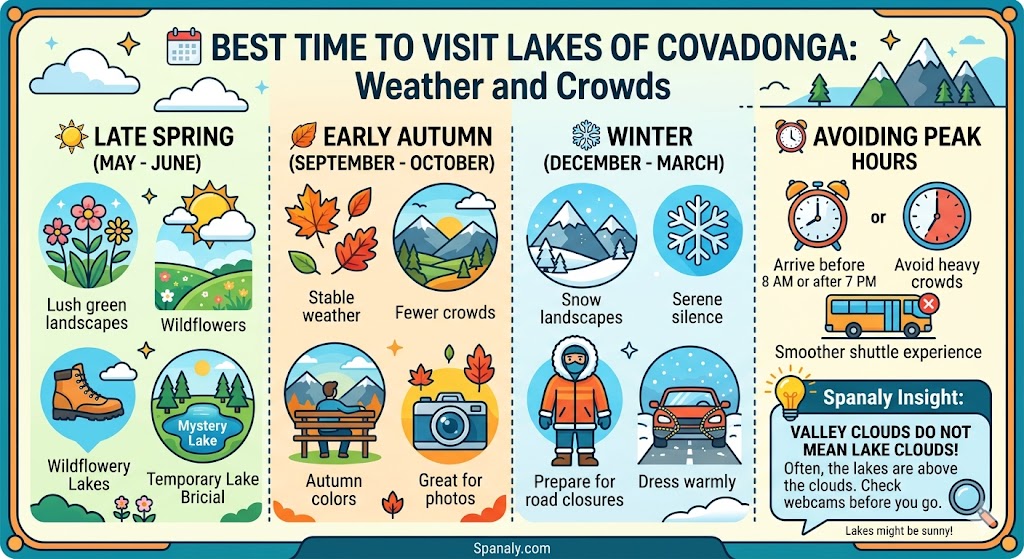
Timing is everything when visiting the Picos de Europa. The right window ensures clear views of the glacial peaks and a smoother logistical experience.
☀️ Late Spring (May – June): The best time for lush green landscapes and the appearance of the temporary “third lake.”
🍂 Early Autumn (September – October): Offers stable weather, fewer crowds, and the beautiful changing colors of the mountain shrubs.
❄️ Winter (December – March): Expect snow-covered peaks and serene silence, though roads may close during heavy storms.
🗓️ Avoiding Peak Hours: Arrive before 8:00 AM or after 7:00 PM during summer to escape the heaviest shuttle bus queues.
🌍 Seasonal Planning: For a broader view of when to explore the region, check our guide on the Best Time to Visit Northern Spain.
Spanaly Insight: Do not be fooled by a cloudy morning in the valley. Often, the lakes sit above the clouds in bright sunshine. Check the local webcams at the sanctuary before deciding to cancel your trip.
⏱️ The Ultimate Lakes of Covadonga One-Day Itinerary
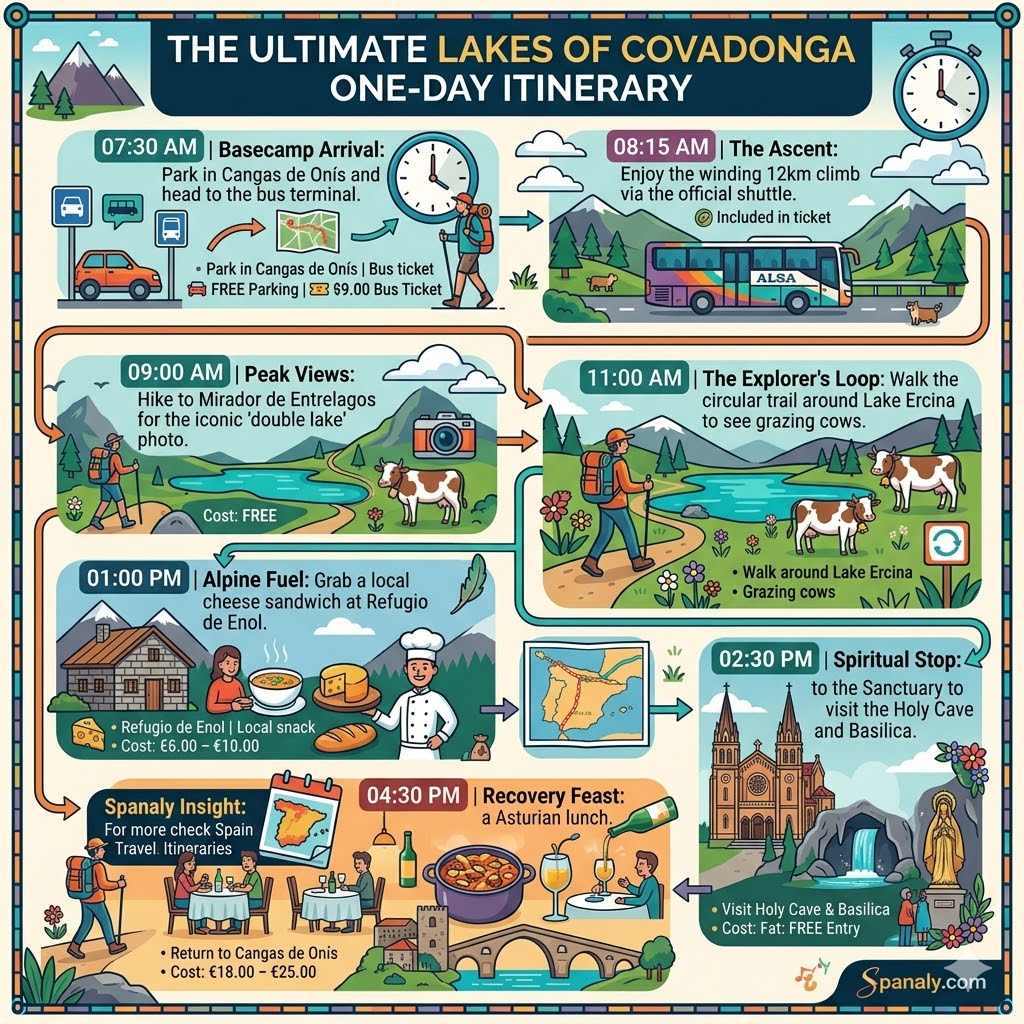
Maximize your mountain adventure with this step-by-step plan. This schedule helps you beat the crowds while keeping your Northern Spain Travel Budget in check.
07:30 AM | Basecamp Arrival: Park in Cangas de Onís and head to the bus terminal. (Cost: Free parking | €9.00 bus ticket).
08:15 AM | The Ascent: Enjoy the winding 12km climb via the official shuttle. (Cost: Included in ticket).
09:00 AM | Peak Views: Hike to Mirador de Entrelagos for the iconic “double lake” photo. (Cost: Free).
11:00 AM | The Explorer’s Loop: Walk the circular trail around Lake Ercina to see grazing cows. (Cost: Free).
01:00 PM | Alpine Fuel: Grab a local cheese sandwich at Refugio de Enol. (Cost: €6.00 – €10.00).
02:30 PM | Spiritual Stop: Descend to the Sanctuary to visit the Holy Cave and Basilica. (Cost: Free entry).
04:30 PM | Recovery Feast: Return to town for a hearty Asturian lunch. (Cost: €18.00 – €25.00).
Spanaly Insight: For more structured trip ideas, check our Spain Travel Itineraries to see how to blend this mountain day into a larger 7 or 10-day route.
Some things aren’t written on the trail signs; you only learn them by standing in the mist and talking to the locals.
💡 Spanaly Elite Tips: Insider Secrets for the Lakes

Forget the generic advice. These are the “underground” tips from seasoned hikers and locals who know the Picos de Europa better than anyone.
🌫️ The “Fog Trap” Strategy: If the valley is sunny but the webcams show fog at the top, go anyway. Often, the lakes are actually above the clouds (a thermal inversion), creating a “sea of clouds” effect that is better than a clear sky.
🐄 Cow Logistics: Never stand directly between a cow and its calf for a photo. While they look peaceful, mother cows in this region are famously protective and can charge surprisingly fast.
💧 The Hidden Spring: Don’t waste money buying multiple water bottles. Look for the “Fuente de las Polvayas” near the Lake Ercina path; it provides ice-cold, pure mountain water for free.
🚗 The 7:59 AM Rule: If you arrive at the checkpoint at 8:01 AM, you are blocked. But if you pass at 7:59 AM, you can stay all day, even if the road is technically “closed” to others later.
📸 The “Invisible” Viewpoint: Skip the crowded Mirador de Entrelagos for a moment and hike 10 minutes further toward the “Buferrera Mines”. You’ll find abandoned tunnels and a perspective of the lakes that 90% of tourists never see.
Spanaly Insight: Download an offline GPS map (like AllTrails or Maps.me) before you ascend. Signal is non-existent between the limestone crags, and the mist can roll in within seconds, making the “well-marked” paths disappear instantly.
🛡️ Visitor FAQs – Lakes of Covadonga Logistics Guide
🛡️ Can I drive my own car to the lakes during the summer?
No. During peak seasons, the road is closed to private vehicles from 8:00 AM to 9:00 PM to protect the ecosystem. You must use the official ALSA shuttle bus or a licensed local taxi (Taxitur) to reach the glacial basin.
🎫 Do I need to book shuttle bus tickets in advance?
Yes, advance booking is essential. Tickets for the morning slots often sell out days in advance during July, August, and Easter. Booking online via the official website ensures you don't spend hours waiting at the Cangas de Onís terminal.
⛅ What happens if it is foggy at the Lakes of Covadonga?
Mountain weather is unpredictable. Often, the lakes are above the clouds (thermal inversion) even if the valley is gray. We recommend checking the official sanctuary webcams in real-time before canceling your trip, as the views above the mist are often spectacular.
🐄 Are the mountain cows dangerous for hikers?
The Asturian cows are generally peaceful, but they are not pets. Always maintain a safe distance and never walk between a cow and its calf. If you see them on the trail, wait patiently or walk a wide circle around them to avoid any defensive reactions.
👟 Are the trails suitable for children or seniors?
The main circular route is accessible and family-friendly. While there are some stone steps and gravel paths, the terrain is manageable for anyone with basic mobility. For those with limited movement, the bus stops very close to the viewpoints of both Lake Enol and Lake Ercina.
Lakes of Covadonga Guide by Spanaly.com
Visiting the Lakes of Covadonga shows a different side of Spain that most city-bound tourists never see. The high-altitude environment of the Picos de Europa offers a rugged, mountain experience that contrasts sharply with the typical Mediterranean image.
🌿 Regional Identity: These lakes represent the core of Asturian mountain heritage and glacial geography.
🏔️ Landscape Variety: Northern Spain provides a vertical landscape that is often overlooked in traditional travel plans.
🎒 Practical Planning: After exploring the peaks, you can reach the coast in less than an hour.
🌊 Coastal Transition: You can easily combine this mountain trek with the coastal spots found in our Ultimate Spain Beach Guide.
Spanaly Insight: The logistical beauty of Asturias is the proximity between the mountains and the sea. You can spend your morning among glacial peaks and your afternoon on an Atlantic beach without rushing your schedule.